

How AI Is Reshaping Competition in Consulting: From Differentiation to Disruption

Table of Contents
Key Takeaways
- AI is standardizing core consulting work, reducing differentiation across firms
- Competitive advantage is shifting from execution to judgment and decision-making
- AI adoption is creating widening gaps across the industry, in scale, maturity, and capabilities
- Faster delivery is increasing pressure on pricing, timelines, and margins
- Embedding AI across the organization is key to generating measurable value
- Higher output requires stronger validation to maintain quality and trust
Artificial intelligence was initially positioned as a productivity lever within consulting, enabling faster research, analysis, and insight generation. While those efficiency gains are real, they represent only the first-order effect. AI is now reshaping the competitive dynamics of the industry itself, altering how value is created, delivered, and perceived by clients.
As barriers to execution fall, capabilities that were once scarce are becoming widely accessible. This shift is accelerating delivery cycles, increasing output volume, and making consulting deliverables more comparable across firms. The result is a structural change: competitive advantage is moving away from execution and toward measurable impact, forcing firms to rethink how they position themselves in an increasingly AI-enabled market.
Commoditization Is Eroding Traditional Differentiation
AI is standardizing elements of the consulting production layer, from research synthesis and analysis to the structuring of presentations. As firms increasingly rely on similar underlying models, comparable data sources, and equivalent generation workflows, parts of the output begin to converge in structure and approach.
For decades, consulting differentiation was rooted in the ability to assemble, synthesize, and analyze complex information under time constraints. AI has reduced that barrier. Many of the capabilities required to produce structured analysis are now more accessible, allowing a broader range of firms to deliver work that meets baseline expectations.
This shift becomes more pronounced when AI is used without sufficient validation or critical input. Outputs tend to follow similar patterns, not because of the tools themselves, but because they are applied in similar ways. Without deliberate effort to introduce context, judgment, and differentiation, results can become standardized. The commercial implications are tangible. As deliverables become more comparable, clients place greater emphasis on price, speed, and the ability to deliver contextually relevant, credible recommendations.
Competitive Advantage Is Shifting Up the Value Chain
The traditional consulting model was built on a clear economic structure: junior consultants carried out the bulk of analytical work while more senior team members focused on interpretation, client communication, and decision-making. This pyramid model justified both the staffing structure and the economics of consulting engagements.
AI is reshaping this foundation. By automating large parts of the analytical production layer, it reduces the need for extensive manual effort at the base of the pyramid. Tasks that once required significant time and coordination can now be completed more efficiently, compressing the role of execution in the overall delivery model. As a result, the locus of value is shifting upward. Competitive advantage increasingly depends on how effectively firms define the problem, interpret outputs, and connect insights to business decisions. The production of analysis remains necessary, but it is no longer the primary source of differentiation.
Clients are adjusting their expectations accordingly. Rather than valuing well-produced outputs alone, they expect consultants to take ownership of outcomes. A structured report or detailed analysis is not sufficient if it does not clearly articulate:
- How recommendations will be implemented
- What impact they are expected to generate
- How success will be measured
Increasingly, the focus is on what actions should be taken and the implications of those decisions. In this environment, judgment, domain expertise, and contextual understanding become central differentiators. Trust and credibility gain importance as outputs become easier to generate but require more scrutiny to validate. The ability to verify, interpret, and confidently defend insights becomes a defining element of competitive positioning.
To understand how this shift is reshaping consulting operating models and day to day workflows, explore our analysis of The Organizational Cost of AI Driven Productivity.
AI Is Creating a More Uneven Competitive Landscape
AI adoption and maturity vary significantly across consulting firms, creating a widening gap between those that are scaling its use effectively and those that remain in experimentation phases. This divergence reflects differences in investment capacity, data infrastructure, and organizational readiness.
According to McKinsey & Company’s State of AI in 2025 Survey, conducted across 105 countries and the full range of industries between June and July 2025, nearly half of organizations with more than $5 billion in revenue have reached the AI scaling phase. By contrast, only 30 percent of companies with less than $100 million in revenue report having scaled AI across their operations. Among the largest organizations, roughly one in ten has progressed to full-scale deployment.
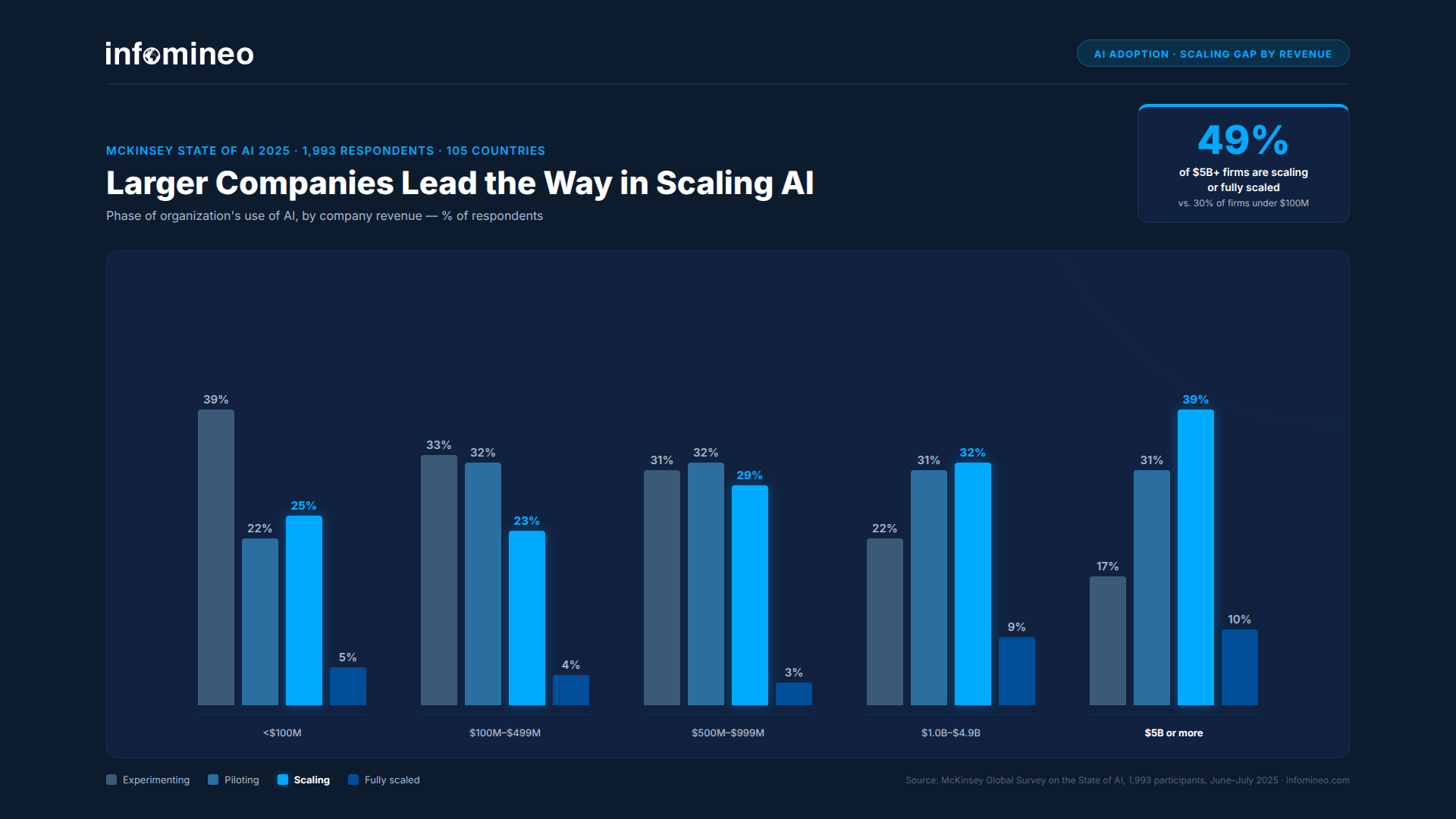
Note: Percentages shown do not total 100% for each company size, as the remainder corresponds to organizations that report no use of AI.
This uneven adoption reinforces structural advantages. Larger firms are better positioned to invest in proprietary tools, integrate AI into workflows, and leverage extensive internal data. Scale also creates a data advantage: accumulated engagement outputs, research repositories, and client insights can be incorporated into AI systems, producing outputs that are more contextually grounded and difficult to replicate.
AI can amplify existing differences. Firms that invest early and build integrated capabilities accelerate ahead, while others face challenges in translating experimentation into consistent value. As this gap widens, competitive pressure increases across the market.
Agile Competitors Are Redefining Speed and Cost Structures
A new category of AI-native consulting players is emerging with operating models designed for speed, flexibility, and efficiency. These firms embed AI at the core of their workflows and operate with leaner teams, allowing them to deliver work more quickly and at lower cost.
AI-first approaches reduce reliance on large analyst teams and enable faster iteration cycles. Tasks that previously required extended timelines can now be completed significantly faster, reshaping client expectations around delivery speed. At the same time, lower operating costs allow these firms to compete more aggressively on pricing while maintaining responsiveness. The impact is not necessarily direct replacement in complex, high-value engagements. Instead, the pressure is most visible in more standardized, deliverable-driven work where speed and cost are key decision factors. This creates sustained pressure on margins, timelines, and scope.
Established firms face structural challenges in adapting. Partner-led models, historically optimized for consistency and risk management, can slow decision-making and limit the speed at which workflows evolve. While these models provide stability and trust, they can also introduce friction in an environment that increasingly rewards rapid adaptation.
AI-native competitors operate without these constraints. They can redesign workflows more quickly and adopt new capabilities without legacy limitations. As a result, competitive pressure is likely to intensify, particularly in segments where delivery speed and cost efficiency are critical.
INFOMINEO INSIGHT ASSURANCE
Speed is no longer the differentiator. Verified quality is.
As AI-native competitors compress delivery timelines, the firms that sustain premium positioning are those that can guarantee the reliability of what they deliver, not just the speed. Insight Assurance provides an independent verification layer between AI generation and client delivery.
How Consulting Firms Can Maintain Competitive Advantage in an AI-Driven Market
As AI reshapes how consulting work is produced and delivered, maintaining a competitive advantage requires a deliberate shift in where and how value is created. Execution alone is no longer sufficient to differentiate. Firms need to strengthen how they ensure quality, apply expertise, and scale capabilities across the organization.
1. Maintaining Insight Quality and Non-Replicable Advantage
Sustaining differentiation increasingly depends on the ability to produce insights that are both reliable and difficult to replicate using widely accessible tools.
- Quality control at scale: Ensuring consistent quality of outputs requires actively addressing inaccuracies and signal-to-noise, which become more prevalent as output volume increases
- Proprietary and premium data: Leveraging proprietary data, premium sources, and primary research enables firms to generate insights that extend beyond widely accessible AI-generated content
- Shift to higher-value work: Shifting effort toward interpretation, strategic recommendations, and decision support allows firms to focus on areas where human judgment is most valuable
For a deeper look at how AI-driven errors impact consulting deliverables, explore AI Hallucinations in Consulting.
2. Differentiating Through Expertise, Context, and Client Proximity
As outputs become more comparable, differentiation increasingly depends on how well firms apply expertise and contextual understanding to each engagement.
- Domain specialization: Focusing on specific industries or problem areas enables firms to build deep expertise that is difficult for competitors to replicate
- Contextual expertise: Leveraging accumulated experience, business judgment, and contextual understanding enables firms to translate analysis into valuable insights
- Client responsiveness: Differentiating through responsiveness, flexibility, and strong client relationships reinforces value beyond the deliverable itself
3. Embedding AI at Scale Across the Organization
To fully capture the benefits of AI, firms need to move beyond isolated use cases and embed it consistently across workflows and teams.
- Integrating AI across teams: Incorporating AI into day-to-day workflows throughout the organization ensures consistent adoption and more reliable delivery outcomes
- Targeted AI capability building: Developing role- and sector-specific training enables consultants to use AI tools effectively within their domain, rather than relying on generic, one-size-fits-all approaches
- AI governance and strategy: Establishing a clear AI strategy and governance framework ensures consistent usage, reduces fragmentation, and maintains quality standards across the organization
What differentiates leading organizations is how consistently these elements come together across the business. McKinsey & Company’s State of AI in 2025 Survey shows that organizations generating more than 5% of EBIT from AI follow a more coordinated approach, combining strategic clarity with disciplined execution.
A first point of separation appears in how direction is set and reinforced. High performers are nearly twice as likely to have a clearly defined AI roadmap, with 60% reporting one compared to 31% of other organizations. This is reinforced by stronger senior leadership engagement, reported by 57% of high performers versus 33% of their peers. The difference is not only in planning, but in how actively leadership shapes and supports AI-driven value creation.
This alignment is matched by more structured execution. High performers are far more likely to integrate human oversight into AI workflows, with 65% reporting a human-in-the-loop approach compared to 23% of others. They also invest earlier in workforce planning, with 54% putting structures in place to adapt roles and skills versus 19% among peers. This reflects an ability to translate intent into operating practices that scale.
Organizations engaging in each practice, % of respondents
| High Prevalence | AI high performers (n = 109) |
All other respondents (n = 1,643) |
| Human in the loop | 65% | 23% |
| Technology infrastructure | 60% | 23% |
| Clearly defined AI road map | 60% | 31% |
| Leadership alignment on value creation | 60% | 41% |
| Rewiring business processes | 58% | 20% |
| Senior leadership engagement | 57% | 33% |
| Agile product delivery | 54% | 20% |
| Strategic workforce planning | 54% | 19% |
| Iterative AI solution development | 54% | 22% |
| Rapid AI development cycles | 54% | 24% |
What emerges is a consistent pattern. Organizations that generate meaningful value from AI do not rely on a single capability. They combine clear direction, active leadership, and disciplined execution, scaling each element across the organization.
Reinforcing Competitive Advantage with Insight Assurance
As firms adapt to an AI-driven environment, maintaining competitive advantage increasingly depends on how reliably insights can be validated, strengthened, and delivered at scale. Speed and volume alone are not sufficient if the underlying analysis cannot be trusted or differentiated. This creates a need for structured approaches that ensure both quality and consistency without slowing down delivery.
Strengthening Reliability and Differentiation in AI-Enabled Workflows
As AI increases the volume and speed of consulting outputs, it also increases exposure to inaccuracies, irrelevant information, and misleading insights. What appears credible at first glance is not always reliable, particularly when outputs are generated from similar models and overlapping data sources. At the same time, traditional validation layers are being compressed under tighter timelines, creating a gap between perceived quality and actual reliability.
Insight Assurance addresses this gap by introducing an independent validation layer between AI output and client delivery. It systematically reviews prompts, sources, claims, and underlying reasoning to ensure that outputs are grounded, accurate, and verifiable. This allows firms to maintain consistent quality even as output volume scales, while strengthening differentiation through more credible, contextually grounded insights. By incorporating premium data sources, primary research, and proprietary knowledge, it extends analysis beyond what standard AI outputs can produce, without relying solely on internal review processes that may already be under pressure.
At the core of this approach is a structured evaluation framework built around three dimensions: Source, Data, and Form.
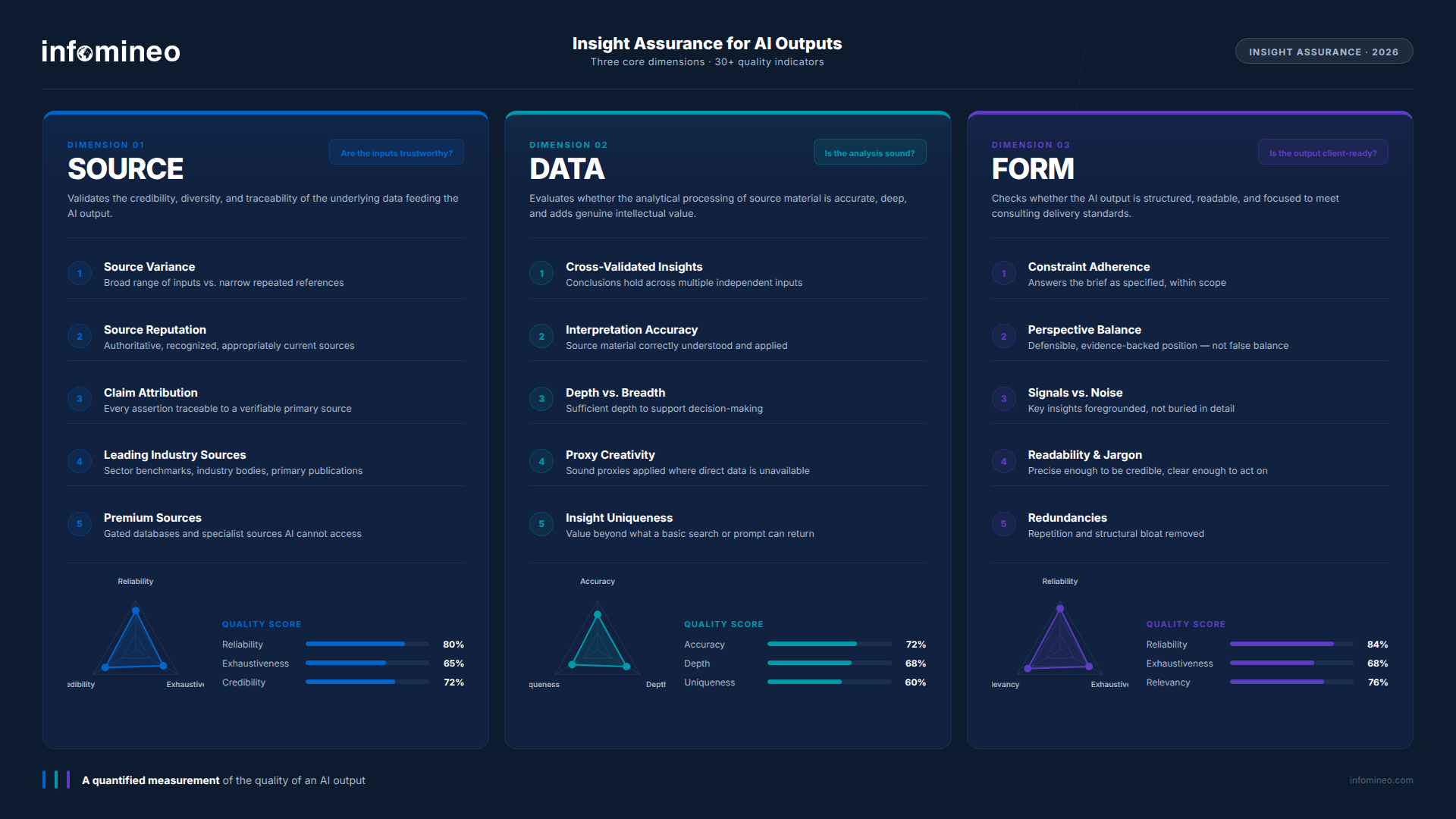
Source assesses the credibility, diversity, and traceability of the information used. This includes evaluating whether inputs come from a broad and reliable range of sources, whether claims can be clearly attributed to verifiable references, and whether the analysis incorporates authoritative or premium data that is not readily accessible through standard AI outputs.
Data evaluates the quality of the analytical processing applied to those sources. This involves assessing whether insights are cross-validated across multiple inputs, whether interpretations accurately reflect the underlying information, and whether the analysis demonstrates sufficient depth and originality rather than remaining surface-level.
Form focuses on how effectively insights are translated into a usable consulting deliverable. This includes clarity of structure, prioritization of key messages, balance of perspectives, and the ability to distinguish signal from supporting detail, ensuring that outputs are both readable and decision-ready.
Together, these dimensions provide a structured and repeatable way to assess the reliability and usability of AI-generated insights.
Allowing Firms to Scale AI While Focusing on Higher-Value Work
AI is shifting consulting work toward higher-value activities such as interpretation, strategic thinking, and client engagement. However, it also increases the volume of outputs that require validation and quality control before they can be used in client deliverables. Without a structured approach, this creates additional pressure on teams and can limit the efficiency gains AI is meant to deliver.
Insight Assurance absorbs this validation layer externally by handling correction, enrichment, and quality assessment outside the consulting team. It provides transparency through audit trails that document sources, reasoning, and improvements applied, ensuring that outputs can be trusted and defended when presented to clients.
By externalizing this workload, consulting teams can focus their time on activities that require judgment and context, rather than on verification tasks. This enables firms to scale AI usage without increasing risk exposure or compromising quality. The result is a more balanced operating model, where AI drives speed and volume, while Insight Assurance ensures reliability, consistency, and differentiation.
INFOMINEO INSIGHT ASSURANCE
Maintain your quality edge as AI compresses the production layer across the industry.
Insight Assurance provides an independent verification layer that evaluates AI outputs across Source, Data, and Form, enabling consulting teams to scale without introducing the reliability risks that erode client trust and firm reputation.
Frequently Asked Questions
How is AI eroding consulting differentiation in practice?
AI is standardizing the production layer of consulting work, including data collection, research synthesis, and slides development, across firms. When similar tools generate outputs from the same underlying data sources, deliverables begin to converge. Clients increasingly receive comparable recommendations from multiple providers, making it more difficult to sustain a premium based on execution alone. Differentiation is shifting toward judgment, problem framing, and the reliability of insights, areas where human expertise remains critical.
Why is AI creating a wider gap between large and small consulting firms?
AI adoption scales with investment capacity, data maturity, and organizational readiness, all of which tend to favor larger firms. According to McKinsey & Company’s State of AI 2025 survey, nearly half of companies with more than $5 billion in revenue have reached the scaling phase of AI adoption, compared with 30 percent of those below $100 million. This gap is reinforced by differences in data assets. Larger firms accumulate structured research outputs and client data over time, enabling more contextually grounded AI applications. As investment and data advantages compound, disparities in performance and capability continue to widen.
Are AI-native boutiques a real threat to established consulting firms?
AI native boutiques represent a credible threat in specific segments. They are highly competitive in defined, deliverable focused engagements where speed and cost are the primary decision criteria. They are less positioned to compete in complex transformation work that depends on trust, continuity, and organizational depth. The impact is concentrated in areas that have historically supported junior development and margin at scale within larger firms.
What does Insight Assurance actually do, and how does it integrate with existing workflows?
Insight Assurance introduces an independent verification layer between AI generated research and client delivery. It evaluates outputs across three dimensions: Source, which assesses the credibility and relevance of inputs; Data, which evaluates analytical accuracy and depth; and Form, which focuses on clarity, structure, and prioritization. Each review produces a quantified assessment along with a traceable record of sources validated, claims corrected, and enhancements applied. It integrates into existing workflows without requiring changes to internal tools, delivering outputs that are ready for client use.
How should consulting firms prioritize AI investment to protect competitive position?
The most effective investments focus on capabilities that are difficult to replicate. This includes proprietary data infrastructure, consistent integration of AI across workflows, and independent quality assurance. Firms that focus only on generation tools are building on a shared foundation with competitors. Those that also invest in validation, structured quality control, and data enrichment develop a more durable advantage that strengthens as AI adoption increases.
