

Healthcare Market Intelligence: The Complete Guide for Strategy Teams

Table of Contents
Only 20% of healthcare executives say they have access to the market data they need to make confident strategic decisions (Deloitte Global Health Care Outlook, 2024) — yet the global healthcare market is projected to surpass $12 trillion by 2030 (IQVIA Global Healthcare Outlook, 2024). For pharma and med-tech strategy teams, GCC health ministries, and consultancies running healthcare engagements, the gap between available data and actionable intelligence is where deals are lost, launches fail, and capital gets misallocated. This guide covers what healthcare market intelligence actually is, why healthcare is structurally harder to research than any other sector, what a rigorous methodology looks like, and how to evaluate whether you’re getting intelligence or just a repackaged dataset.
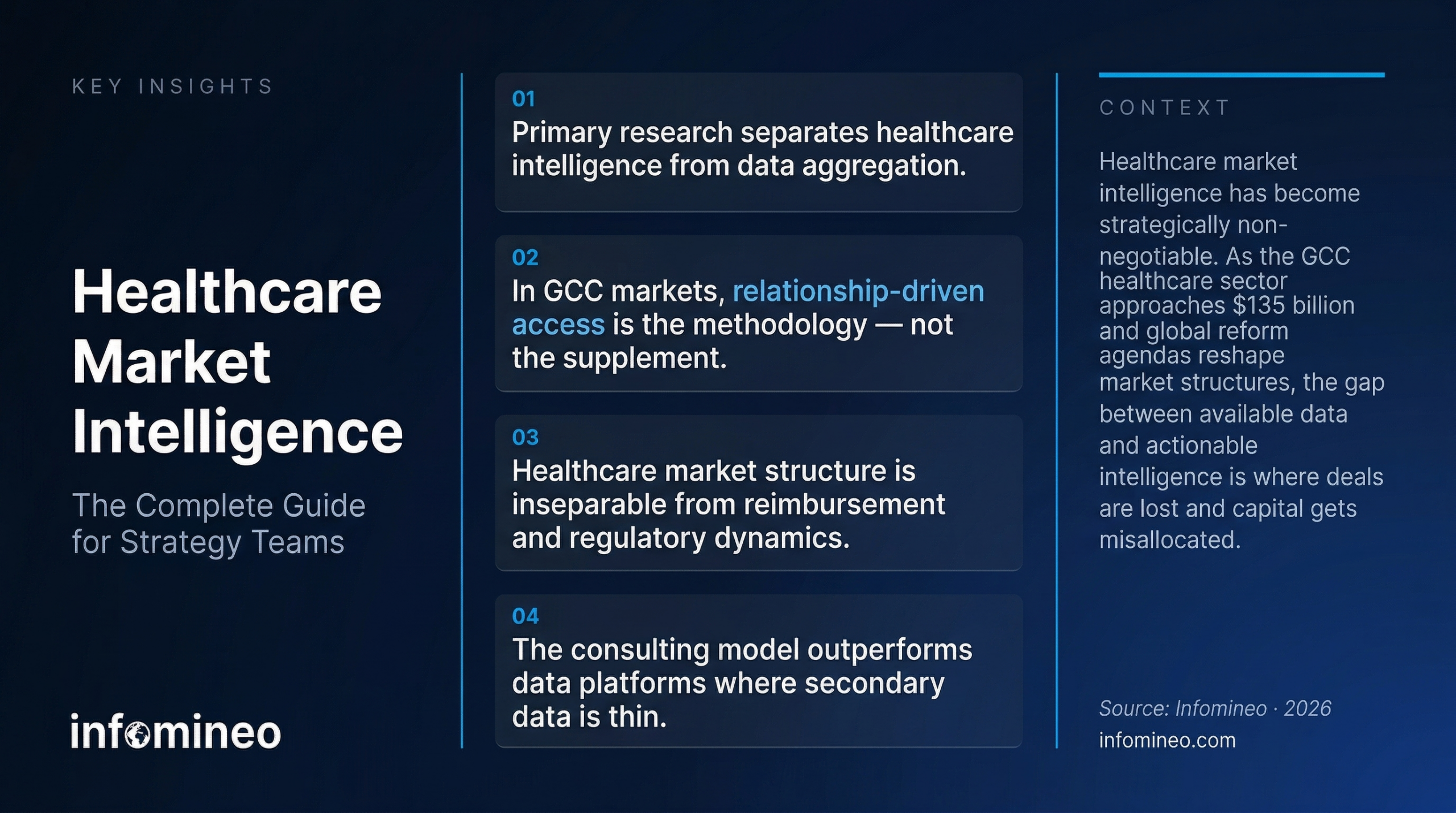
What Is Healthcare Market Intelligence?
Healthcare market intelligence is the systematic process of collecting, analyzing, and synthesizing data about healthcare markets — including patient flows, competitive positioning, provider landscapes, payer dynamics, and demand signals — to support strategic decisions. It is distinct from clinical research, health informatics, or generic market reports: the output is decision-ready intelligence, not data for its own sake.
The term gets used loosely, which creates real problems for buyers. A syndicated report on “the oncology diagnostics market” is not healthcare market intelligence. Neither is a database subscription that surfaces claims data without interpretation. True healthcare market intelligence answers a specific strategic question — “Should we expand our orthopedics service line into the Eastern Province of Saudi Arabia?” or “Which physician segments in France are underserved by current cardiology device distributors?” — by combining multiple data types, human expertise, and analytical frameworks.
Healthcare commercial intelligence is a narrower cousin: it focuses on commercial performance — prescription data, market share by product, promotional response — typically used by pharma and med-tech sales and marketing teams. Healthcare market intelligence is broader, covering market structure, demand dynamics, competitive landscape, regulatory environment, and strategic entry conditions. The two overlap but serve different functions in an organization.
Understanding this distinction matters because the methodology required is fundamentally different. Commercial intelligence is largely quantitative and backward-looking. Market intelligence requires forward-looking synthesis, primary validation, and judgment — especially in markets where secondary data is thin or unreliable.
Why Healthcare Is the Hardest Market to Research
Healthcare combines the data complexity of financial services with the regulatory opacity of government contracting and the structural fragmentation of consumer markets. No other sector requires researchers to simultaneously navigate claims data, clinical registries, payer contracts, regulatory filings, provider credentialing systems, and on-the-ground referral relationships — all of which vary significantly by country, region, and even facility type.
Several structural features make healthcare uniquely difficult:
Data fragmentation at every level
In the United States, claims data from CMS covers Medicare and Medicaid but misses commercially insured patients. Private claims data platforms — including tools built on 150+ million EMS records (ImageTrend) and deduplication systems achieving 99.9% precision on patient matching (LexisNexis) — fill some gaps but introduce their own coverage and lag issues. Electronic health record (EHR) data sits behind institutional walls. Provider facility data is scattered across state licensing boards, accreditation bodies, and CMS cost reports. Integrating these sources into a coherent picture of a specific market requires significant analytical infrastructure and domain expertise.
62% of health system executives cite data fragmentation as a top barrier to confident strategic decision-making (HIMSS, 2023). Outside the US, the challenge intensifies. In many GCC and MENA markets, there is no equivalent of CMS claims data. Hospital utilization figures are published inconsistently. Insurance penetration is growing rapidly but remains low in several markets, meaning claims-based analysis captures only a fraction of actual patient volume. Public data is often two to three years behind reality.
The referral network problem
Patient flow in healthcare is driven as much by physician relationships and referral patterns as by patient preference or payer coverage. Understanding why patients travel from a secondary city to a tertiary center, or why a particular med-tech device dominates a specific hospital network, requires mapping informal relationships that don’t show up in any database. This is fundamentally a primary research problem — it requires interviews with clinicians, administrators, and distributors, not just data pulls.
Regulatory and reimbursement complexity
Market opportunity in healthcare is inseparable from reimbursement. A device that is approved but not reimbursed is commercially irrelevant in most markets. Reimbursement rules vary by country, by insurer, by indication, and in many markets, by individual hospital contract. Mapping the reimbursement landscape for a given product category in five GCC countries requires direct engagement with payer organizations and regulatory bodies — secondary research alone is insufficient.
Fast-moving competitive dynamics
Healthcare markets are experiencing rapid structural change: consolidation among hospital systems, growth of outpatient and ambulatory models, expansion of telehealth, entry of technology players, and in GCC/MENA markets, aggressive government-led capacity expansion. A market map built on data from 18 months ago can be materially wrong. Real-time primary research is not a luxury — it’s a methodological requirement.
The Methodology That Separates Signal From Noise
The methodological gap between rigorous healthcare market intelligence and a repackaged secondary report is larger than most buyers realize. A credible methodology triangulates three distinct evidence streams — secondary data, primary interviews, and proprietary analytical frameworks — and is transparent about what each contributes and where uncertainty remains.
Layer 1: Secondary data foundation
Secondary research in healthcare is more technically demanding than in other sectors. It requires identifying and reconciling data from claims databases, clinical registries, regulatory filings, accreditation records, academic literature, industry association reports, and — in emerging markets — government health statistics that may require native-language access and significant quality assessment.
The critical discipline here is provenance tracking: knowing exactly where each data point came from, when it was collected, what population it covers, and what its known limitations are. A market size figure sourced from a three-year-old syndicated report and a figure derived from triangulating recent claims data and facility census are not equivalent — but they are often treated as if they are in low-quality deliverables.
Layer 2: Primary expert interviews
Primary research is where healthcare market intelligence separates from data aggregation. The questions that actually drive strategic decisions — How are referral patterns shifting in this market? Which physicians are early adopters of this technology? What is the real budget cycle for capital equipment procurement in these hospitals? — cannot be answered from any database.
Effective primary research in healthcare requires access to relevant experts (clinicians, hospital administrators, payer officials, distributors, former executives), structured interview guides that efficiently extract strategic insight, and analysts who can probe intelligently rather than reading from a script. In GCC and MENA markets, this additionally requires native-language capability, local relationship networks, and an understanding of cultural and institutional context that shapes what interviewees are willing to share and how they frame information.
As one senior partner at a healthcare strategy advisory firm noted (private communication, 2025): “The difference between a useful KOL interview and a wasted hour is whether the analyst understands the clinical and commercial landscape well enough to follow a surprising answer down the right path. That’s not a skill you hire off a platform.”
Layer 3: Analytical frameworks and synthesis
Raw data and interview transcripts are not intelligence. The synthesis layer is where analytical frameworks are applied to turn inputs into decision-relevant outputs. For healthcare market intelligence, this typically involves:
- Market sizing and segmentation: Bottom-up construction of addressable market using facility census, utilization rates, and procedure volumes — not top-down extrapolation from global market reports
- Competitive positioning maps: Structured comparison of competitors across dimensions relevant to the strategic question (market share, go-to-market approach, pricing, pipeline, key account relationships)
- Patient flow analysis: Mapping where patients are being treated, where they are being referred, and where structural gaps create opportunity
- Scenario modeling: Quantified projections under different strategic assumptions, with explicit documentation of key uncertainties
The role of AI-augmented synthesis
AI tools are now embedded in serious healthcare market intelligence workflows — primarily for accelerating secondary data processing, pattern recognition across large document sets, and first-pass synthesis of interview notes. The value is real: AI can compress secondary research timelines by 40–60% on tasks that previously required weeks of manual extraction (Gartner, 2024).
However, AI augments human judgment; it does not replace it. The healthcare domain is too complex, too context-dependent, and too prone to data quality issues for automated pipelines to produce reliable strategic intelligence without expert oversight at every stage. The firms and teams that treat AI as a replacement for analytical expertise will produce faster deliverables with higher error rates — a bad trade in high-stakes strategic decisions. See how Infomineo integrates these approaches in our market intelligence methodology. For a structured look at interview design and execution in complex research environments, see our guide on mastering expert interviews.
What a Healthcare Intelligence Deliverable Looks Like
A well-constructed healthcare market intelligence deliverable is not a slide deck with market size circles and a list of competitors. It is a structured argument that answers a specific strategic question, supported by triangulated evidence, with explicit documentation of methodology, data sources, confidence levels, and remaining uncertainties. The format follows the question — some questions call for a focused 20-page report; others require a dynamic model.
The most common deliverable types, and what distinguishes high-quality execution in each:
Market assessment reports
A market assessment answers: “What is the size, structure, and attractiveness of this market for our specific use case?” High-quality execution includes bottom-up market sizing (not just cited from a syndicated report), segmentation by relevant dimensions (geography, facility type, indication, payer mix), growth driver analysis with primary validation, and an honest assessment of barriers to entry and competitive intensity.
A benchmark example: an oncology company that commissioned a rigorous HMI analysis was able to determine it could realistically capture approximately 15% of its addressable market — a figure precise enough to inform capital allocation decisions in a way that a generic “oncology market is growing at X%” never could (Definitive Healthcare case study). For a deeper look at what these outputs contain, see our breakdown of what a market intelligence report includes.
Competitive landscape analyses
A competitive landscape answers: “Who are the relevant players, what are their strategies, and where are the gaps?” This requires mapping not just obvious direct competitors but also indirect competitors (including internal capability build-out by potential customers), adjacent players with potential to expand, and emerging entrants. In healthcare, distribution relationships and key account lock-in are often as strategically relevant as product features or pricing.
Go-to-market intelligence briefs
A go-to-market intelligence brief is targeted at a specific launch or expansion decision: “Which customer segments should we prioritize, through which channels, with what value proposition, against which competitive backdrop?” This requires the deepest integration of primary research because it depends on understanding how specific decision-makers — hospital procurement committees, physician KOLs, payer medical directors — actually evaluate and select products or partners.
Healthcare forecasting models
Healthcare forecasting models project demand, revenue, or market share forward under defined scenarios. The key quality indicator is whether assumptions are grounded in primary research and explicitly documented, or whether they are extrapolated from historical trends that may not hold. In fast-growing markets like GCC healthcare, trend extrapolation is particularly unreliable — government capacity expansion plans, Vision 2030-type initiatives, and changing disease burden patterns can shift demand curves faster than any historical model predicts.
How to Evaluate a Healthcare Market Intelligence Partner
The market for healthcare intelligence services ranges from rigorous advisory firms to data platform vendors to generic research mills that repackage secondary sources. Evaluating a potential partner requires asking precise questions about methodology, not accepting vague claims about expertise or comprehensiveness. The table below outlines the key dimensions and what to look for.
| Dimension | Consulting/Advisory Firm | Data Platform/SaaS | Generic Research Mill |
|---|---|---|---|
| Primary research | Yes — expert interviews, field research | No — data aggregation only | Rarely, if at all |
| Answer to your specific question | Yes — scoped to your decision | Partial — depends on data coverage | No — generic market report |
| Methodology transparency | High — documented sources and assumptions | Medium — data dictionary available | Low — “proprietary research” |
| MENA/GCC coverage | Depends on firm — check specifically | Usually weak — US/EU focus | Poor — sourced from global reports |
| Strategic synthesis | Yes — implications, recommendations | No — data, not recommendations | Minimal — summary of findings |
| Time to insight | 3–8 weeks depending on scope | Immediate — self-serve | 1–2 weeks (often recycled) |
| Cost model | Project-based — scales with scope | Annual subscription | Low per-report cost |
Beyond the table, the questions that reveal the most about a potential partner’s actual capability:
- “Walk me through how you would answer this specific question.” A credible partner will outline a methodology — data sources, primary research design, analytical approach — not just cite credentials.
- “What data would you use, and what are its limitations?” Any partner who can’t articulate the limitations of their primary data sources is either not using primary data or not thinking rigorously about quality.
- “What would you not be able to tell us confidently, and why?” Epistemic honesty is a quality signal. Partners who claim to answer everything reliably are overselling.
- “Do you have native-language research capability in the markets we care about?” For any market outside the English-speaking world, this is non-negotiable. Translated secondary research misses the informal signals that primary engagement surfaces.
Infomineo has supported Fortune 500 pharma and med-tech strategy teams as an embedded intelligence partner — not a one-off report vendor. The distinction matters operationally: embedded partnerships allow for iterative question refinement, faster turnaround on follow-on questions, and institutional knowledge accumulation that makes each successive engagement more valuable.
Explore our healthcare market intelligence methodology →
Healthcare Market Intelligence for GCC and MENA
GCC and MENA healthcare markets are among the fastest-growing in the world — the GCC healthcare sector alone is projected to reach $135 billion by 2030, growing at 8.1% CAGR (GlobalData, 2024) — and among the most poorly served by global market intelligence providers. Saudi Arabia’s Vision 2030, the UAE’s ambitious hospital capacity expansion, Egypt’s Universal Health Coverage rollout, and Morocco’s healthcare reform agenda are reshaping regional market structures at a pace that syndicated reports from global research houses consistently fail to capture. The data infrastructure that makes US and European healthcare research tractable simply doesn’t exist here — and the methodological response has to be different.
Several features distinguish GCC/MENA healthcare intelligence from work in more data-rich markets:
Public data is sparse and often lagged
Ministry of health statistics in most GCC countries are published infrequently, inconsistently formatted, and often two to four years behind current reality. Private insurance claims data — the backbone of US commercial intelligence — is available but covers a minority of patient episodes in most markets. Hospital utilization data is closely held by institutions and government bodies that have limited incentive to share it with external researchers.
This means that market sizing in GCC healthcare requires a genuinely bottom-up approach: facility census from accreditation records, bed capacity from regulatory filings, utilization rate estimation from primary interviews with hospital administrators, patient volume triangulation from specialist physician interviews, and cross-validation against insurance sector data where available. It is labor-intensive, but it is the only path to numbers that are defensible in a board-level strategy discussion.
Relationship-driven primary access is the key variable
In GCC healthcare, the most valuable intelligence is held by people — hospital CEOs, medical directors, payer officials, specialist physicians, and government health ministry advisors — who are not reachable through generic expert network platforms. Access depends on relationships built over time in the region, cultural fluency, and the ability to engage in Arabic when the conversation requires it.
Our analysts cover healthcare markets across MENA, GCC, and Europe — with native-language primary research capabilities that generic firms can’t match. This is not a marginal advantage: in markets where published data is thin, the quality of primary access determines the quality of the intelligence output.
Government is a dominant market actor
In Saudi Arabia, the UAE, Qatar, and Kuwait, government entities control a substantial share of hospital capacity — government-operated hospitals account for over 60% of total bed capacity across GCC states (WHO EMRO, 2023) — alongside health insurance mandates, formulary decisions, and capital equipment procurement. Understanding the strategic priorities, budget cycles, and decision-making processes of government health bodies is therefore central to any market entry or expansion analysis — not a secondary consideration.
We have built intelligence frameworks for GCC government health ministries, where public data is sparse and relationship-driven primary access is the only path to truth. This institutional experience shapes how we approach commercial healthcare engagements in the region: the public-private interface is always relevant, even for commercial market participants.
The reform agenda is the market opportunity
Vision 2030 in Saudi Arabia explicitly targets increasing the private sector’s share of healthcare from roughly 40% to 65% (Saudi Vision 2030 / National Transformation Program, 2021) — a structural shift that creates substantial market opportunities for private hospital operators, med-tech companies, pharma distributors, and digital health providers. Similar reform dynamics are playing out in Egypt, Morocco, and Bahrain. Capturing these opportunities requires intelligence that tracks not just current market structure but the reform implementation timeline, regulatory changes, and investment flows that will reshape the landscape over the next three to five years.
For a deeper grounding in market intelligence methodology applicable across sectors, see our overview of market intelligence frameworks and approaches.
Use Cases by Audience Type
Healthcare market intelligence serves materially different functions depending on who is commissioning it and what strategic question they are trying to answer. A med-tech company evaluating a new geography, a pharma company assessing a therapeutic category, a hospital system planning service line expansion, and a payer evaluating network adequacy are all doing “healthcare market intelligence” — but the data sources, primary research design, and analytical frameworks required are distinct.
Pharma and life sciences strategy teams
For pharma, the central use cases cluster around market entry, lifecycle management, and competitive positioning. Key intelligence needs include:
- Epidemiology and patient population sizing: How large is the addressable patient population, how is it segmented by disease severity and current treatment status, and how is it expected to evolve?
- Prescriber landscape mapping: Who are the high-volume prescribers, what are their current prescribing behaviors, and what drives switching between therapies?
- Payer and reimbursement intelligence: What are the reimbursement conditions in target markets, what is the timeline and process for formulary inclusion, and what evidence requirements do payer committees impose?
- Competitive pipeline tracking: What products are in development by competitors, at what stage, with what differentiation potential?
Life sciences market intelligence in MENA is particularly complex because regulatory approval timelines, reference pricing dynamics, and distributor relationships vary significantly across the GCC’s six member states — making region-wide analysis a genuine multi-country research project, not a simple geographic extension of a single-market approach. For current context on the sector, see our analysis of pharmaceutical trends shaping 2026.
Med-tech and medical device companies
Med-tech market intelligence centers on the hospital buying process and the clinical adoption pathway. Key questions include: Which hospital systems are the relevant targets? Who influences the purchasing decision (surgeon, department head, procurement committee, CFO)? What is the typical sales cycle? How does our product compare on the dimensions that actually drive procurement decisions in this market?
Patient flow analysis is particularly relevant for med-tech: understanding where specific procedures are being performed, at what volume, and with what current device mix enables precise territory planning and prioritization. This analysis requires facility-level data that goes beyond what is available in syndicated reports — it requires integration of procedure volume data, device utilization surveys, and primary interviews with clinical and administrative staff.
For companies expanding into GCC, the distributor landscape is a critical intelligence domain. Market access often depends on the quality of distributor relationships with key hospital systems and government procurement entities — intelligence that requires primary engagement to assess accurately.
Hospital systems and health networks
For healthcare providers, market intelligence serves service line planning, physician recruitment, and competitive positioning. The central analytical tool is patient flow analysis: mapping where patients in a given catchment area are currently seeking care, identifying leakage to competing facilities, and quantifying the opportunity from capturing a higher share of relevant patient episodes.
Service line expansion decisions — Should we build an advanced cardiac surgery program? Is there sufficient demand to support a standalone orthopedics center? — require analysis of procedure volumes in the catchment area, competitive capacity, referral network dynamics, and payer mix. Done rigorously, this analysis can reveal opportunities that facility leadership intuition misses and validate or challenge strategic assumptions before significant capital is committed.
Consultancies on healthcare engagements
Top-tier consultancies running healthcare strategy engagements increasingly use specialist research partners to provide the market intelligence foundation — particularly when engagements involve geographies or data types outside the consulting team’s core expertise. For a European MBB team advising a client on GCC healthcare expansion, commissioning healthcare intelligence from a partner with on-the-ground regional presence is faster, more cost-effective, and more credible than attempting to build the capability in-house for a single engagement. See how we support competitive intelligence consulting engagements of this type.
The partnership model works best when the intelligence partner understands the consulting workflow: tight deadlines, iterative question refinement, presentation-ready outputs, and the ability to defend methodology under client scrutiny. This requires not just research capability but project management discipline and consulting-grade communication skills.
Payers and health insurance organizations
Payer intelligence focuses on network adequacy, utilization management, and cost driver analysis. Key intelligence needs include provider landscape mapping (who is in network, who should be, and what gaps exist), claims-based utilization pattern analysis, and competitive intelligence on benefit design and pricing in target markets.
In GCC markets where mandatory health insurance schemes are expanding — particularly in Saudi Arabia and the UAE — payers face the additional challenge of understanding healthcare utilization patterns in populations with limited insurance history. This requires primary research-heavy approaches: surveys of insured populations, interviews with employers and HR directors, and analysis of early utilization data from analogous markets.
Frequently Asked Questions
What is healthcare market intelligence?
Healthcare market intelligence is the process of collecting and synthesizing data about healthcare markets — including patient flows, competitive positioning, payer dynamics, provider landscapes, and demand signals — to support strategic decisions. It differs from clinical research or generic market reports because it is scoped to a specific strategic question and combines secondary data with primary expert interviews and analytical frameworks to produce decision-ready outputs.
How does healthcare market intelligence benefit MedTech companies?
For med-tech companies, healthcare market intelligence clarifies the hospital buying process, maps the competitive device landscape at facility level, identifies high-volume procedure centers, and profiles the decision-makers who influence procurement. This enables precise territory prioritization, more effective sales strategy, and better-informed market entry decisions — particularly in geographies like GCC where distributor relationships and government procurement dynamics are central to commercial success.
What are the top trends in healthcare market intelligence?
The most significant trends are AI-augmented data synthesis (compressing timelines on secondary research while requiring stronger human oversight for quality control), growing demand for real-world data (RWD) integration in pharma intelligence, increasing interest in GCC and MENA markets driven by Vision 2030-type reform agendas, and a shift from one-off market reports to ongoing intelligence partnerships that accumulate institutional knowledge over time.
What types of data sources are used in healthcare market intelligence?
Primary sources include expert interviews with clinicians, hospital administrators, payer officials, and distributors. Secondary sources include medical claims data, EHR-derived analytics, clinical registries, regulatory filings, facility accreditation records, insurance sector data, government health statistics, academic literature, and industry association reports. Rigorous healthcare intelligence triangulates across multiple source types — relying on any single source produces systematically distorted outputs.
How can healthcare leaders use market intelligence for strategic planning?
Healthcare leaders use market intelligence to size addressable markets for service line expansion, identify patient leakage to competing facilities, assess physician recruitment opportunities in underserved specialties, evaluate geographic expansion options with quantified demand estimates, and track competitive positioning in real time. The common thread is that intelligence replaces assumption-based planning with evidence — reducing the risk of significant capital misallocation in decisions that are difficult to reverse.
What is the difference between healthcare commercial intelligence and market intelligence?
Healthcare commercial intelligence is focused on commercial performance metrics — prescription volumes, market share by product, promotional response, sales force effectiveness — primarily used by pharma and med-tech commercial teams. Healthcare market intelligence is broader, covering market structure, demand dynamics, competitive landscape, regulatory environment, and strategic entry conditions. Commercial intelligence is largely backward-looking and quantitative; market intelligence requires forward-looking synthesis and significant primary research.
Is healthcare market intelligence only relevant for US markets?
No — though the US generates the most structured data, making US-focused intelligence more accessible through data platforms. For GCC, MENA, European, and Asian healthcare markets, the intelligence challenge is often greater because secondary data is thinner and less reliable. This is where the consulting/advisory model has a structural advantage over data platforms: primary research and on-the-ground regional expertise can fill gaps that no database covers, particularly in fast-growing markets like Saudi Arabia, UAE, and Egypt where reform dynamics are outpacing published data.
What are the most common pitfalls in healthcare market intelligence projects?
The most common pitfalls are: relying on a single data source without triangulation; using syndicated market reports as primary evidence for strategic decisions (they are context, not intelligence); underestimating the primary research required, especially in markets with thin secondary data; failing to scope the question precisely enough (leading to broad research that doesn’t answer the actual decision); and choosing a partner based on price without assessing methodology — which produces fast, cheap outputs that fail under scrutiny when the strategic decision is challenged internally.
How long does a healthcare market intelligence project typically take?
A focused single-market assessment typically requires 3–5 weeks. Multi-country projects covering 3–5 GCC markets — which require 15–25 primary expert interviews and triangulation across fragmented data sources — typically run 6–10 weeks. Timeline is driven primarily by the scope of primary research required and stakeholder interview availability, not secondary data collection. Ongoing intelligence retainers compress per-question turnaround significantly once baseline market knowledge is established.
MARKET RESEARCH & INTELLIGENCE
Get Fortune 500-quality healthcare market intelligence — without the Big 4 price tag.
Infomineo builds healthcare market intelligence reports that go beyond secondary research — primary expert interviews, proprietary frameworks, and AI-augmented synthesis. Trusted by Fortune 500 pharma and med-tech teams and GCC government health ministries.
