

Best Market Intelligence Tools in 2026: A Practitioner’s Guide

Table of Contents
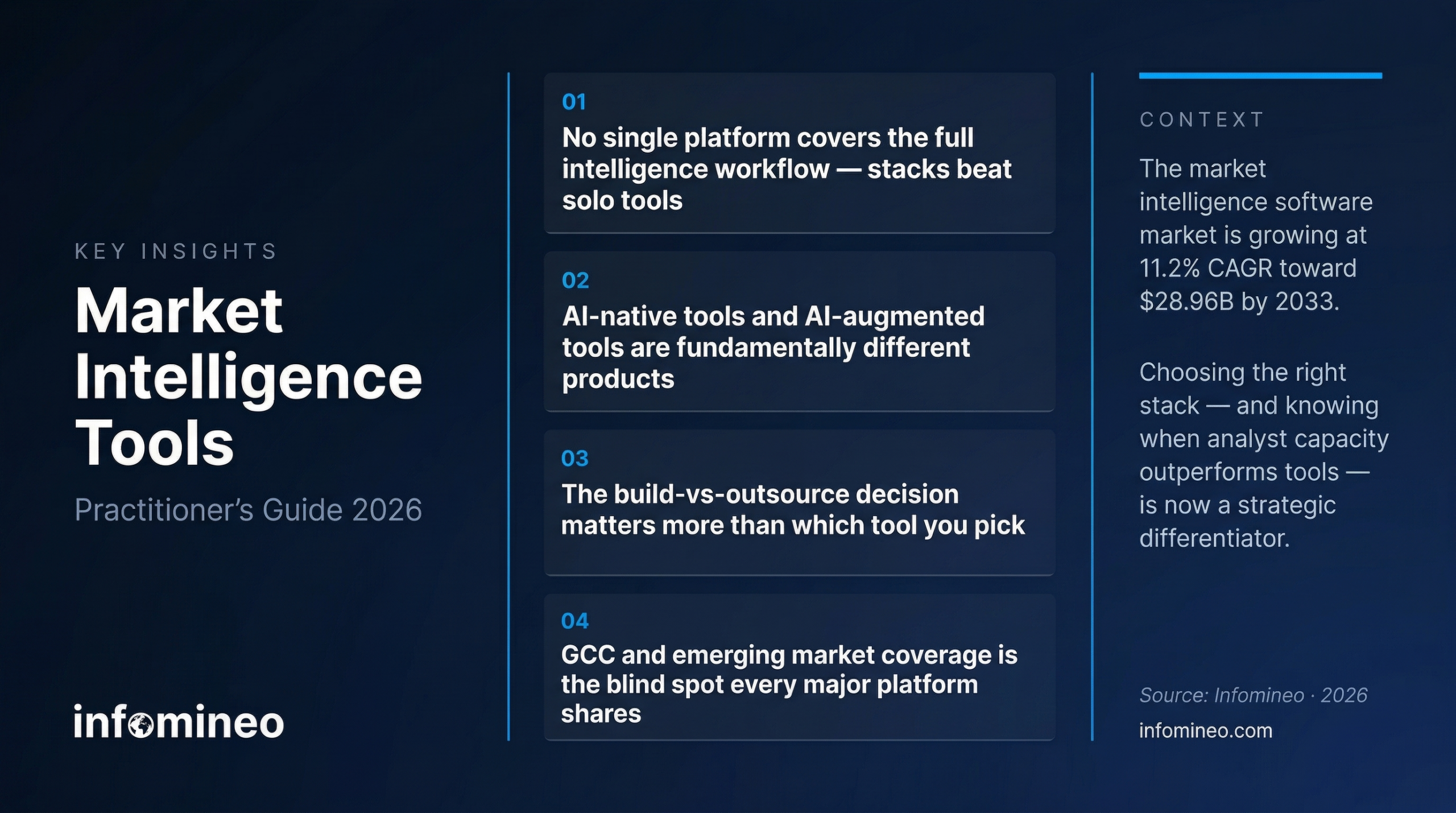
The market intelligence software market reached $12.38 billion in 2025 and is on track to hit $28.96 billion by 2033 — growing at 11.2% CAGR (Grand View Research, 2025). Yet 87% of marketers report that data is their most underused asset (Forrester, 2024). The problem isn’t access to tools. It’s knowing which tools hold up in production, how they fit together, and when to stop relying on them altogether. This guide is written from the perspective of analysts who use these platforms daily on behalf of Fortune 500 strategy teams and top-tier consultancies — not SaaS marketers reviewing their own competitors. We cover the tools that matter, the ones that disappoint at scale, and the decision framework for building an intelligence stack that performs under real workloads.
What Is a Market Intelligence Tool?
A market intelligence tool is any platform that systematically collects, organizes, and surfaces data about markets, competitors, customers, or industries — enabling faster, better-informed strategic decisions. The category spans competitive monitoring platforms, financial data aggregators, and AI-native research engines. Organizations that deploy structured intelligence programs make strategic decisions up to 3x faster than those relying on ad hoc research (McKinsey Global Institute, 2023).
Before going further, three terms worth separating:
- Market intelligence tools track macro-level signals: market sizing, demand trends, industry dynamics, regulatory shifts, and competitive landscape.
- Competitive intelligence platforms (Crayon, Klue) focus narrowly on monitoring what specific competitors are doing — pricing changes, product launches, messaging shifts.
- Market research tools focus on primary data — surveys, panels, consumer sentiment — rather than secondary aggregation.
| Tool | Category | Best For | AI-Native? | GCC Coverage | Price Tier |
|---|---|---|---|---|---|
| Crayon | Competitive Intel | CI teams, battlecards, sales enablement | Partial | Weak | $$$$ |
| Klue | Competitive Intel | CI distribution, sales-focused orgs | Partial | Weak | $$$ |
| AlphaSense | Financial / Document Intel | Strategy teams, earnings, M&A research | Yes | Moderate | $$$$ |
| PitchBook | Private Market Data | VC/PE research, deal tracking, ecosystem mapping | Partial | Moderate | $$$$ |
| Similarweb | Digital Intelligence | Web benchmarking, digital market share | Partial | Good | $$$ |
| Mintel | Consumer Market Research | FMCG, consumer goods, category reports | No | Limited | $$$ |
| Euromonitor | Consumer Market Research | Global market sizing, long-range forecasts | No | Good | $$$ |
| Factiva | News Archive | Historical media research, licensed press | No | Strong | $$$ |
| CB Insights | Tech / Startup Intel | Tech trends, emerging market maps | Partial | Moderate | $$$$ |
| Exploding Topics | Trend Detection | Emerging category identification, early signals | Yes | Weak | $ |
| Statista | Data Aggregator | Quick stats, internal decks, desk research | No | Moderate | $$ |
How Enterprise Teams Actually Use These Tools
The gap between how vendors demo their tools and how enterprise analysts use them in practice is wider than most buyers realize. Enterprise teams that implement intelligence platforms without a structured adoption process waste an estimated 40% of their subscription value in the first year (Forrester, 2023). Understanding where tools succeed — and where they hand off to human judgment — separates intelligence programs that deliver ROI from those that generate noise.
The Stack Model: Tools Work in Combination
No single platform covers the full intelligence workflow. A typical Fortune 500 in-house strategy team or top-tier consultancy analyst team runs at minimum three tools in combination:
- A monitoring layer (Crayon or Klue) for continuous competitive signals
- A deep research layer (AlphaSense or PitchBook) for structured, citation-quality analysis
- A market sizing layer (Euromonitor, Mintel, or Statista) for category context and quantified market data
The 74% of enterprises integrating intelligence tools into their core business workflows (Marketmind Partners, 2025) aren’t running a single tool — they’re running a layered stack where each platform addresses a distinct research type. Building a rigorous competitive analysis framework around these tools is what separates teams that extract consistent value from those that encounter coverage gaps at the worst possible moment: during a board presentation, a pricing review, or a competitive response.
Where Tools Break Down
Four failure modes appear consistently across enterprise intelligence workflows:
- Emerging market coverage. Most platforms were built on US and Western European data sources. GCC government projects, Southeast Asian private markets, and African consumer trends are systematically underrepresented. Teams operating in these regions routinely find their primary tool returns empty results or outdated government-sourced data for markets that are moving quickly.
- Private company depth. Even PitchBook and CB Insights — the leaders for private market intelligence — have significant gaps for mid-market companies below $50 million in revenue that haven’t raised institutional capital. This is a real problem for competitive analysis in fragmented industries.
- Synthesis vs. aggregation. Most tools surface data — they don’t interpret it. AlphaSense’s AI synthesis is genuinely impressive within its document corpus, but it cannot tell you what a competitor’s pricing change means for your positioning, or what a regulatory shift in one market implies for your expansion strategy. That remains an analyst function.
- Signal-to-noise in monitoring platforms. Crayon and Klue both face the same operational challenge: the more sources you monitor, the more noise you generate. CI teams without a triage process quickly find themselves overwhelmed by alerts. The tool creates the problem — and requires a workflow solution on top of it.
The AI-Native vs. AI-Augmented Distinction Matters More Than Vendors Admit
This is one of the most important distinctions buyers fail to probe during demos. An AI-augmented tool takes existing structured data and wraps a GPT-powered summary layer around it. An AI-native tool — AlphaSense is the clearest example — was built from the ground up on natural language processing and semantic search. The intelligence architecture differs at the infrastructure level, not just the interface.
The practical difference: AI-augmented tools produce summaries of data already in their database. AI-native tools surface non-obvious connections across unstructured document corpora, find relevant passages in documents you didn’t know to search for, and synthesize across hundreds of sources without requiring exact query syntax. For teams doing high-stakes, open-ended research, that distinction is significant. For teams doing well-defined, repeatable monitoring, it matters less.
The Consulting and Professional Services Angle
Most tool comparison articles are written for in-house buyers. A significant portion of market intelligence work happens inside consulting and professional services firms — and the tool requirements differ in ways vendors rarely address.
Consulting analysts face three constraints that in-house teams don’t: (1) they work across dozens of industries simultaneously, so no single vertical database suffices; (2) client engagements have strict timelines — a tool requiring deep configuration isn’t usable on a two-week engagement; (3) deliverables require citable, high-credibility sources — Statista is borderline acceptable; a screenshot from an AI summary with unclear provenance is not.
For consulting workflows, AlphaSense (depth and citable sourcing), Factiva (news and licensed press), Euromonitor (market sizing), and PitchBook (company and deal data) form the most defensible core stack. Crayon and Klue are less relevant in this context — monitoring platforms assume a persistent competitive set that evolves slowly, not the rotating client roster of a consultancy. When secondary research from these platforms must be complemented with primary data collection, consulting teams need a clear methodology for when to push beyond what tools can surface.
Infomineo’s analyst teams run this kind of multi-tool stack across client engagements daily — and have built AI-augmented workflows on top of these platforms to accelerate synthesis and coverage across emerging markets where tools alone fall short.
Talk to our team about how we approach market intelligence at scale →
Build vs. Buy vs. Outsource: The Decision Framework
The most important market intelligence decision isn’t which tool to buy — it’s whether buying tools is the right answer at all. Three distinct models exist, each with a different cost and capability profile. The right choice depends on research frequency, required depth, and internal analyst capacity. Enterprises that mismatch their model to their actual research volume overspend by an average of 35% on intelligence infrastructure (Gartner, 2024).
Model 1: Build Your Own Stack (Tool Ownership)
Appropriate when: your team runs 50+ research requests per month, requires continuous monitoring across a stable competitor set, and has at least 2–3 dedicated analysts who can own platform configuration and triage.
Real cost of ownership: SaaS pricing is the starting point, not the total cost. Add implementation time (2–6 weeks for a proper stack setup), ongoing analyst hours for alert triage and database maintenance, and the opportunity cost of internal expertise applied to tool administration rather than analysis. For a mid-market enterprise with one dedicated CI analyst, the all-in annual cost of a Crayon + AlphaSense + Euromonitor stack exceeds $150,000 when analyst time is factored in.
When it pays off: high-frequency, repeatable research on a known competitive set, with volume that justifies the fixed cost. Enterprise companies with mature CI functions and dedicated analyst teams. Cloud-based deployment now accounts for over 60% of intelligence tool deployments (Marketmind Partners, 2025) — the infrastructure barrier has dropped, but the analyst capacity requirement has not.
Model 2: Buy on Demand (Selective Subscription)
Appropriate when: your research needs are episodic — market entry projects, annual strategic reviews, periodic competitive audits — rather than continuous. You need depth when you need it, but not 12 months of access to run 3 projects.
Several platforms offer project-based or limited-seat access that makes this model viable. Statista’s individual plan, Euromonitor’s report-by-report purchasing, and Factiva’s article-level access all support episodic use. The trade-off is losing the compound value of continuous monitoring and the platform familiarity that comes from sustained use.
Model 3: Outsource to a Research Partner
Appropriate when: research requirements are high-stakes but infrequent, internal analyst capacity is limited, or the research requires expertise in markets or methodologies that tools can’t cover — emerging markets, expert interviews, primary survey design, or synthesis that requires judgment rather than aggregation.
The managed-service-versus-tool-ownership decision is real and underappreciated. A Fortune 500 strategy team paying $200,000 per year in tool subscriptions to support occasional market analysis and entry research is frequently better served by a research partner who brings both tools and analyst capacity — at a comparable or lower total cost, with higher output quality and no internal overhead.
This is the model Infomineo operates on: AI-augmented analyst teams who use the same tools described in this guide, combined with primary research capabilities, to produce market intelligence outputs that tools alone cannot generate. For enterprises evaluating whether to build an internal capability or partner with a specialist, the framing in our market intelligence report guide covers how outputs should be structured regardless of the production model.
Decision Matrix: How to Choose
| Scenario | Research Frequency | Internal Analyst Capacity | Recommended Model |
|---|---|---|---|
| Mature CI function, dedicated team | Daily / continuous | High (2+ FTE) | Build full stack |
| Growing team, CI emerging as a function | Weekly | Moderate (1 FTE part-time) | 2–3 targeted subscriptions |
| Episodic projects, strategy team | Quarterly / ad hoc | Low (generalist analysts) | Research partner |
| Emerging market focus, GCC / APAC | Any | Any | Research partner (tools alone insufficient) |
| Consulting firm / professional services | Continuous, multi-client | High (analyst pool) | Selective stack + partner for overflow |
The 74% of tech marketers who identify competitive and market intelligence as a top priority over the next 12 months (Gartner, 2023) are making a capability decision, not just a tool procurement decision. How that capability is built — tool-led, partner-led, or hybrid — determines whether the investment compounds or evaporates.
MARKET RESEARCH & INTELLIGENCE
When tools aren’t enough, our analysts take over.
Infomineo uses and helps clients implement market intelligence tools — but also does the work. AI-augmented research, primary interviews, and analyst-grade synthesis, at a fraction of Big 4 consulting costs.
Frequently Asked Questions
What is the difference between market intelligence tools and competitive intelligence tools?
Market intelligence tools cover broad market dynamics — sizing, trends, demand shifts, regulatory changes — at the industry or category level. Competitive intelligence tools focus specifically on tracking named competitors across product, pricing, messaging, and positioning. Most enterprise teams need both. They address fundamentally different questions and should not be collapsed into a single-platform buying decision.
Which market intelligence tool is best for emerging markets and GCC coverage?
No single platform excels here. Euromonitor has the broadest geographic footprint for consumer market data across emerging economies. Factiva provides the strongest licensed news coverage for MENA and GCC regions. For company-level intelligence on private businesses in these markets, most tools fall short — primary research and local sourcing networks become necessary, which is why analyst-led research partnerships consistently outperform tool-only stacks in these geographies.
How much should an enterprise budget for a market intelligence tool stack?
A functional three-tool stack — monitoring, deep research, and market sizing — typically runs $60,000–$180,000 per year in SaaS fees before analyst time. AI-native platforms like AlphaSense and PitchBook sit at the high end individually. Statista and Exploding Topics are cost-effective supplements. Total cost of ownership, including analyst time to configure, triage, and synthesize outputs, typically doubles the headline SaaS figure.
Are AI-native market intelligence tools reliable enough to replace human analysts?
For synthesis within a known document corpus, AI-native platforms like AlphaSense are genuinely impressive — they compress structured secondary research timelines from days to hours. They do not replace judgment: interpreting competitive signals, assessing strategic implications, conducting expert interviews, or covering markets where underlying data doesn’t exist in digital form. AI tools transform the analyst’s role; they don’t eliminate it.
How do I evaluate which market intelligence tools are right for my team?
Start with the research questions you actually need to answer — not a feature comparison matrix. Map your research types (continuous monitoring, episodic deep research, market sizing, trend detection) to the tool categories that address each type. Then run paid pilots against real research tasks from your actual pipeline, not vendor-provided demo scenarios. Pricing model scrutiny matters as much as features: seat limits, export restrictions, and auto-renewal terms are where procurement surprises hide.
What is the ROI of investing in market intelligence tools?
Quantifying ROI on intelligence infrastructure is genuinely difficult — the value lies in decisions improved or risks avoided, which are hard to attribute directly. The clearest evidence comes from competitive intelligence specifically: companies that implement CI platforms with consistent analyst workflows report a 22% improvement in win rates (Crayon, 2024). For market intelligence broadly, the ROI case is strongest when tools are tied to specific, high-stakes decisions — market entry, pricing strategy, product roadmap — where the cost of an incorrect decision is quantifiable and large relative to the tool investment.
