

The Gender Dividend: Why is Gender Parity a Competitive Edge in AI?

Table of Contents
Navigating today’s volatile global market requires more than just steady hands; it demands diverse perspectives. Consequently, the conversation around women’s leadership has shifted from a box-checking exercise in Corporate Social Responsibility to a strategic business imperative. Organizations that prioritize gender diversity are not merely fulfilling a fairness mandate, they are securing a critical financial edge.
The data is undeniable: female-led tech teams deliver a 35% higher ROI than their all-male counterparts. Yet, despite this proven value, the journey to the top remains fraught with systemic friction. To understand the true state of female leadership, we must look beyond surface-level wins and examine the “drop to the top,” the complex dynamics of AI, and the actionable steps organizations must take to turn diversity promises into profit.
The current status: a “drop to the top”
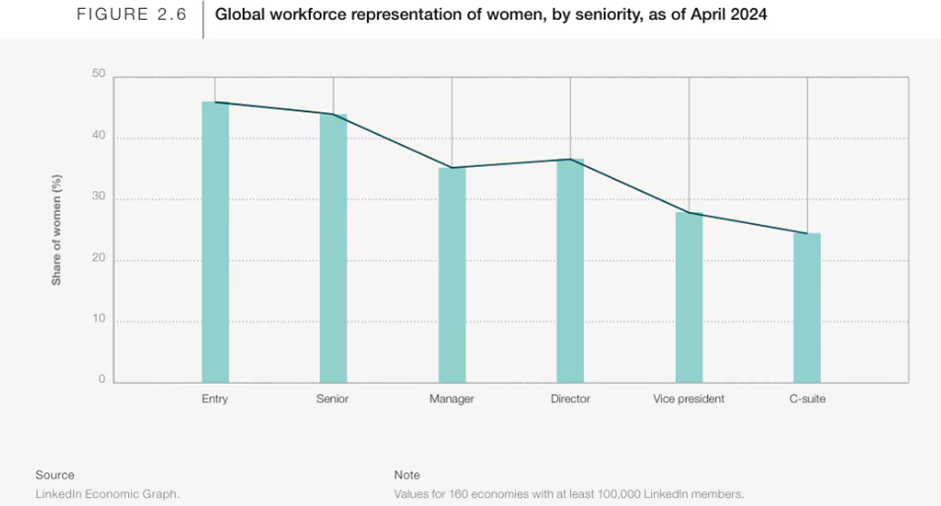
Despite making up 42% of the global workforce, women remain significantly underrepresented in the upper echelons of corporate power. While the current 31.7% share of senior leadership roles represents a notable climb from the 24% mark recorded a decade ago, this progress masks a structural failure known as the “drop to the top”.
The disparity is most visible in the transition from entry-level positions, where women occupy nearly half of all roles, to the C-suite, where their presence plummets to less than a quarter. Even more concerning is that overall workforce participation for women has recently regressed to 2018 levels. This is a definitive wake-up call for HR leaders: if the “leaky pipeline” isn’t plugged with intentional, data-driven intervention, the incremental gains of the last ten years could be erased within the next two.
Industry disparities: leaders vs. laggards
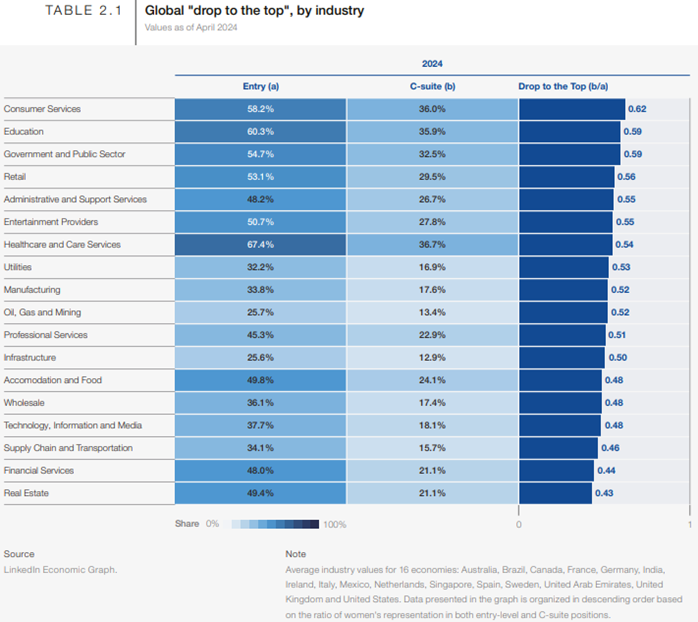
The gender gap is not uniform, but a deeper analysis reveals a stark split between industries that have cultivated female talent and those that remain male-dominated strongholds. This divide is not just a demographic statistic; it represents a significant missed economic opportunity for the sectors falling behind.
- The Leaders: Sectors such as Healthcare (62.1%), Education (54.4%), and Consumer Services (53.1%) boast female workforce participation above 50%. While these industries have historically offered more pathways for women, they still face the “drop to the top” challenge, where high participation at the entry level does not guarantee parity in the C-suite.
- The Laggards: In contrast, Infrastructure (22.4%), Oil & Gas (24.1%), and Supply Chain (31.6%) sectors report alarmingly low female participation.
The strategic implication: For these capital-intensive industries, the lack of female leadership is a critical vulnerability. By failing to attract and retain women, these sectors are effectively locking themselves out of the 35% higher ROI and 25% profitability premium associated with diverse leadership teams. For industries like Supply Chain and Manufacturing, where margins are often tight, failing to retain female talent in leadership roles isn’t just a culture problem, it directly impacts the bottom line.
Regional analysis: a multi-speed global landscape
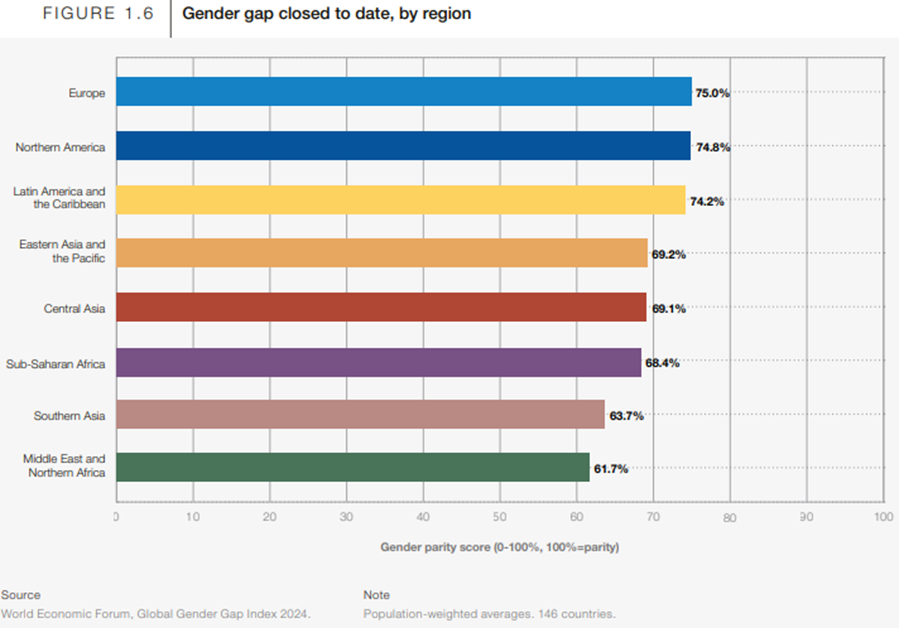
Achieving gender parity is no longer just a social metric; it is a global economic benchmark. While no region has achieved full parity (100%), the data reveals a fragmented picture where different markets are progressing at vastly different speeds.
- Global leaders: Europe (75%) and North America (74.8%) continue to set the standard. North America’s high score is largely powered by exceptional educational attainment, yet the region still faces significant friction in closing the gaps for economic participation and income equality.
- Rapid improvers: Latin America and the Caribbean (74.2%) have emerged as the standout success story, demonstrating the most rapid improvement of any region since 2006. This surge is driven primarily by dramatic gains in closing the political empowerment gap.
- The Pacific Paradox: Eastern Asia and the Pacific (69.2%) present a unique strategic disconnect. While the region shows strong economic participation, it suffers from a significant lack of political empowerment for women, resulting in a moderate score of 69.2%.
- Trailing markets: The Middle East and North Africa (61.7%) and Southern Asia (63.7%) lag behind the global average. These regions struggle specifically with female labor-force participation, representing a massive untapped resource for their respective economies.
Obstacles: systemic barriers and “Pinkwashing”
These statistical disparities are not accidental; they are the result of systemic friction. Unconscious bias remains a major hurdle, with stakeholders often doubting women’s risk-taking abilities or undervaluing their skills during investment pitches.
Even when women break through, they often face the “Glass Cliff.” This phenomenon occurs when women are appointed to leadership roles during periods of organizational crisis, effectively setting them up for failure where their male predecessors struggled.
Furthermore, progress is often hindered by “Pinkwashing”, a practice where organizations superficially promote gender diversity or LGBTQ+ inclusion without enacting real structural change. Companies may hire women to improve diversity statistics but deny them the authority, informal networks, or decision-making power required to succeed. This creates an “authority gap,” where female leaders are respected less than their male counterparts, despite research showing female-led tech teams generate a 35% higher return on investment.
The legal battleground
The tension between diversity initiatives and legal realities has come to a head in recent years.
- California’s Board Diversity Mandate (2022): California attempted to force progress with a law requiring publicly held corporations to include women on their boards. However, in May 2022, a judge struck down the law, ruling it violated the Equal Protection Clause. This highlighted the fragility of legislative solutions to cultural problems.
- Elon Musk & Twitter (2022): Following Elon Musk’s acquisition of Twitter in late 2022, mass layoffs ensued. A subsequent lawsuit alleged that these layoffs disproportionately targeted female employees, indicating that without safeguards, corporate restructuring can rapidly undo years of diversity progress.
GenAI: the opportunity and the risk
The strategic advantage: GenAI offers immense advancement opportunities, but it requires active engagement. For women who embrace the technology, the benefits are measurable:
- Career acceleration: 89% of women in tech agree that AI skills have directly accelerated their careers. By automating repetitive tasks, GenAI allows women to shift focus from support functions to high-value strategic work.
- The soft skills advantage: As AI reshapes the workplace, the demand for “soft skills” like empathy and collaboration is skyrocketing. Women currently possess a 28% higher share of these critical interpersonal skills compared to men. By combining this innate strength with technical AI fluency, women are uniquely positioned to lead.
- Ethical leadership: Women’s leadership is essential for the ethical development of AI. Diverse leadership teams deliver 30% better outcomes in innovation and ethical decision-making. As AI models become central to business, women leaders are the necessary safeguard against baked-in bias, ensuring the creation of “Fair AI” systems.
Why this matters: the pipeline risk
Despite the clear advantages, a reluctance among junior talent threatens to undo progress. This hesitation is driven by lower confidence and a lower tolerance for risk compared to their senior counterparts; while senior women feel secure enough to experiment, junior women often fear making mistakes with new tools.
If the junior gap is not addressed, we risk a future pipeline problem. As AI skills become a prerequisite for management, today’s junior women will be unqualified for tomorrow’s leadership roles.
The business case: why equality wins
Moving toward gender parity is not just a moral goal; it is a financial accelerator. The data is consistent and compelling:
- Higher profitability: Companies in the top quartile for gender diversity on executive teams are 25% more likely to achieve above-average profitability.
- Revenue growth: A recent study indicated that businesses founded by women generated twice as much revenue as those founded by men.
- Better governance: Boardrooms with 30-39% female representation are 18.5% more likely to achieve better corporate results.
- Sustainability: Women’s leadership is positively linked to improved corporate sustainability, reduced greenhouse gas emissions, and fewer incidences of fraud and insider trading.
| Metric | Indicator | Impact |
|---|---|---|
| Tech ROI | Female-led tech teams vs. all-male teams | +35% higher ROI |
| Profitability | Top-quartile diverse executive teams | +25% likelihood of outperformance |
| Governance | Boards with 30-39% female representation | +18.5% better corporate results |
| Revenue | Women-founded startups per dollar invested | 2x revenue generated |
Conclusion: empowering women for a better future
The future of leadership depends on how organizations act today. However, achieving gender parity should not be viewed as an operational cost or a compliance checkbox; it is a strategic investment in future profitability and resilience. We cannot simply wait for the numbers to improve; we must engineer the change to unlock the full economic potential of the workforce.
To close the gap and harness this potential, organizations must:
- Implement bias training & inclusive policies: Move beyond “pinkwashing” by enforcing policies that support flexible work and parental leave, while actively training against unconscious bias in hiring and promotion.
- Ensure responsible AI adoption: Leadership must advocate for ethical AI policies. This includes designing systems that minimize bias in performance evaluations and ensuring women are active participants in AI strategy.
- Target the “Junior Gap” in AI: To counter the “perfectionist trap,” organizations should implement AI Psychological Safety programs. These initiatives create safe environments where junior women are encouraged to experiment with GenAI, take risks, and fail fast without fear of judgment, effectively closing the confidence gap.
By integrating these strategies, organizations can create an environment where women leaders do not just survive the “glass cliff,” but thrive driving innovation, ethical governance, and financial success for the future.
Sources
- World Economic Forum: This is the state of work for women in 2024
- World Economic Forum: Global Gender Gap Report 2024
- Boston Consulting Group (BCG): Women Leaders in Tech Are Paving the Way in GenAI
- UN Global Compact: Gender Equality
- Vogue: What Is the Glass Cliff?
- Law & Crime: Elon Musk’s Mass Termination of Employees Violated Anti-Discrimination Law
- Wilson Sonsini (WSGR): Court Rules Against California’s Mandated Board Diversity
- Forbes: Pinkwashing, Greenwashing, and Mom-Washing Explained
- ILO: Empowering Women at Work – Company Policies
- BCG: Why Women-Owned Startups Are a Better Bet
- McKinsey & Company: Diversity Wins – How Inclusion Matters
- IMD: Women Must Play a Leading Role in the Era of Fair AI for All
- World Economic Forum: How an AI-Driven Future Can Include More Women in Leadership
- Spiceworks: AI’s Role in Advancing Gender Equality
- MIT Technology Review – Infosys: Creating Psychological Safety in the AI Era
- Forbes: Number of Women in Senior Management Stagnant at 24%
