

Data Analytics Consulting: What It Is, When to Hire, and How to Choose the Right Partner

Table of Contents
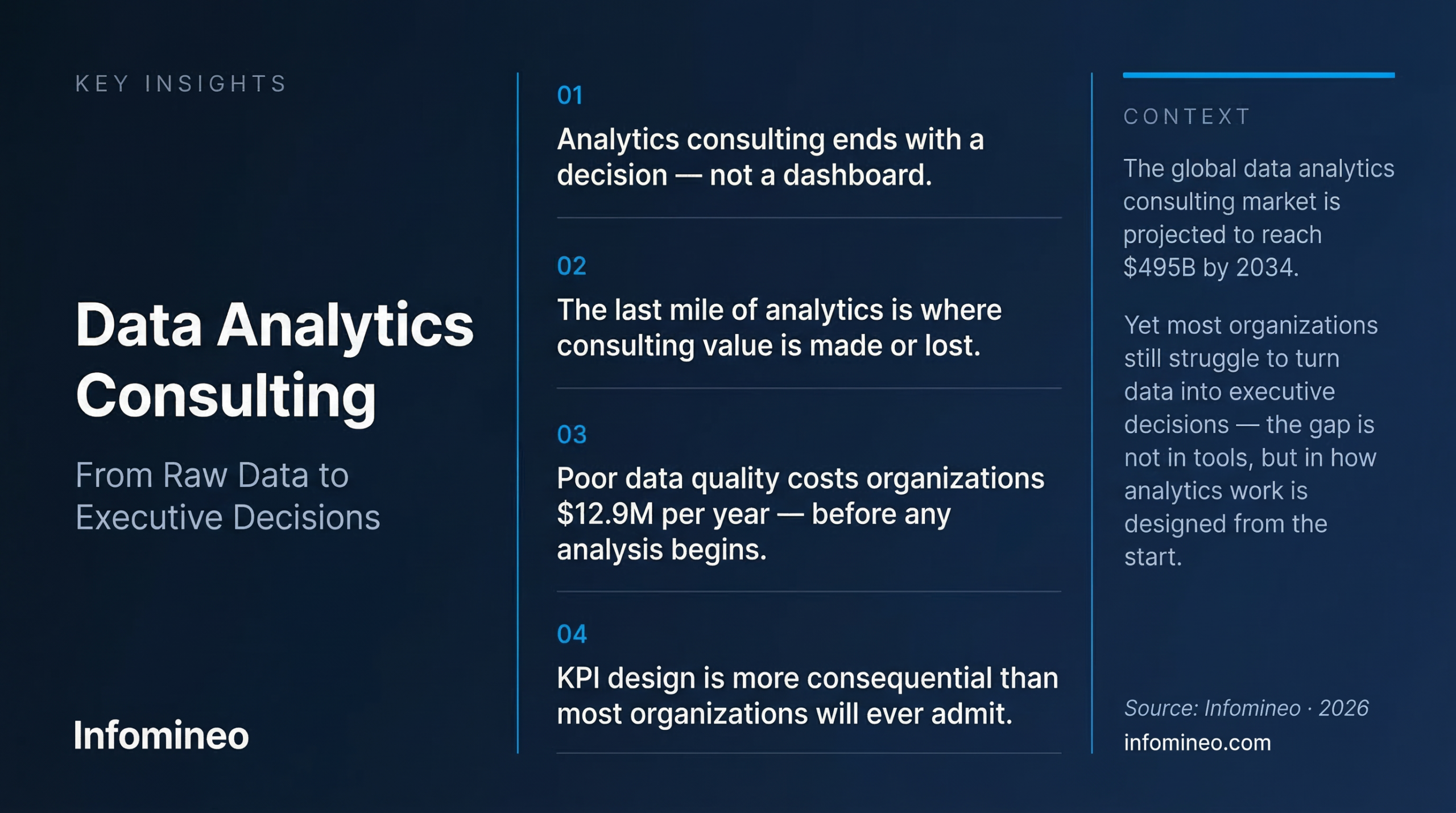
The global data analytics market will reach $495.87 billion by 2034, up from $82.23 billion in 2025 — a 500% expansion in under a decade (Fortune Business Insights, 2024). Yet most organizations don’t struggle to collect data. They struggle to turn it into decisions. Data analytics consulting exists to close that gap: not by producing more reports, but by building the infrastructure, methods, and interpretation layers that make data usable at the executive level. This guide explains what that engagement actually looks like, when it makes sense to hire external help, and how to tell the difference between a genuine analytics partner and a vendor selling dashboards dressed as strategy.
What Is Data Analytics Consulting — and What Does It Exclude?
Data analytics consulting is the practice of helping organizations design, implement, and operationalize the systems, processes, and analytical methods needed to convert raw data into decisions. It is not the same as BI software implementation, data engineering, or periodic report production — though any of those may be components of a larger engagement. The data analytics consulting services market was valued at $26.37 billion in 2025 and is projected to reach $45 billion by 2035, growing at a 5.49% CAGR (MarketsandMarkets, 2025).
This distinction matters because buyers routinely conflate three different categories of service:
- Data engineering firms — build pipelines, ETL processes, and data infrastructure. They handle the plumbing. They don’t interpret what flows through it.
- BI vendors and platform consultants — implement Tableau, Power BI, Looker, or similar tools. Their deliverable is a functional dashboard. What that dashboard is used for, and by whom, is outside their scope.
- Data analytics consultants — work across the full chain: from data architecture to analytical method selection, KPI definition, insight generation, and stakeholder communication. The deliverable is a decision-ready output, not a tool.
A true data analytics consulting engagement begins with a question — “Why is market share declining in the Gulf?” or “Where is our supply chain most exposed to demand volatility?” — and ends when the answer is in the hands of someone with the authority to act on it. Anything that stops short of that is a partial service.
Explore Infomineo’s data analytics and BI advisory services →
What Are the Four Stages of a Data Analytics Engagement?
A well-structured data analytics engagement moves through four sequential stages: data maturity assessment, architecture and governance design, analytical model development, and insight delivery. Skipping stages is the single most common reason engagements fail to produce executive-level output. Organizations that complete all four stages report an average 295% ROI on advanced data integration over three years (Nucleus Research, 2023).
Stage 1: Data Maturity Assessment
Before any analysis begins, a competent consultant maps where the organization sits on the data maturity spectrum — from ad hoc reporting to predictive and prescriptive analytics. This assessment identifies data quality issues, governance gaps, and the realistic ceiling of what analytical work can produce given current infrastructure.
Organizations at early maturity stages often discover that the foundational problem isn’t analytical sophistication — their data is fragmented across incompatible systems, inconsistently defined, or collected at insufficient granularity. No amount of advanced modeling fixes a broken data foundation. According to Gartner (2024), poor data quality costs organizations an average of $12.9 million per year.
Stage 2: Architecture and Governance Design
With maturity mapped, the engagement moves to designing the right data environment. This includes data warehousing decisions (cloud vs. on-premise, centralized vs. federated), data governance policies (ownership, access, quality standards), and the KPI framework governing what gets measured and why.
KPI design is more consequential than most organizations acknowledge. Poorly designed KPIs produce correct answers to the wrong questions — a failure mode that is difficult to detect until strategic decisions begin going wrong. A 2023 Deloitte survey found that 67% of executives who later reversed major decisions cited “measuring the wrong things” as a contributing factor.
Stage 3: Analytical Model Development
This stage is where the analytical work happens: descriptive analysis of historical patterns, diagnostic work to establish causation, predictive models for forward-looking scenarios, and — in more advanced engagements — prescriptive analytics that recommend specific actions. The right tier depends on the maturity assessment from Stage 1 and the specific decision being supported.
BI solution implementations deliver 127% ROI over three years on average (Nucleus Research, 2023) — but these returns are achievable only when the analytical tier is matched to organizational readiness.
Stage 4: Insight Delivery and Decision Enablement
The final stage is where most engagements either succeed or quietly fail. Insight delivery is not report distribution. It requires translating analytical output into the language and format that executives use to make decisions — typically reducing 40 slides to 3 key findings, with explicit recommendation and risk framing.
“The last mile of analytics — getting findings into the room where decisions are made, in a form decision-makers can act on — is where most consulting value is either created or destroyed.”
When Should You Hire a Data Analytics Consultant — and When Shouldn’t You?
External data analytics consultants deliver the greatest value when the analytical challenge is time-bound, requires expertise the internal team doesn’t possess, or demands an independent perspective on a contested strategic question. They deliver poor value when the real problem is a missing data engineer, an unconfigured BI tool, or an understaffed internal team. Knowing the difference saves significant budget — and building a genuine data-driven decision-making culture is a long-term capability, not a one-time engagement. 91% of leading businesses now invest in ongoing analytics initiatives (Forbes Insights, 2024), so the question isn’t whether to invest, but in what form.
Hire externally when:
- A specific strategic question has a defined deadline — market entry analysis, competitive benchmarking, demand forecasting for a new product line
- The internal team has the data but lacks the methodological depth to extract what the question requires (e.g., moving from descriptive to predictive analytics)
- Independent validation of conclusions is needed — particularly when internal teams have a stake in a particular outcome
- Speed is the constraint: building internal capability will take longer than the decision timeline allows
- The question spans multiple geographies or data environments where no single internal team has full visibility
Don’t hire externally when:
- The problem is a data engineering or platform implementation problem — hire a specialist for that work instead
- Executive buy-in for data-driven decision-making doesn’t yet exist — analytical output will go unread
- Ongoing reporting at scale is the need — a permanent internal analytics function is more cost-effective than a retainer for routine work
How Do You Evaluate a Data Analytics Consulting Partner? 5 Questions That Separate Expertise from Vendor Theater
Evaluating a data analytics consulting partner means looking past credentials and case study polish to assess whether they will influence decisions — not just produce deliverables. Five questions reliably separate genuine analytical expertise from well-packaged vendor positioning. Firms that cannot answer all five specifically are not ready for executive-level analytical work.
1. What’s the last time your analysis changed a client’s decision?
This question has no good generic answer. A firm with real experience will describe a specific situation: what the prevailing assumption was, what the analysis revealed, and what changed as a result. Vague references to “delivering insights that drove action” are a disqualifying red flag.
2. How do you handle data quality problems mid-engagement?
Every real analytics engagement encounters data quality issues. A credible partner has a structured response — a documented protocol for flagging, escalating, and adjusting scope when underlying data doesn’t support the original analytical plan. Firms without this discipline either hide the problem or produce unreliable output without disclosure.
3. Can you show me the KPI framework from a comparable engagement?
KPI design is a core analytical competency. A firm that cannot produce structured KPI work — or defaults to industry-standard metrics without customization — is unlikely to produce analysis that maps to a specific strategic context. KPI frameworks should be bespoke, not templated.
4. Who will actually do the work?
Bait-and-switch staffing is endemic in consulting. Senior partners sell the engagement; junior analysts or offshore teams execute it without adequate supervision. Ask specifically who leads day-to-day analytical work, what their background is, and how senior oversight is structured throughout delivery.
5. What does a “finished” engagement look like to you?
The answer reveals whether the firm’s mental model ends at report delivery or at decision enablement. Firms oriented toward outcomes describe stakeholder presentations, executive briefings, and explicit recommendation framing as standard scope — not optional additions that cost extra.
Engagement Model Comparison
How Does Data Analytics Consulting Work for Complex, Multi-Geography Businesses?
Multi-geography analytics engagements present challenges that single-market work does not: heterogeneous data environments, regulatory variation across jurisdictions, inconsistent collection standards, and analytical frameworks that don’t translate across markets. Organizations operating across MENA, Europe, and North America simultaneously face all of these at once — and the compliance dimension alone can invalidate analytical architectures designed without local knowledge.
GCC and broader MENA markets add specific complexity. Data governance regulation is evolving rapidly across Gulf Cooperation Council states: Saudi Arabia’s Personal Data Protection Law (PDPL), the UAE’s DIFC Data Protection Law, and Qatar’s PDPL create a patchwork of compliance requirements affecting what data can be collected, stored, and analyzed across borders. Analytics consultants without direct exposure to these markets consistently underestimate this dimension and design frameworks that work technically but create legal exposure. The UAE’s PDPL, for instance, imposes data localization requirements that directly affect cloud data warehousing architecture decisions.
There are also structural data gaps in emerging markets absent from mature ones. Panel data, longitudinal consumer datasets, and the third-party data ecosystems that Western analytical models rely on are often thin or nonexistent. Consultants experienced in these environments build analytical approaches that function with incomplete data — triangulating from primary research, proxy indicators, and regional benchmarks rather than defaulting to methods that require infrastructure that doesn’t exist locally.
Infomineo operates across Morocco, Egypt, France, and the UAE — which means its analytical teams carry direct working knowledge of both the regulatory environment and the data landscape in markets where most global analytics firms are operating from a distance. For Fortune 500 strategy teams and GCC government agencies running analytics initiatives across these geographies, that ground-level familiarity affects output quality in ways that credentials alone don’t capture.
See how we approach data analytics engagements →
What Does a High-Quality Data Analytics Engagement Actually Deliver?
A high-quality data analytics engagement delivers three things: a decision, the evidence supporting it, and the analytical infrastructure to repeat the process. Anything that produces reports without connecting them to a specific decision and the executive responsible for making it is a partial engagement, regardless of technical quality. Research by McKinsey (2024) found that organizations with mature data-to-decision pipelines are 23 times more likely to acquire customers and 19 times more likely to be profitable than competitors without them.
The output quality gap between strong and mediocre analytics engagements is not primarily about technical sophistication. It’s about whether the analytical work was designed around a decision from the start. This distinction is visible in the deliverable itself:
- Mediocre output: a comprehensive dashboard with 40+ metrics, no prioritization, no recommendation, no explicit connection to the strategic question that initiated the engagement
- High-quality output: 3–5 findings directly mapped to the original question, quantified confidence levels, an explicit recommendation with decision criteria, and a clear statement of what the analysis cannot determine and why
High-quality engagements also produce reusable infrastructure: a KPI framework the internal team can maintain, a data governance protocol that prevents the quality problems discovered mid-engagement from recurring, and documented analytical methodology that enables internal teams to apply the same approach to future questions independently.
The measure of a successful engagement is not whether the consultant delivered. It is whether the organization made a better decision than it would have made without the work.
Frequently Asked Questions
What is data analytics consulting?
Data analytics consulting is an advisory and implementation service that helps organizations design analytical systems, define KPIs, build data governance frameworks, and translate raw data into executive decisions. It spans the full chain from data infrastructure to insight delivery — and is distinct from BI tool implementation or data engineering. The market was valued at $26.37 billion in 2025 (MarketsandMarkets, 2025).
How much does data analytics consulting cost?
Hourly rates range from $120 to $1,000 per hour, with most US-based engagements falling between $150 and $350 per hour. Project-based engagements typically run $5,000 to $100,000 for scoped work. Retainer models for ongoing analytical support range from $10,000 to $50,000 per month. Enterprise annual contracts can reach $100,000 or more depending on scope and team seniority.
What’s the difference between a data analytics consultant and a business intelligence consultant?
Business intelligence consulting focuses on reporting infrastructure — dashboards, data warehouses, and visualization tools that surface historical performance. Data analytics consulting goes further: it encompasses predictive and prescriptive analytics, KPI strategy, and analytical method design. BI is a component of analytics consulting, not a synonym for it. The key distinction is whether the deliverable is a tool or a decision.
When does it make sense to hire a data analytics consultant vs. building an internal team?
External consultants deliver the most value when a specific strategic question has a defined timeline, when the internal team lacks a particular analytical capability, or when independent analysis of a contested question is required. Internal teams make more sense for ongoing reporting at scale, routine analytical work, and long-term capability development where knowledge retention is the priority.
What should a data analytics consulting engagement produce?
At minimum: a specific answer to the initiating question, with supporting evidence, confidence levels, and an explicit recommendation. A high-quality engagement also delivers reusable infrastructure — a maintained KPI framework, documented data governance protocols, and analytical methodology the internal team can apply independently to future questions without re-engaging the consultant.
How long does a data analytics consulting engagement typically take?
Scoped project engagements typically run 6 to 16 weeks from kickoff to final deliverable. The data maturity assessment and architecture design phases account for roughly 40% of total engagement time. Engagements that skip these foundational stages in favor of faster model development routinely take longer overall due to mid-engagement scope revisions caused by data quality issues discovered late.
BUSINESS INTELLIGENCE & DATA ANALYTICS
From Raw Data to Executive Decisions — Without the Big 4 Price Tag.
Infomineo’s data analytics consultants bridge the gap between raw data and executive decisions — from BI architecture to insight delivery. 100+ analysts. Trusted by Fortune 500s and top-tier consultancies.
Book A Discovery Call