

Governing AI in Consulting: Controlling Risk Across Data, Decisions, and Delivery

Table of Contents
Key Takeaways
- AI adoption is accelerating faster than governance and oversight mechanisms can adapt.
- Consulting workflows are becoming more decentralized, reducing traditional validation and accountability layers.
- Governance risks increasingly extend into core delivery through data leakage, regulatory exposure, cybersecurity vulnerabilities, contractual liability, and intellectual property concerns.
- AI-generated outputs can appear highly credible even when they contain unsupported or inaccurate information.
- Firms that scale AI successfully will be those that combine AI-enabled efficiency with structured verification and oversight mechanisms.
Governance and compliance gaps are increasingly emerging as one of the biggest obstacles to successful AI adoption. According to Grant Thornton’s 2026 AI Impact Survey of 950 business leaders across
10 industries and private equity, nearly half of business executives identify governance and compliance failures as a leading cause of AI underperformance. Yet, only a small minority of 11% consider risk and compliance a top organizational priority in achieving their AI ambitions.
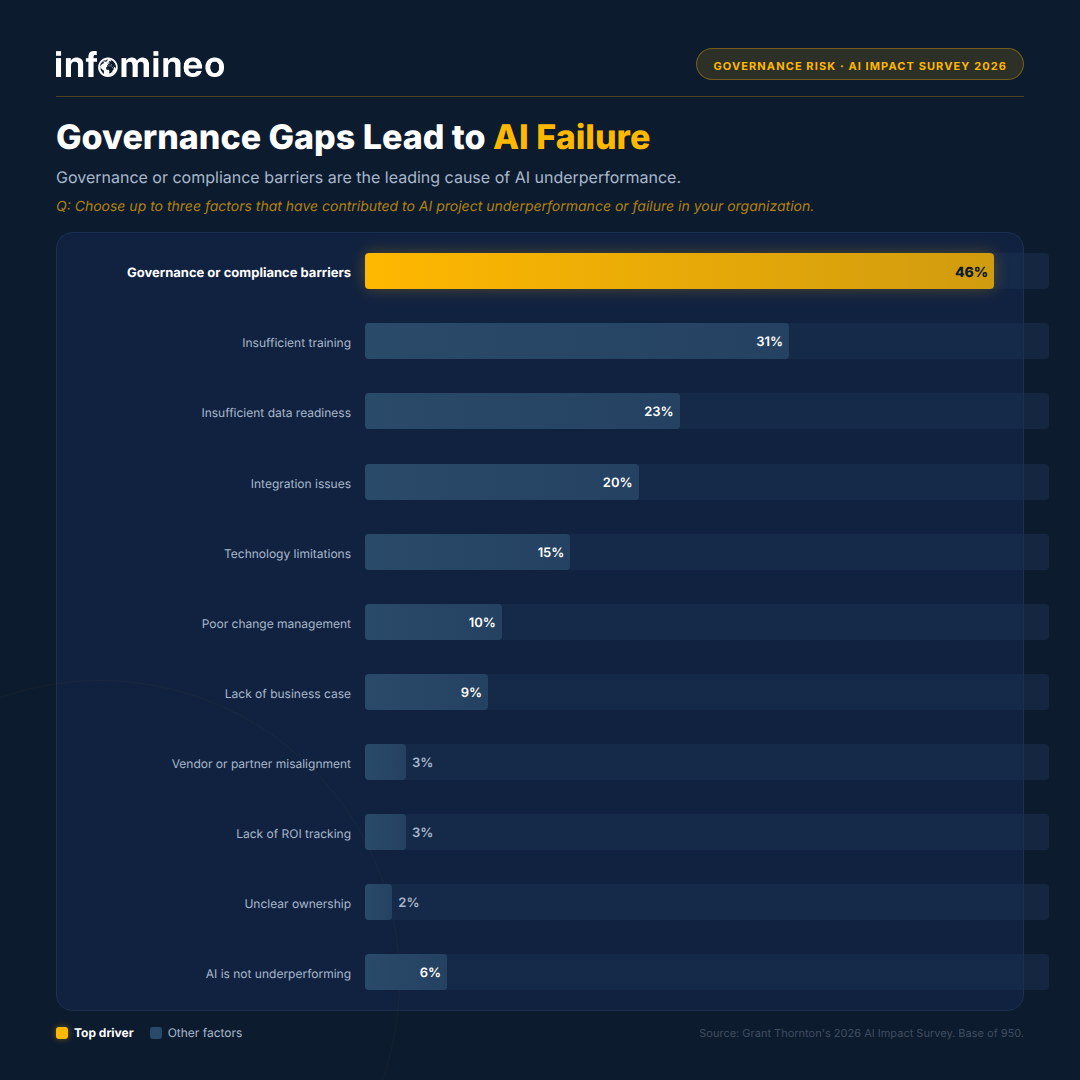
That disconnect matters particularly in consulting, where AI is increasingly embedded across delivery workflows that directly influence client decisions. As firms accelerate AI adoption, the challenge is no longer whether these tools can improve efficiency. It is whether organizations can scale AI-enabled workflows while maintaining the levels of quality, accountability, confidentiality, and defensibility that consulting work requires.
AI Is Scaling Faster Than the Controls Built to Govern It
AI is rapidly accelerating how consulting work is produced. Research that previously required hours or days of manual collection can now be synthesized in minutes, while tasks such as drafting RFP responses and client emails increasingly begin with AI-generated drafts that consultants refine and build upon. The productivity gains are real, but the pace of adoption has moved significantly faster than the governance structures surrounding it.
Traditional consulting workflows were designed around deliberate friction. Research, analysis, review, and delivery occurred across multiple stages, with each layer creating opportunities to validate assumptions, challenge inconsistencies, and strengthen the final output. AI compresses many of these stages into a single execution cycle.
A consultant can now move from raw input to client-ready synthesis with far fewer checkpoints between generation and delivery. This changes the nature of operational risk. Weak sourcing, unsupported assumptions, insecure data handling, or flawed reasoning are no longer isolated upstream issues. They can move rapidly through the workflow and become embedded directly into client-facing outputs.
The operational pressure created by AI-driven productivity expectations is also reshaping how consulting teams work, review outputs, and allocate oversight capacity. For a deeper look at how AI efficiency gains can introduce hidden organizational vulnerabilities, check out our article on AI productivity pressure in consulting and its impact on delivery quality and governance.
How Decentralized Consulting Workflows Multiply Governance Risk
Historically, consulting delivery depended on relatively centralized execution models. Work moved through shared team structures, standardized processes, and hierarchical review systems that distributed accountability across multiple people. AI-assisted workflows are gradually shifting that model toward more autonomous execution.
Individual consultants increasingly operate across multiple AI tools, external platforms, and fragmented data environments simultaneously, often with far greater independence than traditional governance structures were designed to oversee. This decentralization creates new governance blind spots. External tools, disconnected workflows, and unsanctioned platforms expand the number of places where confidentiality, compliance, cybersecurity, and quality risks can emerge.
The challenge is not simply that more tools are being used, it is that consulting firms are losing some of the natural oversight mechanisms that previously came from collaboration itself. Tasks that once required coordination between researchers, managers, and reviewers can now be completed by a single individual operating within an AI-assisted workflow.
As accountability becomes more distributed and workflows become more individualized, risk becomes harder to isolate and easier to scale across the delivery lifecycle.
For a deeper look at how AI-generated errors propagate through consulting workflows, see Infomineo’s article on AI hallucinations in consulting and why verification layers are becoming increasingly important in AI-assisted delivery environments.
Where Governance Breaks Down: Five Critical Failure Points
As adoption scales, governance risk is no longer confined to IT or compliance functions. It is becoming embedded directly into how consulting work is produced, validated, and delivered. It develops gradually across disconnected workflows, unclear accountability structures, fragmented oversight, and growing reliance on AI-generated outputs that appear reliable on the surface.
1. Client Data Leakage from Uncontrolled AI Usage
One of the fastest-growing governance concerns in consulting is the informal use of external AI tools within client workflows. Consultants increasingly rely on public or unsanctioned platforms to summarize information, accelerate research, or structure analysis outside approved governance environments.
This creates “shadow AI” environments where organizations lose visibility into how sensitive client data is stored, reused, or incorporated into external systems. The issue is difficult to contain because the behavior is often driven by convenience and productivity rather than malicious intent. According to research from the Thomson Reuters Foundation across 2,972 companies and 11 sectors globally, only one in five companies with AI strategies have established formal policies governing data sharing with third-party AI providers.
In consulting environments, where confidentiality obligations are central to client relationships, weak oversight at this stage can create downstream exposure across compliance, legal liability, and client trust. Organizations therefore need governance models that combine oversight with practical alternatives employees can realistically adopt.
Expert Tips:
- Define and enforce an approved list of AI tools and prohibit external usage for sensitive data
- Implement data classification frameworks that clarify what information can be used in AI systems
- Provide secure internal AI alternatives to reduce reliance on public platforms
- Train employees on real-world data leakage scenarios rather than relying solely on compliance policies
2. Regulatory Complexity Across Jurisdictions
Consulting firms operating globally are navigating an increasingly fragmented AI regulatory environment. Requirements related to transparency, explainability, data handling, accountability, and cross-border transfers vary significantly across jurisdictions and continue evolving rapidly.
The challenge is operational as much as legal. AI-enabled consulting workflows may simultaneously interact with multiple regulatory environments, particularly in sectors such as healthcare, financial services, infrastructure, or public sector advisory where scrutiny is significantly higher.
At the same time, governance expectations are expanding globally through initiatives such as the EU AI Act, the OECD AI Principles, UNESCO’s Ethics of AI Recommendation, and the G7 Hiroshima AI Process. Together, these frameworks signal increasing attention not only to how AI outputs are used, but also to how they are produced, governed, and validated internally.
As a result, compliance can no longer function as a final-stage legal review layered onto otherwise uncontrolled workflows. Governance increasingly needs to be embedded directly into AI-enabled delivery processes.
Expert Tips:
- Establish centralized AI governance frameworks aligned with multi-jurisdictional requirements
- Maintain continuous monitoring of evolving AI and data regulations across key markets
- Embed compliance checkpoints directly into AI-assisted workflows rather than treating them as final validation steps
- Involve legal and compliance teams early in AI deployment and governance decisions
3. Contractual Liability and Unclear Accountability
AI is also introducing growing ambiguity around accountability in consulting engagements. While AI systems may contribute to research, analysis, or other processes, responsibility toward the client generally remains with the consulting firm.
Many contracts and governance policies were developed before AI-assisted delivery became widespread. As a result, they often lack explicit guidance regarding AI-generated errors, data breaches, ownership disputes, or liability boundaries between firms and third-party providers.
The challenge is amplified by the fact that AI-generated outputs can appear highly credible even when they contain unsupported assumptions, fabricated references, or inaccurate reasoning. In advisory environments where clients rely on the reliability and defensibility of analysis, these issues quickly become legal and reputational risks rather than just operational failures.
Organizations are therefore beginning to rethink how accountability is reflected contractually, operationally, and within governance frameworks.
Expert Tips:
- Clearly define liability, accountability, and data ownership within contracts
- Include clauses addressing AI-related risks such as factual errors, breaches, and misuse
- Establish escalation procedures for AI-related incidents affecting client deliverables
- Align internal AI governance policies with organizational risk tolerance and third-party tool usage
4. Intellectual Property Ownership and Infringement Risks
Generative AI systems can reproduce language patterns, concepts, or structures derived from training data without visibility into their origins. This creates dual exposure for consulting firms. Organizations may unintentionally incorporate copyrighted or proprietary material into client deliverables while simultaneously lacking clear ownership over AI-generated outputs themselves. In many jurisdictions, copyright protections still depend on meaningful human authorship.
For consulting firms, this creates practical commercial concerns around ownership rights, reuse permissions, and the defensibility of client-facing deliverables. The issue is particularly difficult because AI-generated content often appears original on the surface, making potential intellectual property conflicts harder to detect without deliberate review mechanisms.
As AI adoption scales, intellectual property governance is becoming less of a theoretical legal discussion and more of an operational requirement embedded directly into delivery workflows.
Expert Tips:
- Introduce review mechanisms to identify potential copyright risks in AI-generated outputs
- Ensure meaningful human involvement in synthesis and framing to strengthen authorship claims
- Establish internal policies governing ownership, reuse rights, and disclosure obligations
- Train teams on the intellectual property risks associated with generative AI workflows
5. Cybersecurity Vulnerabilities Introduced by AI Systems
AI systems are expanding the cybersecurity landscape in ways that traditional security models were not designed to address. Threats such as prompt injection, data poisoning, adversarial attacks, and model manipulation introduce new forms of operational risk across AI-enabled workflows.
At the same time, AI-assisted cyberattacks — including deepfakes, synthetic impersonation, and AI-generated phishing campaigns — are weakening traditional assumptions around authentication and trust. The attack surface now extends beyond infrastructure itself to include prompts, training data, interaction layers, models, and generated outputs.
Unlike traditional system failures, AI-related attacks can subtly manipulate outputs while leaving systems operational. Prompt injection, compromised data pipelines, or manipulated models may influence AI-generated analysis without triggering conventional security alerts, making detection and attribution significantly more difficult.
For consulting firms, where trust, confidentiality, and credibility are central to client relationships, these vulnerabilities increasingly affect both operational resilience and the integrity of client-facing deliverables.
Expert Tips:
- Treat AI systems as critical infrastructure within cybersecurity strategies
- Secure models, data pipelines, and interaction layers through continuous monitoring and anomaly detection
- Strengthen identity verification mechanisms against deepfakes and impersonation threats
- Reduce dependency risks and single points of failure through diversified AI architectures and governance controls
Reintroducing Control: The Independent Verification Layer
The risks surrounding AI in consulting are not emerging because firms are adopting AI too quickly. They are emerging because governance, validation, and accountability mechanisms are not evolving at the same pace as the workflows themselves.
The competitive pressure to use AI is real, and the productivity gains are increasingly difficult to ignore. Firms are unlikely to slow adoption meaningfully. The more practical challenge is how to preserve quality, defensibility, and trust as consulting workflows become faster, more decentralized, and increasingly AI-assisted. This is where independent verification becomes increasingly important.
Restoring Independent Validation in AI-Compressed Workflows
As AI compresses traditional consulting workflows, organizations increasingly need mechanisms that reintroduce challenge and validation into the delivery process. The objective is not to manually recreate older workflows, but to restore the separation between generation and verification that many AI-assisted processes are gradually removing.
This includes validating sources, reassessing reasoning chains, checking data accuracy against primary research and proprietary knowledge, and identifying where AI-generated confidence may be substituting for evidence-based analysis. Human oversight remains critical, but its role shifts from manually producing every layer of work toward shaping, verifying, and strengthening AI-generated insights.
This distinction matters. Effective governance is not simply about keeping humans “in the loop.” It is about ensuring humans remain meaningfully in control of judgment, accountability, and validation.
Without independent verification mechanisms, early-stage weaknesses — whether factual, analytical, or interpretive — can become embedded throughout the delivery lifecycle with fewer opportunities for correction. The challenge is often not reviewer negligence, but the fact that many review structures were designed for workflows where the source of error looked fundamentally different. 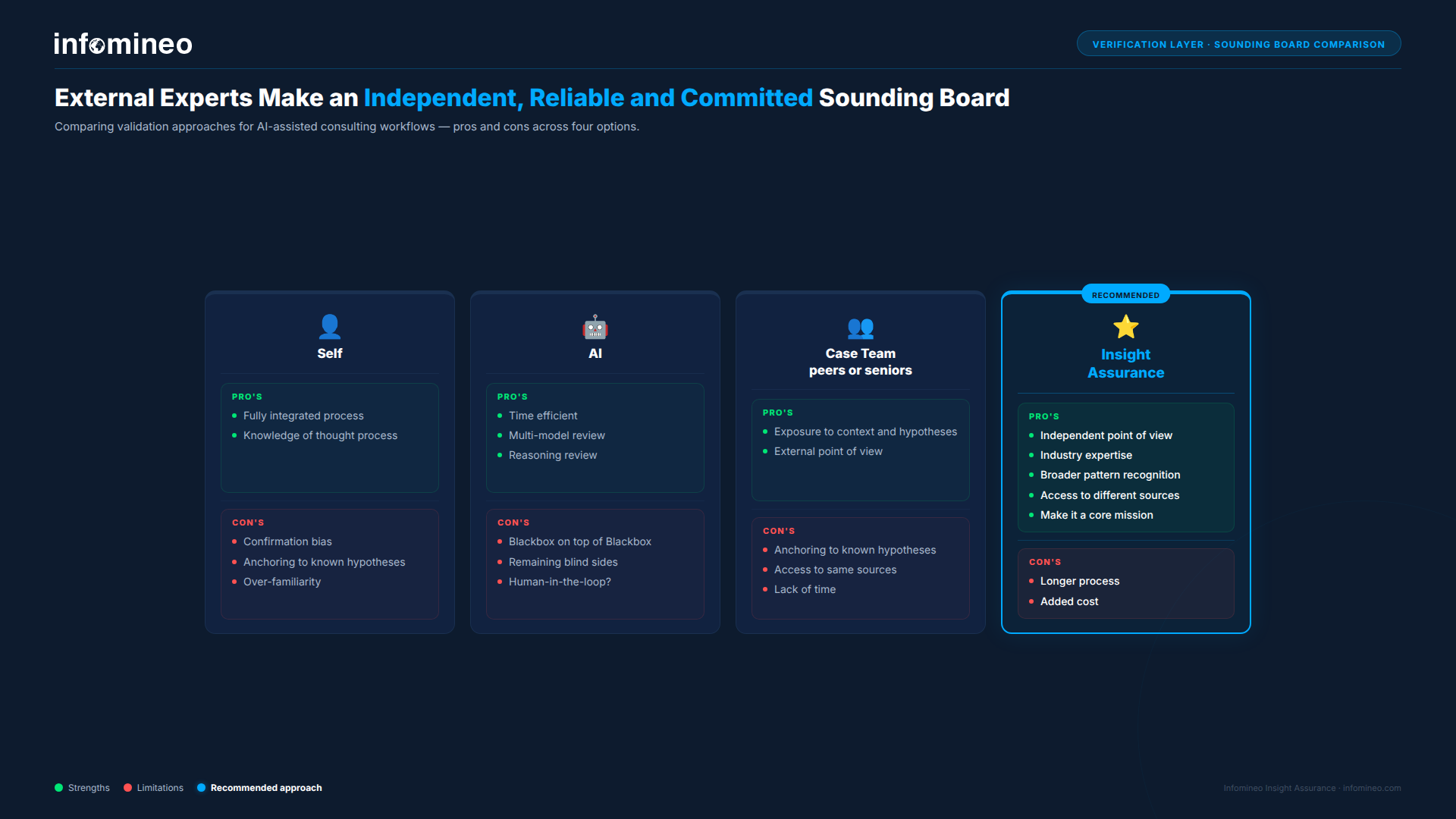 Independent validation also introduces something increasingly valuable in AI-assisted environments: structural separation. Reviewers who are detached from the original production workflow are often better positioned to identify unsupported assumptions, weak sourcing, inconsistencies, or hidden reasoning flaws that internal teams may overlook.
Enabling Scalable AI Adoption Without Increasing Risk Exposure
Structured verification layers do not constrain AI adoption. In many cases, they are what make scalable adoption possible.
Organizations that successfully scale AI are unlikely to be those that simply generate outputs faster. They are more likely to be the firms capable of combining AI-enabled efficiency with reliable oversight mechanisms that maintain quality and accountability as adoption expands.
Verification layers restore separation between generation and validation while improving traceability across sources, reasoning, and outputs. This allows organizations to scale AI usage more confidently across teams, engagements, and workflows without distributing governance risk across uncontrolled processes.
That traceability is also becoming commercially important. Clients increasingly expect greater visibility into how AI-generated analysis is governed, validated, and approved, particularly in regulated industries where transparency and defensibility are becoming competitive differentiators.
This is where structured verification models such as Infomineo’s Insight Assurance become increasingly relevant. By combining source assessment, hallucination correction, gated data enrichment, and independent re-analysis, the objective is not to slow AI-assisted workflows, but to ensure they remain reliable, defensible, and client-ready at scale.
INFOMINEO — INSIGHT ASSURANCE
Your AI workflows are producing more. Are your governance controls keeping pace?
Infomineo’s Insight Assurance services represent an independent verification layer for AI-assisted research, covering source validity, hallucination correction, proprietary data enrichment, and full re-analysis on high-stakes deliverables. Built for consulting firms that cannot afford to deliver unverified work.
Frequently Asked Questions
What is AI governance risk in consulting?
AI governance risk in consulting refers to the operational, legal, and reputational exposure that emerges when AI-enabled workflows scale faster than the oversight mechanisms designed to govern them. As AI becomes increasingly embedded across delivery processes, risks extend beyond the technology itself into how consulting work is produced, validated, and controlled. According to Grant Thornton’s 2026 AI Impact Survey, governance and compliance gaps are among the leading drivers of AI underperformance, yet they remain significantly underprioritized across many organizations.
Why are traditional consulting review processes insufficient for AI-generated work?
Traditional consulting review models were designed around workflows where research, analysis, and delivery occurred through relatively distinct stages with multiple opportunities for challenge and validation along the way. AI-assisted workflows increasingly compress these stages into a single execution cycle, reducing the separation between generation and review. As a result, reviewers are often evaluating outputs that appear highly coherent while containing unsupported assumptions, unverifiable sources, fabricated references, or hidden inaccuracies embedded earlier in the process. At the same time, consulting firms are producing significantly more analytical output without proportional increases in review capacity.
What are the most common governance failures when consulting firms use AI?
The most common governance failures in AI-assisted consulting workflows typically emerge across five areas: uncontrolled AI usage and client data leakage, fragmented regulatory compliance, contractual ambiguity around accountability, intellectual property exposure, and AI-related cybersecurity vulnerabilities. These risks are increasingly interconnected, meaning a single governance breakdown can simultaneously trigger confidentiality concerns, regulatory exposure, contractual disputes, and reputational damage. The challenge is amplified by the fact that many AI-generated outputs appear highly credible on the surface, making weaknesses in oversight, sourcing, or validation harder to identify before they reach client-facing deliverables.
How does independent verification reduce AI governance risk in consulting?
Independent verification helps restore the separation between generation and validation that many AI-assisted workflows are gradually removing. Rather than relying exclusively on the same teams that produced the analysis, independent reviewers can reassess sources, validate data accuracy, challenge reasoning chains, and identify unsupported conclusions before outputs reach the client. This becomes increasingly important in AI-assisted environments where speed, output volume, and AI-generated fluency reduce opportunities for deeper scrutiny during traditional review processes. Beyond improving reliability, structured verification also strengthens traceability and accountability across the workflow.
How can consulting firms scale AI adoption without increasing governance risk?
Consulting firms are unlikely to scale AI successfully through restrictive policies alone. Sustainable adoption increasingly depends on combining AI-enabled efficiency with governance mechanisms capable of maintaining quality, accountability, and operational control as workflows accelerate. In practice, this means establishing clear governance around approved AI tools, embedding compliance and validation checkpoints directly into delivery workflows, strengthening oversight across data usage and sourcing practices, and introducing independent verification mechanisms before client delivery. Organizations that integrate governance directly into AI-enabled workflows are generally better positioned to scale adoption confidently without distributing risk across fragmented and uncontrolled processes.
