

Competitive Intelligence Consulting: What It Delivers and When to Hire It

Table of Contents
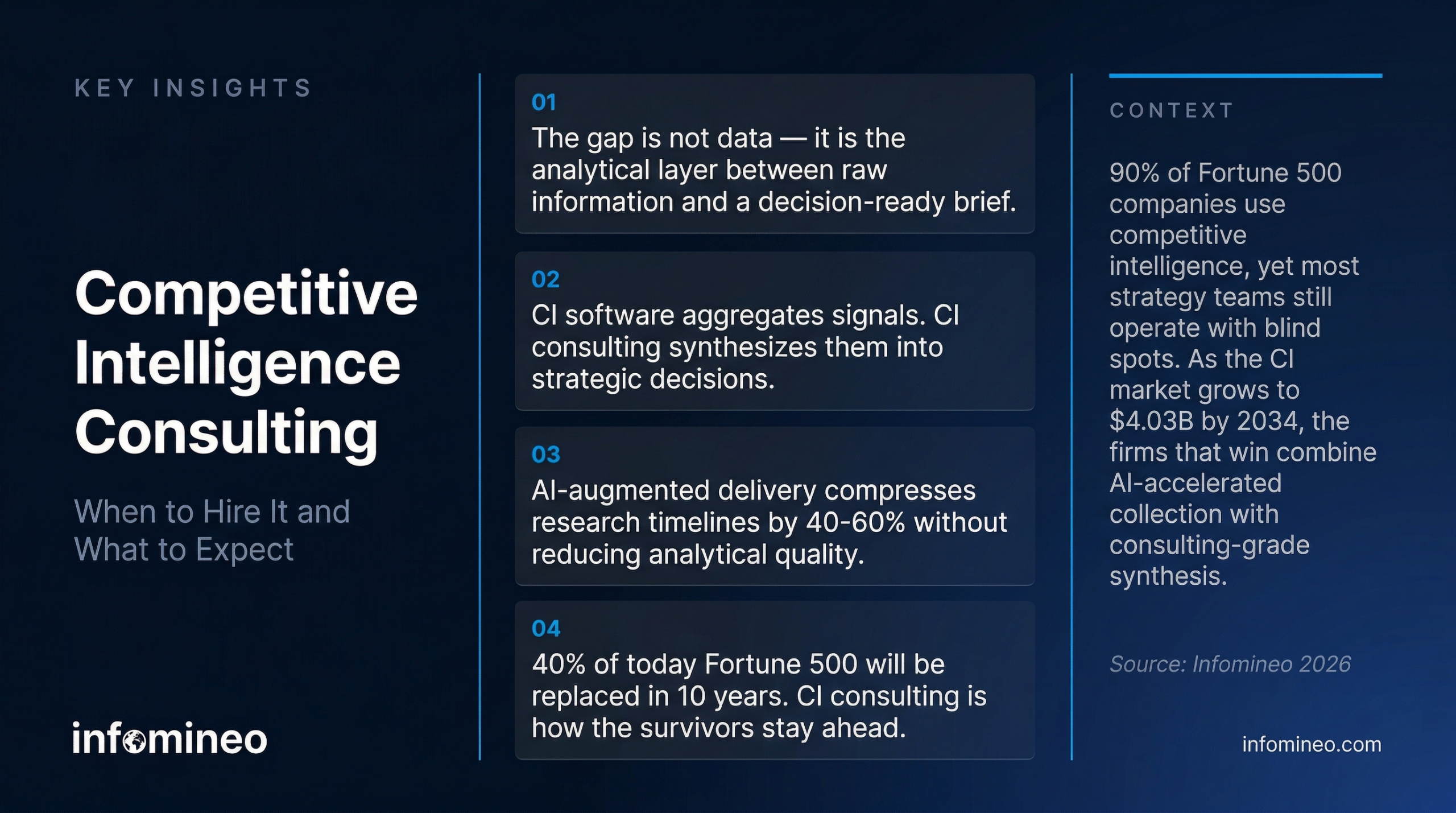
Ninety percent of Fortune 500 companies use competitive intelligence, yet most strategy teams still operate with blind spots that cost them deals, market share, and M&A decisions (Emerald.com, 2023). The gap isn’t data — it’s the analytical layer between raw information and a decision-ready brief. That’s exactly what competitive intelligence consulting firms provide: structured research, expert synthesis, and intelligence outputs calibrated to the questions actually on the table. This article covers what a CI consulting engagement delivers, how it compares to building in-house or buying software, and what separates a firm worth hiring from one that produces PDF decks nobody reads.
What Does a Competitive Intelligence Consulting Firm Actually Do — and What Does It Deliver?
A competitive intelligence consulting firm designs and executes structured research programs that turn competitor behavior, market signals, and stakeholder intelligence into decision-ready outputs. The deliverable is an analysis calibrated to a specific strategic question — whether that’s a market entry decision, a competitive positioning refresh, or a pre-acquisition due diligence sprint. According to SCIP’s State of Competitive Intelligence report, 62% of companies planned to increase their CI spend in the year ahead, reflecting how widely organizations now treat structured intelligence as a strategic necessity rather than a nice-to-have (SCIP, 2021).
The output formats vary by engagement type. Common deliverables include:
- Competitor landscape reports — positioning, pricing, go-to-market model, leadership, and product roadmap signals for a defined competitive set
- Battle cards — structured one-pagers built for sales teams, covering objection handling and differentiation by competitor
- Win/loss analysis — primary research with buyers and churned accounts to isolate why deals are won or lost
- Market entry analysis — addressable market sizing, competitive density, regulatory context, and entry scenario modeling
- CI monitoring programs — ongoing tracking of competitor signals (pricing changes, hiring patterns, product launches, executive moves) with curated digests on a defined cadence
- M&A vetting briefs — rapid competitive and market context for acquisition targets, built for deal timelines
The intelligence cycle behind all of these deliverables — planning, collection, processing, analysis, and dissemination — separates consulting-grade CI from what a tool subscription or a junior analyst produces. A CI consulting firm manages the full cycle, including primary research (expert interviews, supplier conversations, channel checks) that software cannot execute. As Jan Herring, a pioneer of corporate competitive intelligence at Motorola, observed: “Intelligence is not information — it is the product of analysis, and its value lies entirely in what it enables the decision-maker to do next.”
When Does It Make Sense to Hire a CI Consultant vs. Build In-House or Use a Software Tool?
The decision between hiring a CI consulting firm, building an in-house team, or deploying a competitive intelligence software platform depends on three variables: the complexity of your competitive environment, the frequency and depth of intelligence you need, and the internal capacity available to manage and act on research. Each model has a different cost structure and output quality ceiling. A 2022 survey found that companies analyze only about 12% of the data they collect — the bottleneck is analysis capacity, not data volume (Leftronic, 2022), which is precisely where a consulting firm adds structural value over a software subscription.
| Dimension | In-House CI Team | CI Software (Crayon, Klue, Kompyte) | CI Consulting Firm |
|---|---|---|---|
| Upfront cost | High (hiring, onboarding, tools) | Low–medium (subscription) | Project- or retainer-based |
| Ramp time | 3–6 months | Days (setup) / weeks (real signal) | 1–2 weeks to first deliverable |
| Primary research | Possible if staffed for it | No — secondary/digital only | Yes — expert interviews, channel checks |
| Analytical depth | Varies by team quality | Low — aggregation, not synthesis | High — consulting-grade synthesis |
| Market coverage | Strong in home market | Strong in English-language markets | Global — including MENA, Africa, GCC |
| Scalability | Limited by headcount | Scales easily | Scales by engagement scope |
| Best for | Ongoing, high-volume monitoring | Real-time digital signal tracking | Strategic decisions, deep analysis, emerging markets |
CI software platforms excel at continuous monitoring of publicly available digital signals — website changes, review site activity, job postings. They surface raw intelligence efficiently. What they cannot do is synthesize that intelligence into a strategic narrative, conduct primary interviews, or account for markets where digital signals are thin.
The right trigger for hiring a CI consulting firm is typically one of the following: a consequential strategic decision (market entry, product pivot, M&A), a competitive environment changing faster than the internal team can track, or a geography where in-house researchers lack the language access and network to source primary intelligence.
How a CI Consulting Engagement Works — Scope, Process, and What You Receive
A well-run CI consulting engagement moves through four phases — scoping, collection, synthesis, and delivery — and typically concludes within two to four weeks for a focused competitive landscape. The scoping phase is where most value is created or destroyed: a CI firm that skips a structured briefing and jumps straight to research will answer the wrong question on time and on budget. Expect the first conversation to be diagnostic, not promotional.
Here’s what a typical engagement looks like from a client perspective:
- Scoping (Days 1–3): The CI firm clarifies the decision that needs to be made, the competitive set to cover, the markets in scope, and the primary questions to answer. A well-scoped brief prevents scope creep and focuses collection effort.
- Collection (Days 4–14): Secondary research (financial filings, press, industry databases, job postings, patent activity) runs in parallel with primary sourcing — expert interviews, former employee conversations, channel partner checks, and in some markets, direct buyer research. This is where the depth differential between a consulting firm and a software tool is most visible.
- Synthesis (Days 14–18): Raw intelligence is triangulated, structured into an analytical framework, and translated into findings. A senior analyst layer ensures the output reflects strategic judgment, not aggregated data alone.
- Delivery (Days 18–21): Deliverables are presented in formats calibrated to the end user — board-ready slides for executive audiences, detailed competitor profiles for product teams, battle cards for sales. A readout session allows the internal team to pressure-test findings and ask follow-on questions.
Infomineo runs CI engagements for Fortune 500 strategy teams and top-tier consultancies using exactly this process — ex-McKinsey/BCG operators setting the competitive analysis framework, with an AI-augmented research layer that compresses collection timelines without sacrificing depth. Engagements are available as standalone projects, quarterly retainers, or embedded research support for consulting firms that need a credible research extension. With 200+ completed CI engagements across financial services, healthcare, technology, and GCC/MENA markets, the delivery model is calibrated to what senior strategy audiences actually need.
Typical project timelines range from two to four weeks for a focused competitor landscape to three to six months for a full CI monitoring program. Pricing is driven by competitive set size, market geography, primary research intensity, and delivery cadence — not by a fixed rate card.
Which Industries and Use Cases Does CI Consulting Cover?
Competitive intelligence consulting applies across any industry where competitive dynamics are complex, fast-moving, or geographically dispersed. According to PwC’s 18th Annual CEO Survey, 56% of executives use competitive intelligence to plan for new markets — making market entry the single highest-stakes CI use case across industries (PwC, 2015). The use cases vary by function: strategy teams use CI to pressure-test positioning and evaluate market entry; product teams use it to track competitor roadmaps and feature velocity; sales teams use CI outputs — particularly battle cards and win/loss analysis — to improve conversion in contested deals.
Industry applicability is broad, but the depth a CI firm delivers varies by how well the firm knows the sector. Key verticals where CI consulting generates measurable impact:
- Financial services: Competitive positioning in retail banking, asset management, and fintech; regulatory intelligence; M&A target vetting
- Healthcare and pharma: Competitive pipeline analysis, pricing intelligence, market access strategy for new geographies
- Technology and SaaS: Feature benchmarking, pricing model analysis, sales battle card development, partner channel intelligence
- GCC and MENA markets: Market intelligence for entry analysis, government procurement intelligence, local competitor mapping in markets where public data is limited and primary sourcing is essential. PE firms and GCC government agencies consistently turn to external CI partners because in-house teams lack the regional network and language access to source credible intelligence.
In emerging markets, where information asymmetry is highest, the return on a well-executed CI engagement is directly measurable in the quality of the entry decision. A single avoided misstep in a market entry — a misread competitive position, an underestimated local incumbent — routinely exceeds the cost of a CI engagement by an order of magnitude.
How AI-Augmented Research Changes the Speed and Depth of Competitive Intelligence
AI-augmented CI delivery compresses research timelines by 40–60% without reducing analytical quality — but only when applied to the right tasks (Crayon, 2023). Collection and initial processing are where AI earns its place: ingesting and categorizing large volumes of secondary sources, flagging signal changes in monitored competitor sets, and accelerating research in non-English markets. The synthesis and strategic judgment layer remains human. As Cliff Kalb, former Vice President of Strategy at Merck, noted: “The firms that will win at competitive intelligence are those that use AI to handle the volume, and humans to handle the meaning.”
In practice, AI-augmented CI delivery changes three things:
- Collection speed: What previously required five analysts reading trade press for two weeks is processed and structured in days, freeing senior analyst time for primary sourcing and synthesis.
- Market coverage: AI tools that process Arabic, French, or Mandarin-language sources expand the effective coverage of a CI engagement into markets where English-only research produces systematically incomplete intelligence.
- Monitoring fidelity: For ongoing CI programs, AI-driven monitoring catches early signals — executive hiring patterns, procurement filings, partnership announcements — that a human-only team reviewing weekly digests would miss.
No CI software vendor currently active in this market offers a consulting layer on top of their AI tooling. The combination of consulting-grade analytical frameworks and AI-accelerated collection produces faster time-to-brief without the quality ceiling that pure software platforms hit. The global CI tools market is projected to grow from $0.87 billion in 2026 to $4.03 billion by 2034 at a CAGR of 21.17%, reflecting how rapidly organizations are investing in structured intelligence capability (Fortune Business Insights, 2024).
Frequently Asked Questions
What is competitive intelligence consulting and how does it differ from market research?
Competitive intelligence consulting focuses specifically on competitor behavior, market positioning, and strategic signals relevant to a business decision. Market intelligence studies customer segments, demand patterns, and the broader competitive landscape. CI consulting is narrower in scope, more action-oriented, and routinely includes primary sourcing — expert interviews, channel checks — that traditional market research firms do not execute.
How much does a competitive intelligence consulting engagement cost?
Project-based CI engagements typically range from $15,000 to $80,000+ depending on competitive set size, geography, and primary research intensity. Ongoing retainer programs for CI monitoring run $5,000–$20,000 per month. Both figures are materially lower than Big 4 strategy team rates, which can exceed $500,000 for a comparable competitive landscape project.
How long does a competitive intelligence consulting project take?
A focused competitor landscape covering four to six players across one to two geographies typically delivers in two to three weeks. Broader market entry analyses with primary research components run three to five weeks. Ongoing CI monitoring programs operate continuously with weekly or monthly deliverables, depending on engagement scope and cadence.
Is competitive intelligence legal and ethical?
Yes. Professional CI consulting operates entirely within legal and ethical boundaries. Collection relies on publicly available sources — financial filings, industry databases, press, job postings — plus primary research conducted transparently. SCIP (the Society of Competitive Intelligence Professionals) publishes a formal code of ethics governing the profession. Economic espionage and deceptive sourcing are explicitly prohibited.
When should a company hire a CI consulting firm instead of building an in-house team?
External CI consulting is the right choice when the intelligence need is episodic rather than continuous, when the target geography requires specialist sourcing capability (particularly in emerging markets), or when the internal team lacks bandwidth to run a research program alongside existing responsibilities. Many organizations combine both: in-house teams for ongoing monitoring, external consultants for high-stakes strategic questions.
What should I look for when choosing a competitive intelligence consulting firm?
Evaluate firms on four criteria: sector depth in your industry, demonstrated primary research capability beyond secondary databases, analyst seniority on your actual project, and a track record with engagements similar in scope to yours. Clear red flags include vague methodology, over-reliance on aggregator databases, and failure to define the decision their research will support before scoping begins.
How does competitive intelligence consulting support M&A due diligence?
CI consulting firms conduct rapid competitive vetting of acquisition targets — typically in one to two weeks — covering the target’s market position, competitive threats, customer concentration, and pricing dynamics relative to sector peers. This intelligence informs bid pricing, integration assumptions, and go/no-go recommendations. M&A CI is particularly valuable in markets where public financial data is limited, such as privately held targets in GCC or African markets.
COMPETITIVE INTELLIGENCE
Get Fortune 500-quality competitive intelligence — without the Big 4 price tag.
Infomineo delivers competitive intelligence at consulting-firm quality, without the Big 4 price tag. 200+ CI engagements for Fortune 500s and top consultancies.
