















Supply Chain Disruption and Resilience Planning
Managing geopolitical tensions, port congestion, and climate-driven disruptions across global logistics networks, forcing constant contingency and re-routing planning.

Rising Freight and Logistics Costs
Absorbing fuel price volatility, freight rate swings, and inflationary pressure squeezing margins across warehousing, transportation, and last-mile delivery.

Regulatory and Customs Complexity
Navigating evolving trade tariffs, customs classifications, and cross-border compliance requirements across multiple jurisdictions and trade agreements.

Technology and Visibility Gaps
Overcoming limited end-to-end visibility across multi-tier supplier networks, legacy systems, and fragmented data that slow real-time decision-making.

Sustainability and ESG Pressure
Balancing decarbonization targets, green logistics investment, and ESG reporting requirements against cost and service-level commitments.









Analysis of Public Policies in Postal and Logistics Services: Insights from Germany, France, the UK, Australia, and Singapore
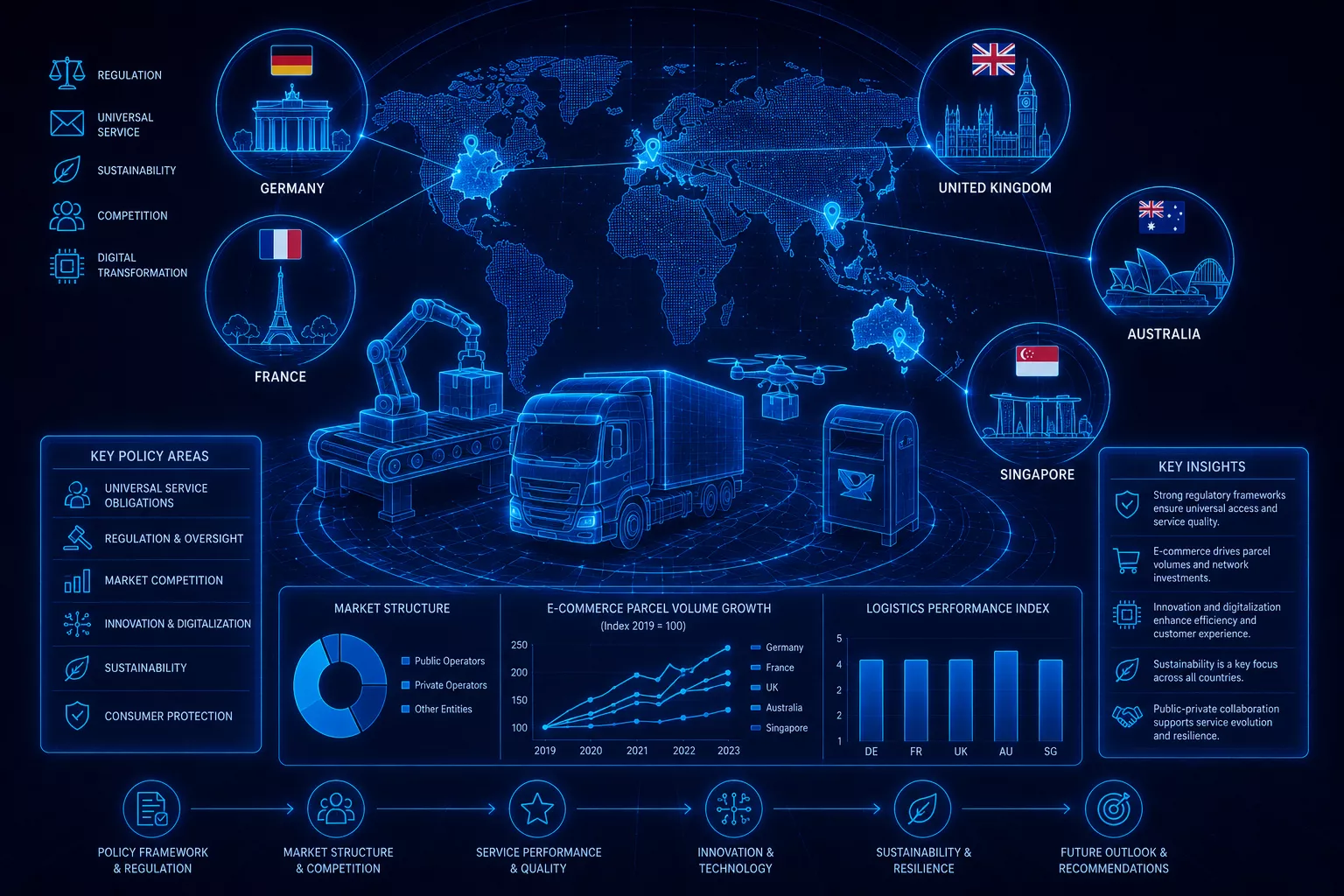
A global consulting firm providing services across technology and innovation management, marketing and sales, organizational transformation, strategy, risk management, and corporate finance needed to examine and catalog public policies across both the postal services and logistics sectors in five countries: Germany, France, the UK, Australia, and Singapore.
- Accessed official government and relevant regulatory agency websites in each country for the most accurate and current policy information
- Identified policies from transportation ministries, trade departments, and national logistics associations
- Examined each policy to determine prominent themes
- Delivered a repository of current postal and logistics policies across all five countries, with summary insights on each policy's scope, objectives, and regulatory emphasis
- Identified key differences and similarities in policy approaches, and recurring themes such as digitalization, security, environmental sustainability, and accessibility
- Flagged supportive policies (e.g., for sustainable logistics or digital postal solutions) and summarized the main strategic implications for sector stakeholders
Benchmarking Warehousing Licensing Practices Across Global Transport and Logistics Authorities
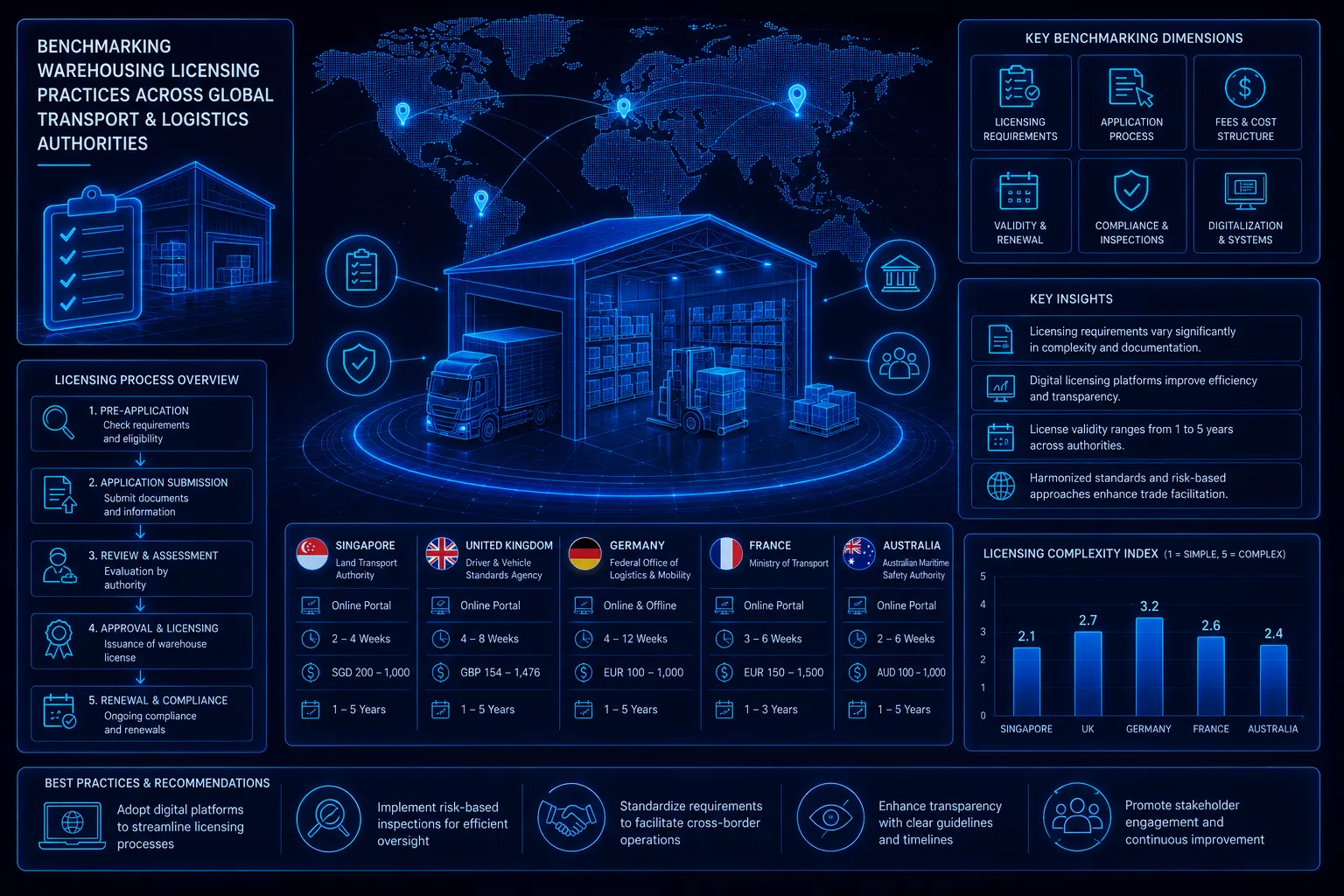
A global consulting firm needed to analyze and compare how different countries manage and regulate licensing for warehousing and storage activities, with a focus on transport and logistics ministries or authorities.
- Collected foundational data on licensing authorities, regulations, and warehousing-specific licensing requirements across six target countries: the UK, Germany, the Netherlands, France, Canada, and South Korea
- Identified the specific licenses required for various warehousing activities in each country, including container handling, general merchandise storage, specialized storage, and warehousing within ports, customs zones, or logistics fulfillment centers
- Conducted a comparative analysis of the licensing processes and regulatory structures across countries
- Determined which governmental bodies, specifically those under ministries of transport and logistics, are responsible for issuing warehousing licenses across land, air, and sea sectors in each target country
- Benchmarked warehousing-specific licenses issued by each country's transport and logistics authorities across distinct storage activities, including dark stores and last-mile delivery hubs
- Clarified whether licensing responsibilities fall exclusively under ministries of transport and logistics or involve other governmental departments
Commercial Due Diligence on Southern Africa's Transport Market

A long-standing company in the logistics and transportation business wanted a solid grasp of the transport market in Southern Africa: the size of the market, how efficient different routes are, and what the costs entail. It faced tough competition in both trucking and port operations, shifting volumes of goods, and various regulatory challenges, with one of its biggest struggles being identifying the best transport routes and improving logistics efficiency as Beira became more important while Durban had usually been the go-to option.
- Port and Corridor Analysis: examined how the Beira and Durban corridors are performing on efficiency, costs, and competition
- Trucking and Logistics Market: carried out an in-depth study of the trucking sector, exploring the competitive landscape, regulatory hurdles, and market trends
- Customer Insights: gathered qualitative and quantitative data by speaking with industry experts and potential customers about the transport market in the region
- Conducted 25 interviews with key experts from Mozambique, South Africa, and neighboring countries, and analyzed 168 reports, articles, and databases
- Delivered a detailed PowerPoint breaking down market size, competitor landscape, and port performance
- Provided actionable recommendations on capturing the Beira corridor's lower costs while staying mindful of risks like competition from Durban and changes in Zambia's regulations
Growth and Challenges in Last-Mile Delivery: A Comparative Analysis of Emerging Markets in MEA and India

A global consulting firm providing services across technology and innovation management, marketing and sales, organizational transformation, strategy, risk management, and corporate finance needed to understand the growth and trends in last-mile delivery services, particularly across the Middle East and Africa (MEA) and India.
- Reviewed market reports, industry publications, and government data to identify growth rates, key players, and trends
- Analyzed recent industry case studies for insights into specific innovations, growth strategies, and service challenges
- Gathered data on food delivery trends and profitability challenges from sources including financial reports of companies operating in the sector
- Mapped regional growth trends driving the expansion of last-mile delivery in MEA and India, including economic growth, digital adoption, urbanization, and the role of regional players
- Identified key service types and innovations (contactless delivery, drones, automated vehicles) alongside shifting consumer expectations for speed and flexibility
- Surfaced provider-side challenges: logistical complexity, delivery infrastructure gaps, rising fuel costs, operational inefficiencies, and workforce shortages
