

Top Data Quality Tools in 2026: Platforms That Improve Data Accuracy and Reliability

Table of Contents
The era of unreliable data is over. As organizations rely more heavily on analytics, AI, and automated decision-making, the cost of bad data has become impossible to ignore — from inaccurate reporting and failed campaigns to broken forecasts and poor business decisions. The question is no longer whether your data needs quality controls, but how quickly you can put the right system in place.
Imagine detecting duplicate records before they corrupt your dashboards, catching schema changes before they break your pipeline, and spotting data drift before it affects a critical business decision — all in one place. That is what modern data quality tools make possible. From fast-growing startups to enterprise data teams, the organizations that win are the ones that treat data quality as a competitive advantage, not a cleanup task.
We’ve curated the leading data quality tools that help teams profile, cleanse, validate, and monitor their data with confidence. Each tool in this guide has been selected for its real-world value — whether you need data observability, cleansing, validation, MDM, or governance support. If you’re building a stronger data stack in 2026, this is where to start.
Welcome to the era of trusted data — where accuracy is not optional, and every decision starts with confidence.
What Are Data Quality Tools?
Data quality tools are software platforms that help organizations assess, improve, and continuously monitor the accuracy, consistency, completeness, and reliability of their data. They identify issues such as duplicates, missing values, format inconsistencies, schema mismatches, and data drift before those problems affect dashboards, analytics, customer workflows, or AI models.
At their core, these tools cover four critical pillars: data profiling (understanding structure, anomalies, and patterns in your datasets), data cleansing and validation (correcting errors and enforcing rules), data observability (monitoring pipelines and detecting issues in real time), and governance and master data management (ensuring consistency across systems and business entities).
The distinction between tool categories matters. Some platforms focus on data observability and monitoring like Monte Carlo or Bigeye, while others specialize in data cleansing and enrichment like Talend or Informatica. Choosing the right tool depends on your data maturity, stack complexity, compliance requirements, and whether you need operational monitoring or transformation-focused cleanup.
📖 Want to go deeper? Read our broader technology and research coverage for business decision-makers: Infomineo Insights →
Best Data Quality Tools in 2026
Data quality is not a technical nice-to-have — it is the foundation of trustworthy analytics, reliable automation, and scalable AI.
1. Monte Carlo
Monte Carlo is one of the most recognized data observability platforms, helping teams monitor pipelines, detect anomalies, and trace data issues back to their root cause before they affect downstream reporting or decision-making.
Pros:
- Excellent for real-time anomaly detection and data incident management.
- Strong lineage and root-cause analysis capabilities.
Cons:
- Primarily built for observability, not cleansing or transformation.
- Pricing is generally enterprise-oriented.
Pricing:
Custom pricing on request.
2. Bigeye
Bigeye focuses on data quality monitoring and observability with an emphasis on automated issue detection, quality scoring, and data health tracking across modern data stacks.
Pros:
- Clear quality scoring and alerting for data teams.
- Good fit for modern cloud data environments.
Cons:
- Less suited for broad enterprise data governance needs.
- Not a cleansing or ETL-first platform.
Pricing:
Custom pricing.
3. Acceldata

Acceldata offers enterprise-grade data observability with monitoring across pipelines, warehouses, and lakehouses, helping organizations manage performance, reliability, and data health at scale.
Pros:
- Strong enterprise coverage across complex data ecosystems.
- Useful for large-scale pipeline and warehouse monitoring.
Cons:
- Can be complex to deploy in smaller environments.
- More observability-focused than remediation-focused.
Pricing:
Custom enterprise pricing.
4. Informatica

Informatica is a long-standing leader in enterprise data management, offering data quality, cleansing, matching, deduplication, and governance capabilities for organizations that need broad control over data integrity.
Pros:
- Very strong for cleansing, standardization, and matching.
- Enterprise-grade governance and metadata capabilities.
Cons:
- Can be heavy and expensive for smaller teams.
- Implementation may require specialized expertise.
Pricing:
Custom pricing.
5. Talend

Talend combines data integration with strong data quality features, making it useful for organizations that want cleansing, validation, and transformation in one environment.
Pros:
- Good combination of ETL and data quality functionality.
- Suitable for batch-based data operations.
Cons:
- Interface and workflows can feel more technical than newer tools.
- Pricing and packaging may be complex.
Pricing:
Custom pricing.
6. IBM InfoSphere QualityStage

IBM InfoSphere QualityStage is built for enterprise data standardization, matching, and cleansing, with a strong reputation in regulated and large-scale environments.
Pros:
- Excellent for standardization and record matching.
- Strong enterprise and legacy-system compatibility.
Cons:
- Can be heavy to deploy and maintain.
- Less modern than newer cloud-native alternatives.
Pricing:
Custom enterprise pricing.
7. OpenRefine

OpenRefine is a powerful open-source tool for cleaning messy datasets, standardizing values, clustering similar records, and fixing inconsistencies in spreadsheets and flat files.
Pros:
- Free and highly effective for hands-on cleanup work.
- Great for ad hoc data wrangling and normalization.
Cons:
- Not built for continuous monitoring or large-scale automation.
- Requires manual effort and technical familiarity.
Pricing:
Free and open source.
8. Trifacta
Trifacta is designed for data preparation and transformation, helping teams clean, reshape, and standardize data before it enters analytics and BI workflows.
Pros:
- Excellent visual interface for data preparation.
- Useful for analysts and data engineers alike.
Cons:
- Less focused on monitoring than observability-first tools.
- May be overkill for simple cleanup tasks.
Pricing:
Custom pricing.
9. Yellowfin

Yellowfin combines analytics and data storytelling with governance features that help business teams consume cleaner, more reliable data in a more structured way.
Pros:
- Strong collaboration and reporting features.
- Useful for business-facing data trust and visibility.
Cons:
- Not a dedicated data quality platform.
- Best used as part of a broader analytics stack.
Pricing:
Custom pricing.
10. Snowflake Data Quality Ecosystem
Snowflake itself is not a traditional data quality tool, but its ecosystem supports monitoring, validation, and governance through partner integrations and native data platform controls.
Pros:
- Strong ecosystem for scalable data operations.
- Pairs well with observability and governance tools.
Cons:
- Requires other tools for true data quality management.
- Not a standalone cleansing solution.
Pricing:
Platform pricing is usage-based; partner tools priced separately.
11. Qlik
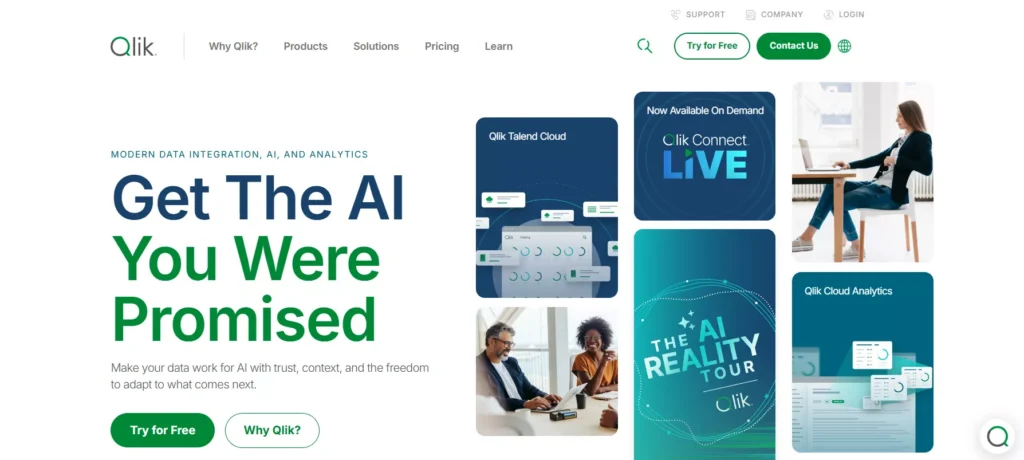
Qlik provides data integration and analytics capabilities with quality and transformation features that help teams manage trustworthy reporting pipelines.
Pros:
- Strong for analytics-driven data workflows.
- Good integration and transformation support.
Cons:
- Quality features are not the only focus of the platform.
- May be better suited to broader BI use cases.
Pricing:
Custom pricing.
How to Choose the Right Data Quality Tool
Choosing the right data quality tool is less about finding the most feature-rich platform and more about matching the tool to your data maturity, workflows, and business priorities. The right choice should improve trust in your data without creating extra operational overhead or fragmentation.
① Identify Your Primary Problem
If you need to catch pipeline failures and anomalies in real time, prioritize data observability tools like Monte Carlo, Bigeye, or Acceldata. If your main challenge is messy records, duplicates, and inconsistent formats, look at cleansing-focused tools like Informatica, Talend, or OpenRefine. Matching the tool to the problem is the fastest way to avoid overspending on features you won’t use.
② Map It to Your Data Stack
Modern data teams often work across warehouses, pipelines, BI tools, APIs, and reverse ETL layers. The more distributed your stack is, the more useful observability becomes. On the other hand, if your workflow is centered around batch processing or spreadsheet cleanup, a lighter tool can be more effective than an enterprise platform.
③ Think in Terms of Automation
The best tools do more than report issues — they help you automate detection, escalation, and sometimes remediation. Features like anomaly detection, quality scoring, rule-based validation, and alert routing save time and reduce manual cleanup work. The more automated the system, the easier it is to scale quality without adding headcount.
④ Factor in Team Skill Level
Open-source and enterprise data engineering tools often provide strong control, but they can also require specialized technical knowledge. If your team is small or distributed across analytics and business roles, ease of use matters just as much as feature depth. Tools with visual workflows, strong documentation, and simple alerting often deliver faster value.
⑤ Consider Governance and Compliance
For regulated industries, data quality is closely tied to governance. You may need lineage, audit trails, ownership mapping, and policy enforcement in addition to standard quality checks. In those environments, tools that integrate with broader governance and metadata layers often create more long-term value than standalone point solutions.
⑥ Test the Tool on Real Data
Always validate a tool using your own datasets, pipelines, and business rules. Demo environments rarely show how a platform behaves with messy source systems, inconsistent naming conventions, or large-scale volume. A real-world trial will tell you more about effectiveness than a polished sales presentation ever will.
The right data quality stack does more than clean records — it protects trust across your reporting, operations, and AI systems. Whether you need continuous monitoring, batch cleanup, or enterprise governance, the tools in this guide give you a strong starting point for building reliable data foundations in 2026.
At Infomineo, we help organizations navigate technology decisions through research, benchmarking, and strategic insight — so they can invest with confidence.
