

From Clean Data to AI-Ready Data: What Companies Must Fix Before AI Can Scale

Table of Contents
Key Takeaways
- Clean data is only the starting point for AI readiness
- The biggest data gap may be information you never collected
- Data can be accurate and complete yet still be unusable for AI
- The goal is not perfect data, it is fit-for-purpose data
- Use-case-led preparation can turn months of broad data clean-up into weeks of targeted preparation
The question “Is our data ready for AI?” sounds straightforward. In practice, it is difficult to answer without first asking a more useful question: ready for what?
A company can have years of well-maintained records, modern data infrastructure, and established data management processes and still find that its data cannot support a particular AI use case.
A dataset can be accurate and complete and still lack information the use case requires. It can contain the right information but represent the same thing differently across records. And it can be well prepared for a pilot but deteriorate as more systems, teams, and use cases depend on it.
This is why AI readiness cannot be assessed as a general property of a company’s data. It has to be assessed against what the data needs to do. At Infomineo, we assess the data behind a priority use case by asking three questions:
- Coverage: Does the data contain the information the use case needs?
- Consistency: Is the data labelled and structured consistently?
- Governance: Is the data maintained, governed, and accessible over time?
Together, these questions identify the gaps that need to be addressed before the data is ready for the use case.
The Three Foundations of AI-Ready Data
Coverage — Does the Data Contain the Information Needed to Answer the Question?
Coverage is the easiest problem to overlook because it can fail silently. A system can return an answer whether or not it found everything the question required. Testing accuracy will not necessarily expose the problem: if a prepared test sample contains all the information needed to answer the question, the system can perform well on the test while failing on the real-world question.
Consider a bank trying to understand whether its branch network is aligned with the populations it serves. Its internal systems may contain branch locations, opening dates, transaction volumes, customer numbers, and financial performance. Those datasets can be accurate and complete. But none of them necessarily describes the population surrounding each branch.
To answer the question, the bank needs information that sits outside its own systems: current locations of its branches and competitors, population characteristics, income levels, demographics, or other relevant socio-economic indicators.
The problem is not poor-quality data. The required facts simply do not exist in the dataset.
The same issue arises when an organisation has relevant information but not enough of it. A model may need more observations, market benchmarks, or historical data before there is enough signal to learn reliably. The question is therefore not simply whether the company has data. It is whether it has enough of the right data for the question being asked.
Consistency — Is the Data Labelled and Structured Consistently?
Consistency asks whether the same information is labelled and structured in the same way across the dataset. This is where “the data is correct” can become misleading.
Imagine a procurement dataset containing more than 200,000 lines. The same product might be labelled using a short commercial name in one record, a detailed product description in another, and a description that also includes the department, location, delivery requirements, or installation details in a third. This is indeed a challenge we encountered with a client and helped solve through product data harmonisation (see below).
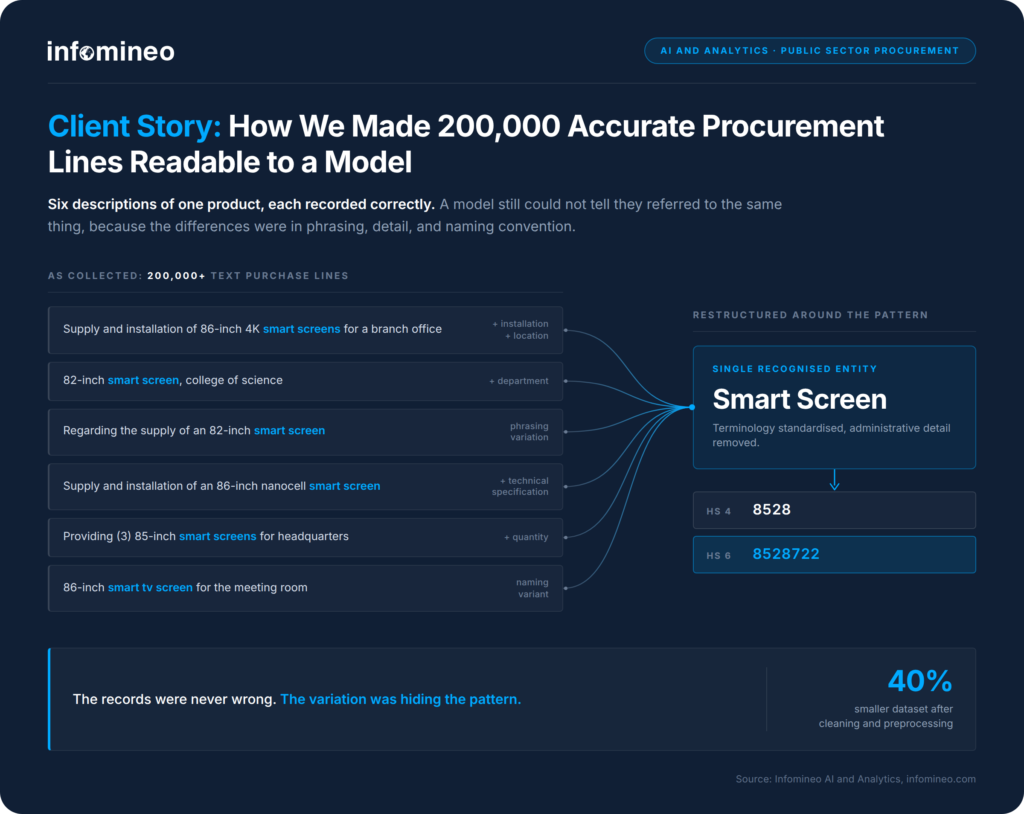
Every individual record can be accurate. But from a modelling perspective, records describing the same product may look unrelated. The issue is not inaccurate data. It is that the same underlying information is represented differently.
This is common in datasets built from multiple systems, historical records, free-text fields, or information collected independently by different teams. Different naming conventions, formats, terminology, and levels of detail can prevent a model from recognising that records refer to the same underlying entity or concept.
Data harmonisation addresses this problem by bringing equivalent records into a common framework. In some cases, this also involves entity resolution: identifying records that refer to the same product, customer, organisation, location, or other underlying entity.
The goal is not to make every field identical. It is to remove variations that obscure meaningful relationships while preserving differences that matter to the use case.
Governance — Is the Data Maintained, Governed, and Accessible Over Time?
Even when data has sufficient coverage and has been structured for a particular use case, another problem remains: what happens next?
Data changes continuously. New records are created, definitions evolve, systems are modified, and additional teams begin using the same datasets. A dataset that was reliable at the beginning of an AI project can gradually become inconsistent again.
This is particularly visible when reporting draws on several operational systems. Different systems may use different definitions, historical data may contain inconsistencies introduced over years of use, and manual processes can create additional opportunities for variation.
Automation improves how data is collected. It does not automatically guarantee that the data remains fit for purpose.
Maintaining data quality requires clear ownership, agreed data standards, quality rules, access controls, monitoring, and mechanisms for resolving problems as they appear. Data quality monitoring can identify when records fall outside agreed thresholds, while documented ownership and governance processes determine who is responsible for addressing the issue.
The evidence increasingly points to governance as a factor in maintaining data quality. The 2026 State of Data Integrity and AI Readiness study shows a clear difference in data trust: 71% of organisations with a data governance programme report high confidence in their data, versus 50% among organisations without one. The same research found that 42% of leaders say governance improves AI readiness.
Four Ways to Prepare Data for AI: Lessons from Our AI & Analytics Experts
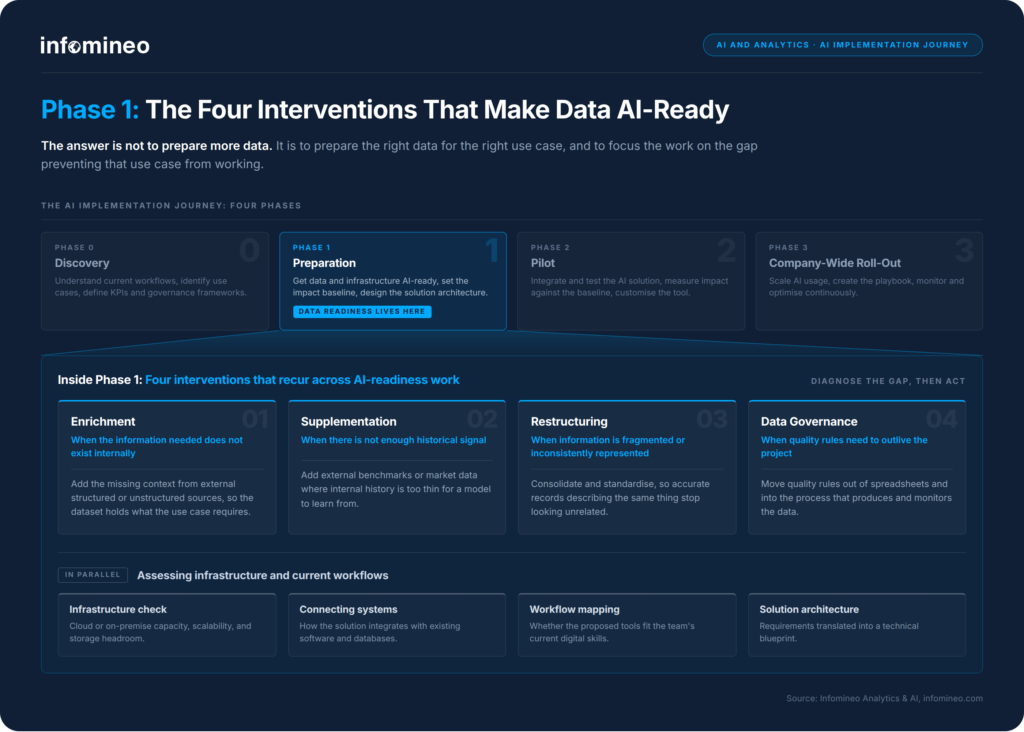
The three questions above help identify where data falls short. The next step is to address the specific gap rather than launch a broad clean-up exercise. Four interventions can address the gaps that emerge: enrichment, supplementation, restructuring, and data governance.
Data preparation is already consuming a significant share of organisations’ capacity. Nearly 80% of data teams spend more than half their time preparing data rather than generating insights, according to the 2026 Data, AI & Analytics Trends survey. The goal, therefore, is not to prepare more data for the sake of it, but to prepare the right data for the right use case.
AI readiness is one part of a broader AI journey. We support clients across four phases: discovery, preparation, pilot, and roll-out. The preparation phase has two parts: preparing the data for the prioritised AI use cases, and assessing the infrastructure and current workflows needed to support the solution. Data readiness comes first: before an AI solution can be piloted and scaled, the data it depends on needs to be fit for purpose.
1. Data Enrichment
Data enrichment adds missing context from additional structured or unstructured sources when the information required for a use case does not exist within the organisation. This could include demographic data, market information, geographic attributes, industry benchmarks, or other external sources that add the context needed to answer a specific question. The 2026 State of Data Integrity and AI Readiness study found that 96% of organisations surveyed invest in location intelligence and third-party data enrichment to add context to their data and AI initiatives.
When the required information is missing internally, we recommend identifying relevant external sources early rather than trying to improve data that cannot answer the question on its own.
2. Data Supplementation
Data supplementation addresses situations where an organisation has relevant internal data, but not enough history, volume, or variation for a model to learn reliable patterns. Adding external benchmarks, market data, historical datasets, or other relevant sources can provide the additional signal needed to strengthen the model’s training data.
This is particularly important when internal records cover only a short period, a limited number of cases, or conditions that do not adequately represent the environment in which the model will operate. We recommend assessing not only whether the right type of data exists, but whether there is enough of it to support the intended use case.
3. Data Restructuring and Harmonisation
Data restructuring makes information usable when the underlying data exists but is fragmented, siloed, or represented inconsistently across records and systems. Correct data can still be difficult for AI to interpret when the same product, customer, location, or transaction is described in different ways or stored in incompatible formats.
The process can involve data integration, transformation, label standardisation, and entity resolution to create a consistent structure for the intended use case. We focus on making different representations of the same underlying information recognisable to the model, while preserving distinctions that matter to the use case.
4. Data Governance
Data governance ensures that the quality achieved during preparation is maintained as data moves into regular use and more teams, systems, and AI applications depend on it. This requires clear ownership, agreed data definitions and standards, appropriate access controls, ongoing data quality monitoring, and processes for addressing issues as they arise.
In our work, we find that quality rules that matter for an AI application need to be embedded into ongoing data processes, rather than treated as one-time checks. This makes data quality part of how data is produced, managed, and monitored over time.
From Data Clean-Up to Data Readiness
The key shift is from asking “How clean is our data?” to asking “What does this use case require, and where does our current data fall short?”
A traditional clean-up exercise often starts with the data itself: identifying inconsistencies, removing duplicates, standardising formats, and working through the backlog until the dataset is considered clean. For AI, that can become an open-ended exercise because different applications require different information, structures, and levels of quality.
A use-case-led approach starts from the other direction. The requirements of a priority use case define what data is needed, which gaps matter, and what preparation is worth doing. This makes it possible to focus resources on the data that will actually affect the outcome, rather than trying to make every dataset across the organisation AI-ready before any AI work begins.
Where possible, the preparation should also produce something reusable: a repeatable pipeline, standardised structure, quality rules, or other process that can support future use cases rather than requiring the same work to be repeated from scratch.
Why This Matters for Scaling AI
The challenge becomes more significant as organisations move beyond individual pilots. The 2026 State of Data Integrity and AI Readiness study found that 43% still identify data readiness as a major obstacle to achieving their AI goals. Having the infrastructure and capability to run an AI solution is therefore not the same as having the data foundation required to make that solution reliable in practice.
The cost of that gap can increase as AI adoption grows. IDC’s FutureScape 2026 report forecasts that by 2027, companies that do not prioritise high-quality, AI-ready data could face a 15% productivity loss as they struggle to scale generative and agentic AI solutions. The goal is not perfect data across the organisation. It is data that is fit for the use cases that matter most, prepared in a way that can be maintained, measured, and reused as those use cases grow.
Infomineo — AI & ANALYTICS
Get your data ready for the AI use cases that matter.
Infomineo helps organisations assess their data against priority AI use cases, identify the gaps that matter, and prepare the data, infrastructure, and workflows needed to move from AI pilots to scalable solutions.
Frequently Asked Questions
What does AI-ready data mean?
AI-ready data is data that contains the information a specific use case requires, is structured consistently enough for a model to identify meaningful patterns, and can maintain its quality over time. Readiness judged without reference to a use case tends to produce confident answers that do not survive the pilot.
Can accurate data still be unsuitable for AI?
Yes. Accuracy alone does not determine whether data is suitable for AI. Data can be factually correct but still lack the context, consistency, or structure needed for a particular application.
Should companies clean all their data before adopting AI?
Not necessarily. A company-wide clean-up can become a lengthy and open-ended exercise, including data that may have little relevance to the AI applications being prioritised. A use-case-led approach focuses preparation on the datasets and improvements that can directly affect the outcome of a specific AI application.
What are the main ways to make data AI-ready?
There are four methods for addressing common data gaps: enrichment adds missing information, supplementation adds insufficient historical or external signal, restructuring makes fragmented or inconsistent data usable, and data governance helps maintain quality over time.
Why does data readiness matter when scaling AI?
Data that works for a single pilot may not remain reliable as more users, systems, and AI applications depend on it. Building data that is fit for purpose, measurable, maintainable, and reusable helps organisations move from individual AI pilots to broader adoption.
