

Where to Build AI Teams: The Growing Case for Egypt and Morocco

Table of Contents
Key Takeaways
- As AI adoption scales, access to qualified AI talent is becoming a strategic constraint
- The global AI talent map is shifting, with emerging markets rapidly expanding their talent pools
- Africa is building its AI capabilities, with Egypt and Morocco emerging as relevant markets for AI teams
- Egypt offers talent scale, competitive costs and an established outsourcing ecosystem
- Morocco combines engineering depth, proximity to Europe and government-backed incentives
- Salary is only one part of the equation: companies should also assess talent quality, AI readiness, availability and scalability
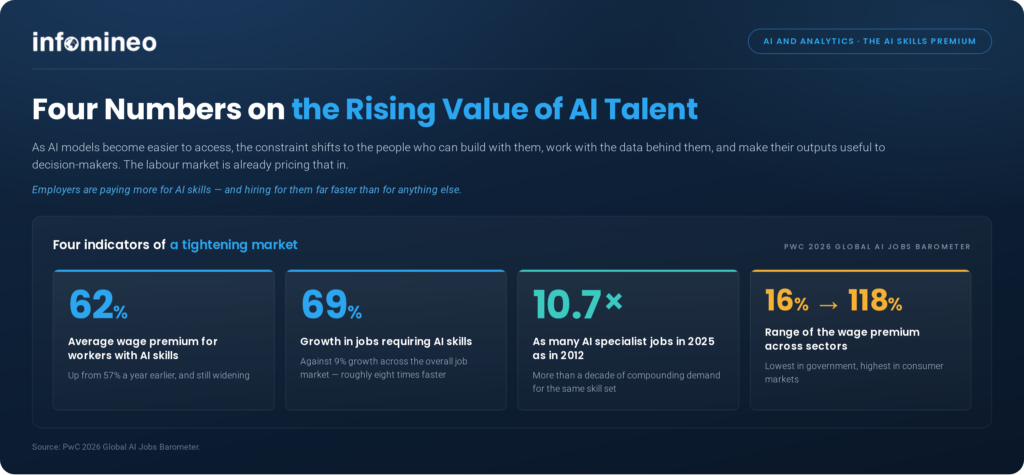
AI adoption is accelerating, but access to the right talent is becoming a more important constraint. As AI models become increasingly accessible, the differentiator is shifting toward the people who can build AI solutions, work with data, integrate them into business processes, and make their outputs useful to decision-makers. This is already reflected in the labour market: workers with AI skills earn an average wage premium of 62%, up from 57% a year earlier.
For companies looking to scale AI, this creates a strategic question: where can they find enough qualified talent, at a sustainable cost, to move beyond individual pilots and build AI capabilities at scale?
The Global Race for AI Talent
The pressure on AI talent is visible from both sides of the market. Demand for jobs requiring specific AI skills, including machine learning and prompt engineering, grew roughly eight times faster than the overall job market last year.
The premium employers are willing to pay is also increasing. But this premium varies considerably by sector, meaning that companies operating in areas where AI has significant commercial potential may face particularly strong competition for experienced talent.
The supply of AI talent is also uneven across markets. Some countries have already built highly concentrated talent pools, while others are rapidly expanding their share.
In 2025, Israel had the highest concentration of AI talent among LinkedIn members, followed by Singapore and Luxembourg. At the same time, the UAE, India and Saudi Arabia more than doubled their share of AI talent between 2019 and 2025.
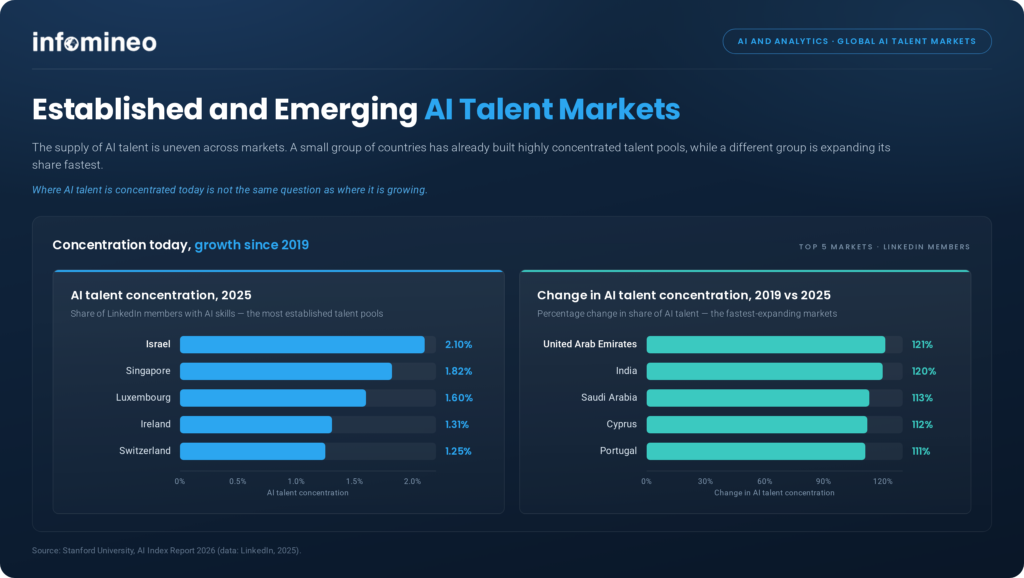
The difference between established and emerging markets is important when considering where future AI teams can be built. The countries with the highest concentration today are not necessarily the only places where talent supply is expanding.
Africa is Becoming Part of the AI Talent Landscape
Africa is also developing its position in the global AI market. The African Development Bank estimates that inclusive AI deployment could add up to US$1 trillion to Africa’s GDP by 2035, reflecting AI’s potential impact on productivity, employment and economic activity.
Countries across the continent are developing national AI strategies, investing in digital skills and strengthening the policy environment around AI. Progress, however, varies significantly between markets.
The 2026 African AI Governance Index provides one view of this landscape. It assesses all 55 African nations across eight pillars, including policy & strategy, regulatory framework, institutional capacity, ethics & rights, infrastructure & data, talent & research, investment & ecosystem, and implementation & impact.
Egypt, South Africa, Kenya, Rwanda, and Morocco rank among the top five countries across the overall index and all pillars, except investment, where Nigeria ranks fifth and Morocco sixth.
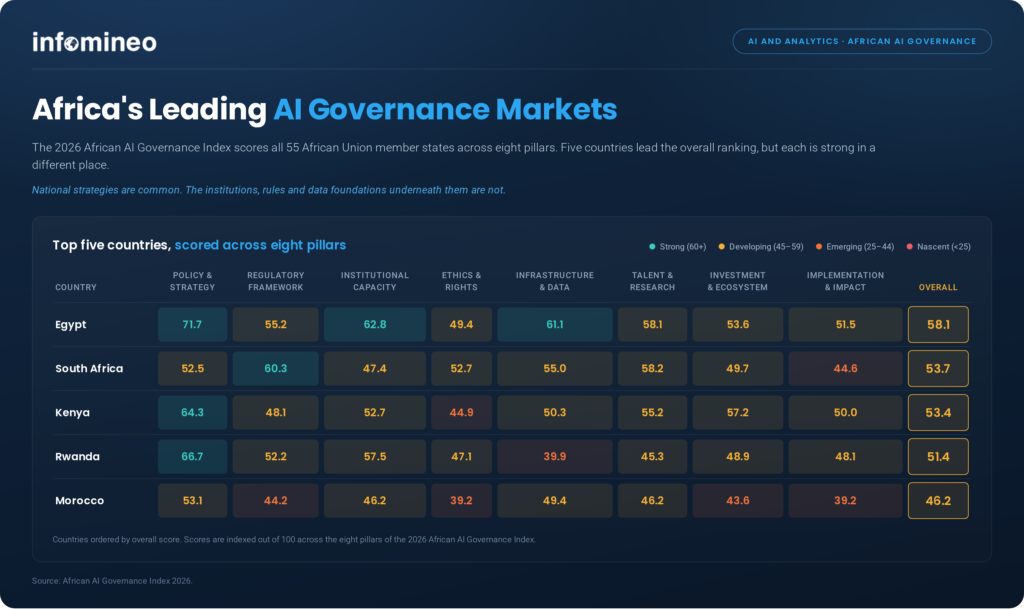
This broader picture shows that AI capacity is developing across several parts of the continent. Within this landscape, Morocco and Egypt offer two of the more established technology and digital-services ecosystems in North Africa, making them relevant markets to examine more closely.
Egypt and Morocco are Building the Foundations for AI Talent
Both Morocco and Egypt have been expanding their technology talent bases alongside broader efforts to develop their digital economies. Their approaches differ in scale and structure, but in both cases, talent development is being supported by government programs, growing technology sectors and increasing demand for digital services.
Morocco: Combining Engineering Talent with Proximity to Europe
Morocco has a relatively high share of science and engineering graduates. In 2023, these fields accounted for 24.57% of all graduates, ranking Morocco 45th globally on this specific indicator, out of 139 economies in the World Intellectual Property Organization’s Global Innovation Index 2025. The country is also expanding its digital talent pipeline, with more than 40,000 IT and engineering graduates trained in 2025.
These efforts are complemented by longer-term ambitions under Digital Morocco 2030 and Maroc IA 2030. Digital Morocco 2030 focuses on expanding the country’s broader digital talent base, while Maroc IA 2030 adds more specific ambitions for AI skills and employment.
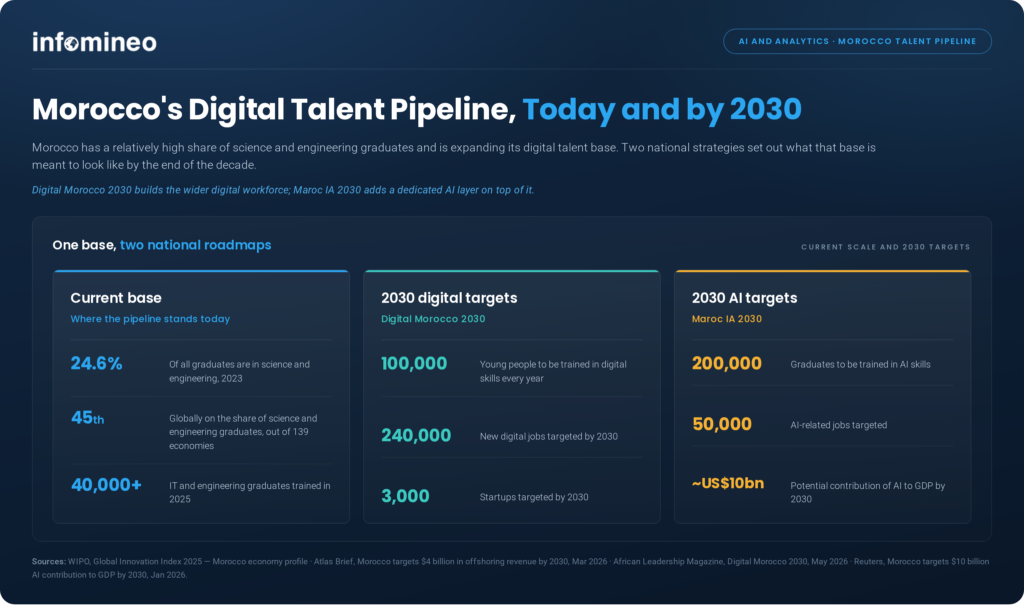
The country’s AI ambitions extend beyond general digital skills. Maroc IA 2030 adds a dedicated national AI roadmap, with talent and skills alongside AI infrastructure, innovation and entrepreneurship, public-sector AI and data sovereignty. The roadmap also includes the creation of the Al-Jazari Institutes as national AI centers of excellence.
Morocco’s location is another factor in its technology proposition. Casablanca operates on London working hours and is one to two hours behind Paris, allowing teams to work within the same business day as European clients. German firms are also building research and development hubs in the country, supported by its proximity to Europe, competitive costs and growing engineering talent base.
The country is using its offshoring policy to support the expansion of technology and business services. In November 2025, the Moroccan government published a comprehensive circular detailing the operational framework of the renewed Morocco Offshoring Offer, as part of the implementation of Digital Morocco 2030. The framework covers five areas: Information Technology Outsourcing (ITO), Customer Relationship Management (CRM), Business Process Outsourcing (BPO), Engineering Services Outsourcing (ESO), and Knowledge Process Outsourcing (KPO). It combines employment and training incentives with tax measures for qualifying activities, while setting targets for further expansion of the sector through 2030.
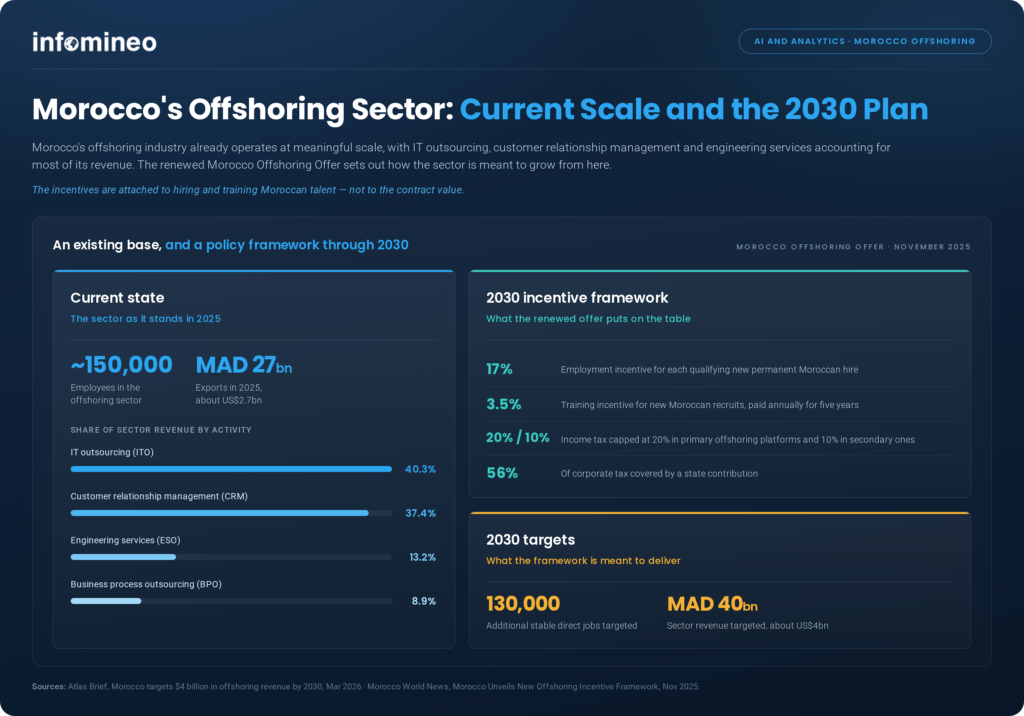
Morocco’s offshoring industry is therefore already operating at meaningful scale, with IT outsourcing and customer relationship management accounting for a significant share of activity. The 2025 framework builds on this existing base by providing incentives for further employment, training and sector growth through 2030.
Egypt: Building on Talent Scale with AI Ambition
Egypt combines a large pool of technology and STEM graduates with an expanding digital-skills pipeline and an established export-oriented services industry. Its geographic position between Europe, the Middle East and Africa also supports delivery models serving multiple markets and time zones.
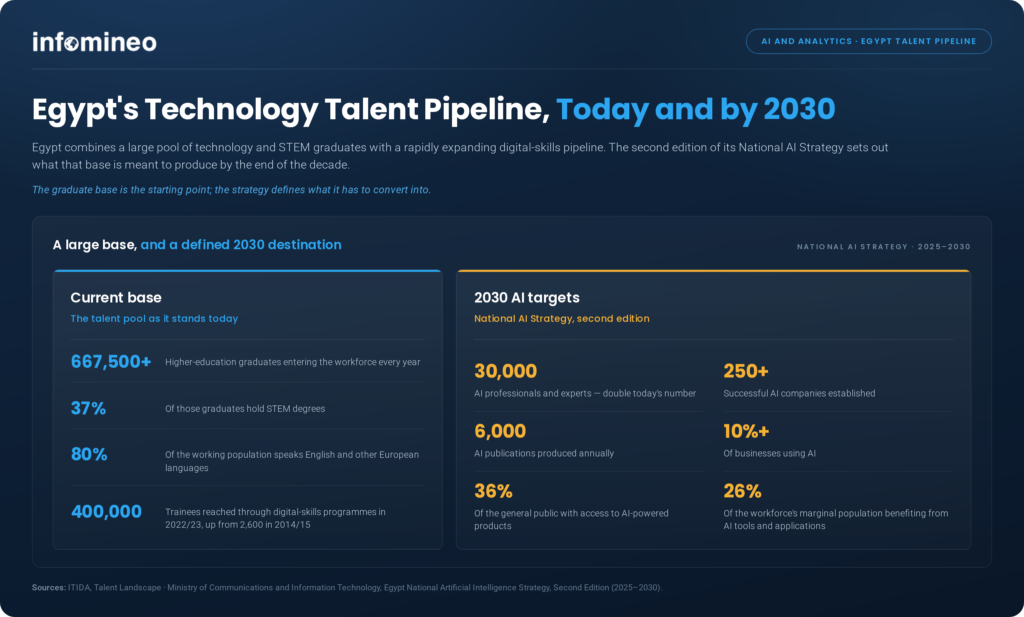
Each year, more than 667,500 higher-education graduates enter the workforce, with 37% holding STEM degrees, according to the Information Technology Industry Development Agency (ITIDA). ITIDA also estimates that 80% of the working population speaks English and other European languages.
The country continues to expand this talent base through large-scale training programs covering software development, AI, cybersecurity and other ICT disciplines. Government-backed digital-skills programs grew from 2,600 trainees in 2014/15 to 400,000 in 2022/23, illustrating the scale-up of Egypt’s investment in technology skills.
This expanding digital talent base is now being complemented by a dedicated AI agenda. In January 2025, Egypt launched the second edition of its National AI Strategy, covering 2025–2030, building on the foundations established by its first strategy. The new edition is organized around six pillars — governance, technology, data, ICT and AI infrastructure, ecosystem, and talent — and aims to strengthen Egypt’s AI capabilities and position the country as a regional leader.
The strategy also sets specific 2030 targets for AI talent, research, entrepreneurship and adoption. Among them, Egypt aims to double its number of AI professionals and experts to 30,000, support the establishment of more than 250 successful AI companies, and reach 6,000 AI publications per year.
Egypt’s geographic position — connecting Europe, the Middle East and Africa — further supports its role as a delivery base. Combined with its multilingual workforce and competitive cost structure, this makes the country well suited to delivery mandates that require teams to support multiple regions and time zones.
This combination is already reflected in the country’s outsourcing industry. Egypt currently has more than 240 companies operating around 270 outsourcing service centers and providing approximately 181,000 jobs. The sector serves international clients across IT services, business processes, knowledge services, and engineering and R&D.
The industry has expanded rapidly in recent years. Digital offshoring exports increased from US$2.4 billion in 2022 to US$4.8 billion in 2025, while the number of offshoring companies increased from 90 to more than 240. In November 2025, the government also signed agreements with 55 global and local companies expected to generate more than 70,000 additional jobs over the following three years.
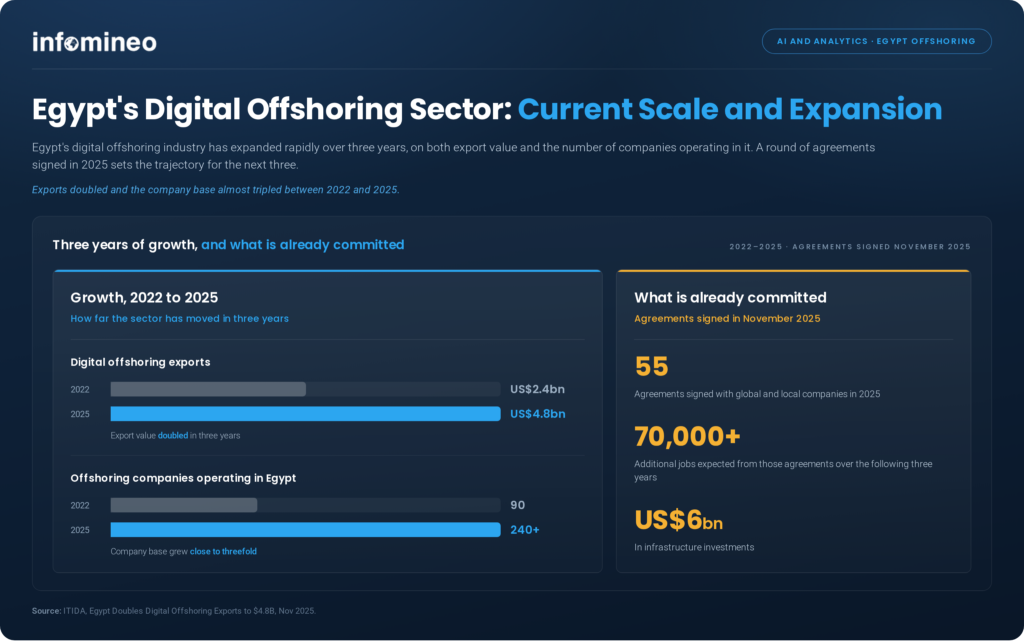
The expansion is also moving beyond traditional business-process outsourcing. Egypt’s offshoring industry now spans software development and testing, IT consulting, business-process services, knowledge services, engineering, R&D and semiconductor-related activities
Taken together, Egypt’s expanding talent base, national AI strategy and established export-services ecosystem provide an increasingly broad foundation for technology and AI-related delivery. The country’s proposition is therefore not limited to the availability of individual AI specialists; it is supported by a wider ecosystem of skills development, technology services and international delivery capabilities.
AI and Data Talent Costs Across Markets
The growing talent base in Egypt and Morocco matters not only because it expands the pool of potential AI professionals, but because it can offer companies a different cost structure from more established AI talent markets.
Salary data provides an indication of the potential gap. Our Glassdoor benchmark across four technology roles — Data Scientist, AI/ML Engineer, Data Engineer and Data Analyst — shows that compensation in Egypt and Morocco is generally below the levels observed in several established and emerging technology markets. The gap is particularly pronounced for Egypt, while Morocco’s position is more mixed and varies considerably by role.
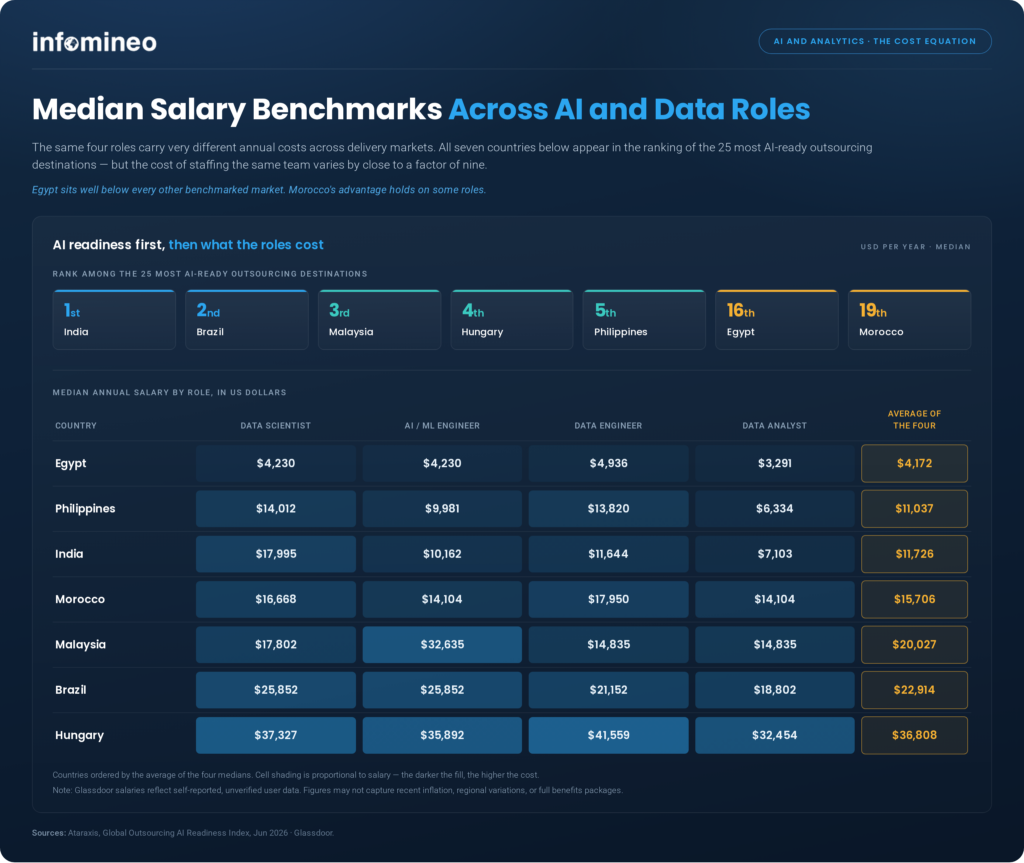
This makes cost a potential advantage, but not a sufficient reason to choose either market. Salary comparisons alone do not capture differences in experience, talent availability, productivity, retention or the broader cost of building and operating a team.
On this measure, Egypt and Morocco both rank among Africa’s top five countries in the 2026 African AI Governance Index, suggesting that the opportunity is not simply a low-cost labour arbitrage story; both markets are developing broader foundations for AI adoption.
The two markets, however, offer different propositions. Egypt’s principal advantage is scale: a large STEM and technology talent pool, an expanding training pipeline and an established outsourcing industry capable of supporting large delivery teams. Morocco’s proposition is more closely tied to engineering depth, proximity to Europe and an increasingly structured offshoring ecosystem, reinforced by incentives under the 2025 Morocco Offshoring Offer.
For companies evaluating where to build AI capabilities, the relevant comparison is therefore not salary versus salary, but capability versus total cost of delivery. The strongest opportunity may lie in markets where competitive compensation coincides with a sufficiently deep talent pool, growing AI capabilities and an operating environment that can support teams as they scale.
What We’ve Learned from Building Teams in Cairo and Casablanca
For Infomineo, the opportunity is grounded in experience. Cairo and Casablanca have served as delivery hubs for years, and both now host our AI and Analytics team. Across this footprint, we have delivered more than 500,000 client requests for leading global strategy consultancies and more than 50 Fortune 500 companies, working across eight languages and 25 nationalities.
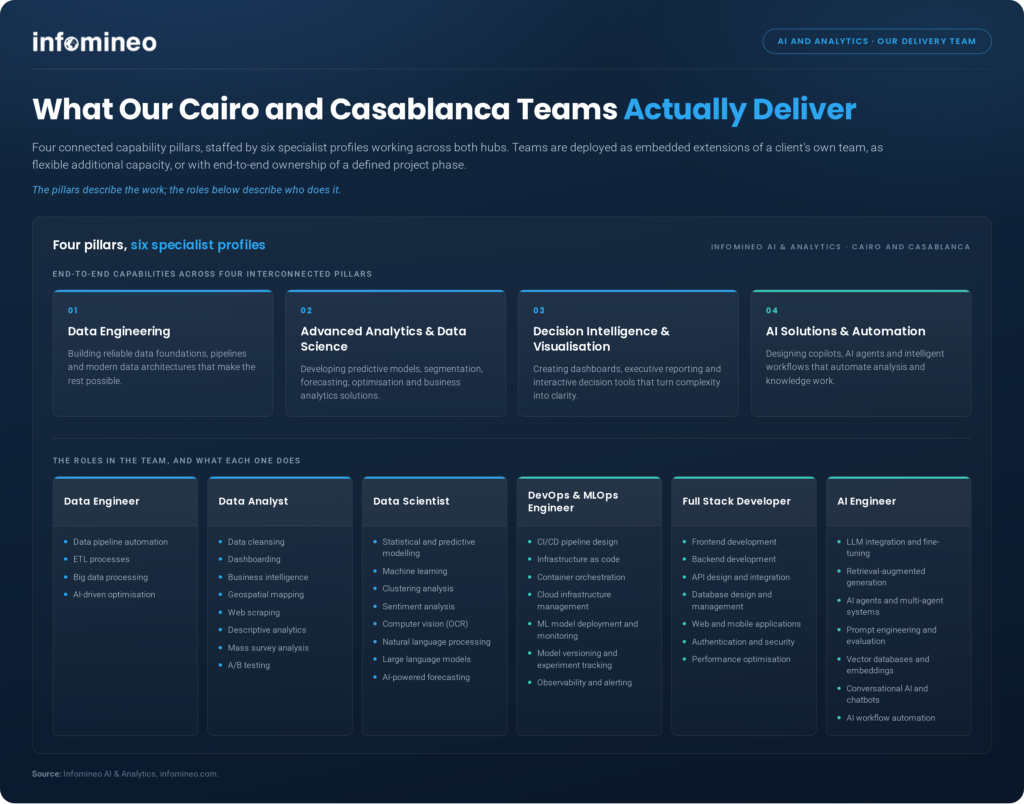
As client demand has shifted from individual AI use cases toward scaled adoption, we have correspondingly expanded our capabilities across data engineering, advanced analytics and data science, decision intelligence and visualization, and AI solutions and automation. These capabilities can be deployed through embedded specialists, flexible capacity or end-to-end project delivery, depending on the client’s needs.
A Multidisciplinary Talent Model
Our experience also reinforces the importance of building AI teams around complementary specialist capabilities rather than a single generic definition of “AI talent.” Our AI and Analytics team across Cairo and Casablanca includes data engineers, data analysts, data scientists, DevOps and MLOps engineers, full-stack developers and AI engineers, supported by BI, research and project-management capabilities.
This breadth allows teams to cover the full AI delivery lifecycle, from data preparation and modelling through deployment, integration and automation. It also reflects the depth of the talent pools available in both markets: our teams include professionals with three to sixteen years of prior experience across different industries.
AI Adoption Requires More Than Technology
A second lesson from our experience is that technology is rarely the only constraint to AI adoption. Successful implementation depends on whether employees can incorporate new tools into their day-to-day workflows. We therefore build enablement into the delivery process rather than treating it as a final training step. This includes role-specific workshops, hands-on sessions using client workflows and data, internal AI champions, and practical playbooks and adoption measures designed to sustain usage beyond the initial engagement.
Different Markets, Complementary Advantages
Our experience also highlights the distinct strengths of the two hubs. Casablanca’s proximity to Europe and overlapping working hours support close collaboration with European clients, while Cairo’s scale and multilingual workforce support larger teams serving multiple markets. Maintaining capabilities across both locations also provides greater flexibility as demand for experienced AI talent increases.
Infomineo — AI & ANALYTICS
Build the right AI team for your next stage of growth.
Infomineo helps organizations assess where AI talent can best support their needs, from identifying the right skills and team structure to building scalable AI and Analytics capabilities across markets.
Frequently Asked Questions
Why is AI talent becoming a strategic constraint for companies?
Demand for workers with AI skills is growing much faster than the broader job market, while experienced AI professionals command significant wage premiums. As companies move from AI experimentation to scaled deployment, securing enough qualified talent is becoming an increasingly important constraint.
Which countries currently have the highest concentration of AI talent?
Israel, Singapore and Luxembourg had the highest concentration of AI talent among LinkedIn members in 2025. At the same time, markets including India, the UAE and Saudi Arabia have rapidly increased their share of AI talent, showing that the global AI talent map is evolving.
How is Africa building its capacity to participate in the AI economy?
African countries are developing national AI strategies, investing in digital skills and strengthening their technology and AI ecosystems. The 2026 African AI Governance Index highlights significant differences across markets, with South Africa, Egypt, Kenya, Morocco and Rwanda among the continent’s leading performers across most dimensions.
What advantages do Egypt and Morocco offer companies building AI teams?
Egypt offers scale, competitive costs and an established outsourcing ecosystem, while Morocco combines engineering talent, proximity to European markets and government-backed offshoring incentives. Both are also expanding their AI and digital-skills pipelines.
What should companies consider when choosing where to build AI teams?
Companies should look beyond salary and assess talent quality and availability, AI readiness, language capabilities, infrastructure, incentives, proximity to target markets, retention and scalability. The most attractive location will depend on the company’s required skills and operating model rather than on labour cost alone.
