

Inside Saudi Arabia’s AI Opportunity: Three Factors Making the Kingdom Attractive to Investors

Table of Contents
Key Takeaways
- Saudi Arabia has moved beyond AI funding, with the foundations needed to turn investment into AI at scale
- The Kingdom’s digital infrastructure is already mature, reducing a major barrier to enterprise AI adoption
- Its data estate is increasingly catalogued, standardized, and addressable, shifting the challenge from finding data to making it fit for purpose
- AI and data policy is becoming increasingly commercially enabling, creating clearer rules for responsible use and data monetization
- The opportunity now depends on execution: choosing the right use cases, preparing the right data, and turning AI investment into measurable value
In March 2026, Saudi Arabia’s Council of Ministers designated 2026 the Year of Artificial Intelligence. Five months later, the World Bank’s World Development Report 2026 placed the Kingdom among the top 10 global markets for private AI investment. In the run-up to that designation, Saudi AI companies secured $9.1 billion in funding, and the Kingdom ranked 14th in the 2025 Global AI Index.
Those numbers describe a market that is well funded. They do not, on their own, describe a market that is fertile. Capital moves easily between jurisdictions and is the input an investor can redirect fastest. What separates a well-funded market from a well-prepared one is the condition of everything underneath the capital: whether the systems that would consume AI are modern enough to receive it, whether usable data exists in volume, and whether the rules governing that data are written down.
What follows sets out the three structural conditions that make the Kingdom a well-prepared ground for AI capital: the state of its digital infrastructure, the depth of its data estate, and the maturity of the rules governing both.
Saudi Arabia Has Built the Digital Foundation for AI
In most mature markets, the largest cost of enterprise AI is not the model. It is the excavation work required to reach the data buried under decades of accumulated systems.
Consider what an established bank typically works with: core platforms specified decades ago, layers of bolted-on middleware, several acquisitions’ worth of incompatible customer records, and a compliance archive nobody has been authorized to touch since the last regulator visit. The AI pilot is rarely the hardest part. Producing a clean, current, permissioned feed into it is what consumes the budget and the calendar.
Saudi Arabia undertook much of its digital transformation during the Vision 2030 period, giving the Kingdom a relatively modern technology base on which to build AI. Rather than retrofitting AI onto decades of fragmented legacy infrastructure, many government and enterprise systems have been built or modernized around cloud computing, APIs, and interoperable digital platforms. The clearest evidence is the pace of change: in the 2024 edition of the UN E-Government Development Index, the Kingdom climbed 25 places to 6th of 193 nations, ranking first regionally and second in the G20.
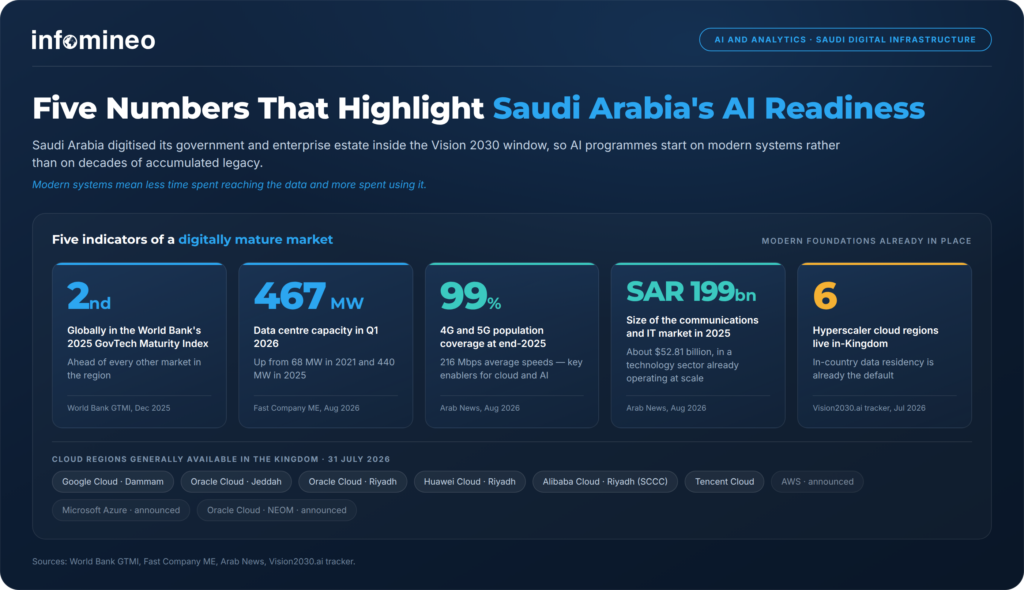
Two numbers are worth highlighting. The Kingdom reached 99% 4G and 5G coverage by the end of 2025, with average speeds of 216 Mbps, providing the key enablers for the expansion of cloud services and AI applications. Also, six hyperscaler cloud regions are available inside the Kingdom as of 31 July 2026, operated by Google, Oracle, Huawei, Alibaba through the SCCC joint venture, and Tencent, with AWS and Microsoft Azure announced.
Saudi digital infrastructure is now treated as mature; the question is how to leverage the internal data those systems have been generating.
From Fragmented Data to a National Data Estate
Saudi Arabia has inventoried its public data estate against common standards and made it addressable from one place.
SDAIA’s National Data Lake integrates more than 430 government systems, and the authority operates a public data integration platform spanning more than 60 government entities. In most economies, comparable data sits fragmented across dozens of agencies with no common standard and no shared catalogue. In the Kingdom it is inventoried, standardized, and increasingly addressable. The constraint moves from finding data to using it.
Set that against the readiness numbers above. In most economies, the first months of an AI programme are spent discovering what data exists, who holds it, and whether two systems describing the same thing can be reconciled. In the Kingdom, a substantial part of that discovery work has been done centrally, catalogued, and standardized. The constraint moves from finding data to using it.
Building the Rules and Policies for AI and Data
Most emerging AI markets have a national strategy. Very few have the instruments underneath one. Saudi Arabia has spent years building instruments, and more are on the way.
Two instruments came first. The Personal Data Protection Law has been fully enforceable since 14 September 2023, setting the baseline rules for collecting, processing, and transferring personal data. The AI Adoption Framework, issued in September 2024, gives public and private entities a shared reference for adopting AI responsibly, with maturity levels and practical steps.
The instrument that changes the commercial picture is the third. On 20 June 2026, SDAIA issued the Data Monetization Policy, establishing the principles under which government entities, and private entities handling government-sourced data, may develop and commercialize data-driven products. Seven principles anchor it, including treating data as a national asset, privacy by design, promoting open data, and preventing monopolies. The policy grants private entities limited usage rights through licensing rather than ownership, requires data products to be registered in a national registry, and prohibits licensed entities from re-sharing datasets beyond their approved use case.
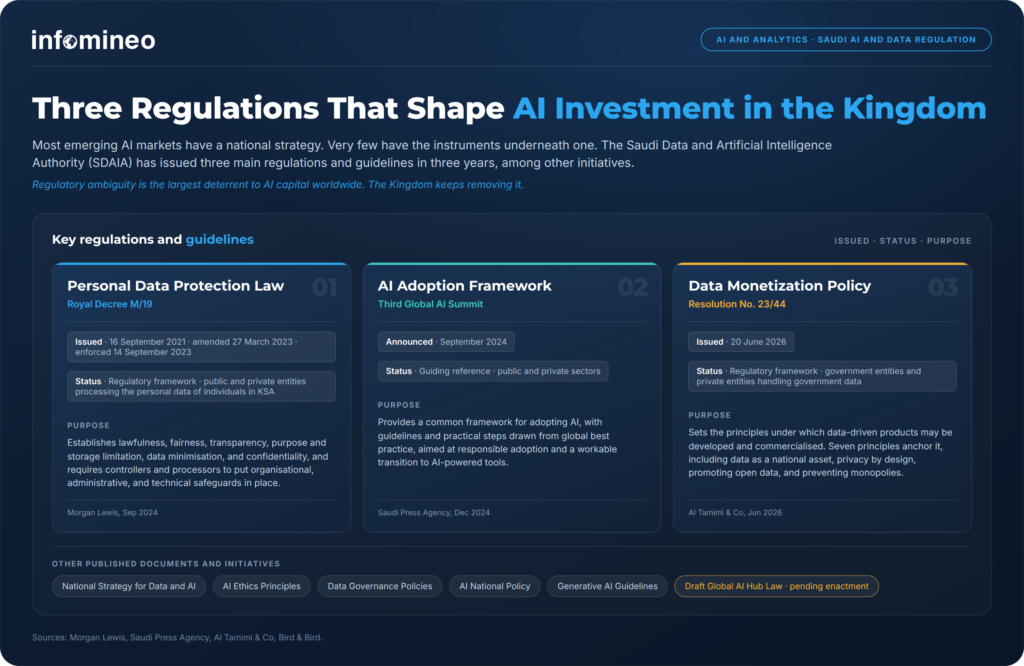
The pipeline continues. AI ethics principles, generative AI guidelines, and data governance policies are already issued.
The most consequential item remains in draft. The Global AI Hub Law, issued for consultation by the Communications, Space and Technology Commission on 14 April 2025, proposes three categories of in-Kingdom data facility:
- Private hubs, operated by a foreign state for its own exclusive use under its own laws, established through a bilateral agreement with Saudi Arabia, with staff granted diplomatic-style immunities.
- Extended hubs, run by an independent operator hosting third-party data under a guest country’s legal framework, requiring both a bilateral agreement and a separate agreement with the competent authority.
- Virtual hubs, where a Saudi-incorporated service provider hosts customer data under the laws of a designated foreign state, with both the state and the provider approved by the Council of Ministers.
In effect, the Kingdom has proposed data embassies: the ability to host data on Saudi soil while remaining under a foreign legal regime.
How Much Has Saudi Arabia Actually Committed to AI?
The infrastructure, data, and policy story is what makes the Kingdom investable. The capital story is what makes it visible.
Three things are happening at once. Sovereign money has been allocated at a scale that removes financing risk from the equation, with the Public Investment Fund committing tens of billions to AI ventures and anchoring partnerships with the largest names in the industry through its state AI company, HUMAIN. Physical compute is being built rather than promised, with hyperscale facilities and AI factories under construction inside the Kingdom. And the workforce is scaling alongside both, through domestic training programmes and one of the strongest net inflows of AI professionals of any market.
The frontier layer of that build-out runs on American technology: in November 2025 the US Commerce Department authorized HUMAIN to purchase the equivalent of up to 35,000 NVIDIA Blackwell chips, subject to security and reporting conditions.
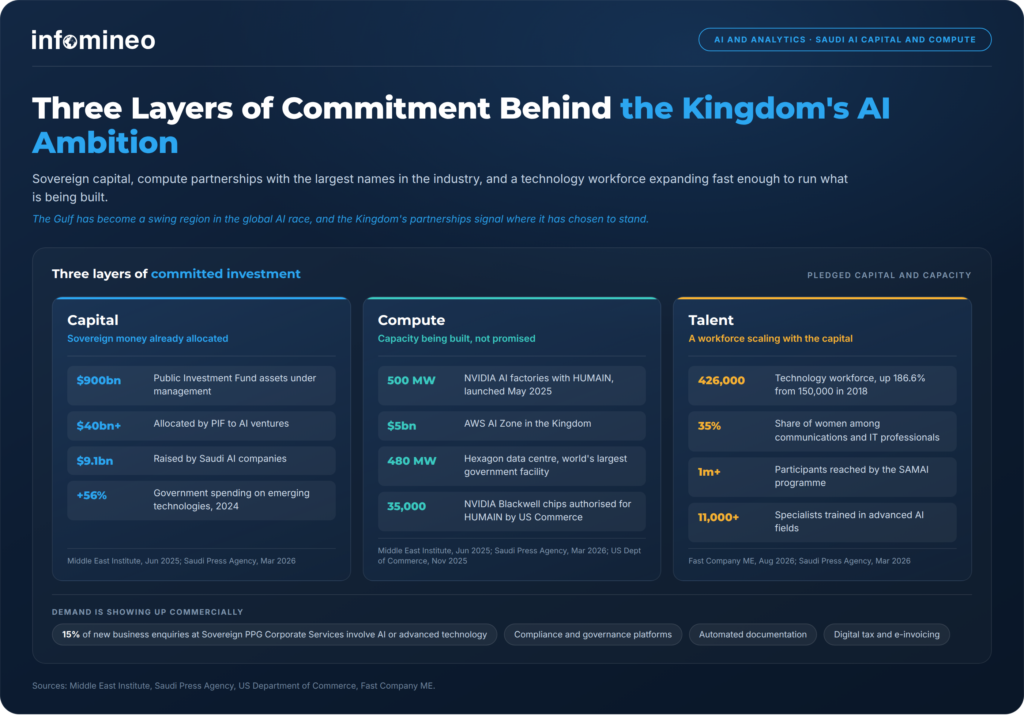
Demand is now visible in commercial activity rather than only in announcements. One corporate services firm operating in the Kingdom reports that AI and advanced technology account for 15% of new business enquiries, concentrated in compliance and governance platforms, automated documentation and workflow, digital tax and e-invoicing technology, and AI-enabled professional services, among others.
How We Can Help You Invest in the Right AI Opportunities
Well-prepared ground still has to be worked. Most organizations entering the Kingdom begin by choosing how to resource the work: hire in and compete for scarce talent, license a vendor product and accept the assumptions built into it, or bring in a partner. That choice matters less than it appears. Programmes rarely stall because the wrong resourcing model was picked. They stall in the work surrounding it, the months before a use case is chosen, and the months after a pilot succeeds.
Our AI and Analytics team works across that span, in five areas.
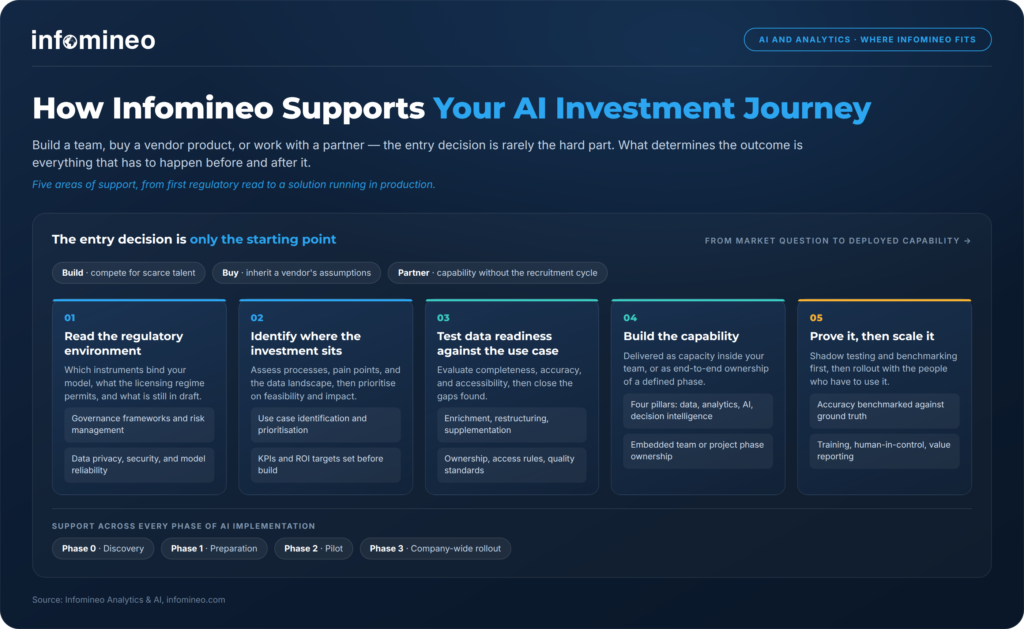
Reading the regulatory environment. Which instruments actually bind your model, what the licensing regime permits, what is still in draft, and how the pipeline is likely to affect your timeline. On the delivery side, this becomes the governance work: defining policies for responsible and compliant AI use, assessing risks around data privacy, security, and model reliability, and establishing clear roles and oversight.
Identifying where the investment sits. Assessing current processes, pain points, and the data landscape to uncover AI opportunities, prioritizing them on feasibility and business impact, and setting measurable KPIs and ROI targets with baselines before anything is built.
Testing data readiness against your use case, not against national statistics. Evaluating whether the data you need is complete, accurate, consistent, and accessible, then enriching it from external sources, restructuring what is fragmented, supplementing thin internal history with external benchmarks, and establishing ownership, access rules, and quality standards that hold as usage scales.
Building the capability. Data engineering, advanced analytics and data science, AI solutions and automation, and decision intelligence and visualization — delivered either as capacity that integrates into your team from week one, or as end-to-end ownership of a defined phase with a single point of accountability.
Proving it, then scaling it. Running the solution in shadow mode alongside the existing process and benchmarking outputs against ground truth before anyone relies on it, then rolling out across business units with role-based training, human-in-the-loop validation layers, and monthly value realization reporting that translates performance into hours and dollars saved.
Those five areas run through the four phases we work in with clients: Discovery, where use cases, KPIs, and governance are agreed; Preparation, where data and infrastructure are made AI-ready and the solution architecture is set; Pilot, where the solution is built, tested in shadow mode, and refined until performance holds at the agreed threshold; and company-wide rollout, where it scales across business units with training, validation layers, and continuous monitoring.
If you are evaluating an AI investment in the Kingdom or already committed and trying to move from pilot to production, let’s talk about your roadmap in Saudi Arabia.
Infomineo — AI & ANALYTICS
Ready to Invest in AI? Make Your Next Move With a Partner Who Knows the Market
Infomineo has worked across the GCC and the Kingdom for years, with 350+ specialists tailoring each engagement to local conditions and client needs. Our AI and Analytics practice extends that work into building the data foundations, models, and solutions that turn a market opportunity into a deployed capability.
Frequently Asked Questions
What makes Saudi Arabia an attractive market for AI investment?
Three conditions undermine the case. The digital estate was built inside the Vision 2030 window, so AI programmes start on modern systems rather than decades of legacy. The public data estate has been catalogued centrally against common standards, with the National Data Lake integrating more than 430 government systems. And the rules governing that data are written down, which removes the regulatory ambiguity that deters AI capital in most emerging markets.
What is Saudi Arabia’s Data Monetization Policy?
A policy issued by SDAIA on 20 June 2026 that sets the principles under which government entities, and private entities handling government-sourced data, may develop and commercialize data-driven products. Seven principles anchor it, including treating data as a national asset, privacy by design, promoting open data, and preventing monopolies. It also creates regulatory sandboxes for testing monetization models, and it bars the sale of raw government data. It places the addressable value in the applications, analytics, and data-product layer rather than in the data itself.
Can private companies commercialize Saudi government data?
Private entities may commercialize government data under license, though not in raw form. The policy permits them to develop and monetize products built on government data, including open datasets. The policy does not transfer ownership: entities gain limited usage rights through licensing, must register data products in a national registry, and cannot re-share licensed datasets beyond the approved use case. Where several government entities contribute to a dataset, revenue-sharing arrangements have to be documented.
Can foreign companies operate AI infrastructure in Saudi Arabia?
Foreign providers already operate AI infrastructure in the Kingdom. Six hyperscaler cloud regions were generally available inside the Kingdom as of 31 July 2026, operated by Google, Oracle, Huawei, Alibaba through the SCCC joint venture, and Tencent, with AWS and Microsoft Azure announced. The draft Global AI Hub Law would go further, allowing in-Kingdom facilities to operate under a foreign state’s legal framework through three models: private hubs run by a foreign state for its own use, extended hubs run by an independent operator under a guest country’s law, and virtual hubs where a Saudi provider hosts customer data under a designated foreign state’s law. The draft went to consultation in April 2025 and remains pending enactment.
How does Saudi Arabia compare with the UAE for AI investment?
The World Bank identifies Saudi Arabia and the UAE as regional and global leaders in AI readiness, and in November 2025 the US authorized advanced chip exports to national champions in both markets — HUMAIN in Saudi Arabia and G42 in the UAE — each cleared to purchase the equivalent of up to 35,000 NVIDIA Blackwell GB300 chips, on the same security and reporting. The Middle East Institute frames the Gulf as a whole as a swing region in the global AI race.
