

Fast on AI, Slow on Value: What Is Holding the Gulf Back?

Table of Contents
Key Takeaways
- The Gulf has closed the AI adoption gap and is scaling faster than global peers
- Very few organizations can attribute earnings to AI, despite widespread adoption
- Strategy and funding are not the constraint, with most reporting strong leadership backing and a well-funded roadmap
- The organizations capturing value share four characteristics, none of them technological
The Gulf has closed the AI adoption gap. According to McKinsey’s 2025 survey on The State of AI in GCC Countries, 84% of organizations use AI in at least one business function, up from 62% two years earlier and within four points of the 88% recorded globally.
The same research measured value against a stricter definition. To count as a value realizer, an organization had to meet three conditions at once: adopt AI in at least one function, scale or fully scale it across the organization, and attribute more than 5% of earnings to it. Only 11% qualified. Usage is easy to count, while attribution requires a baseline set before deployment and a measurement approach agreed in advance.
The Region’s Momentum Is Not the Problem
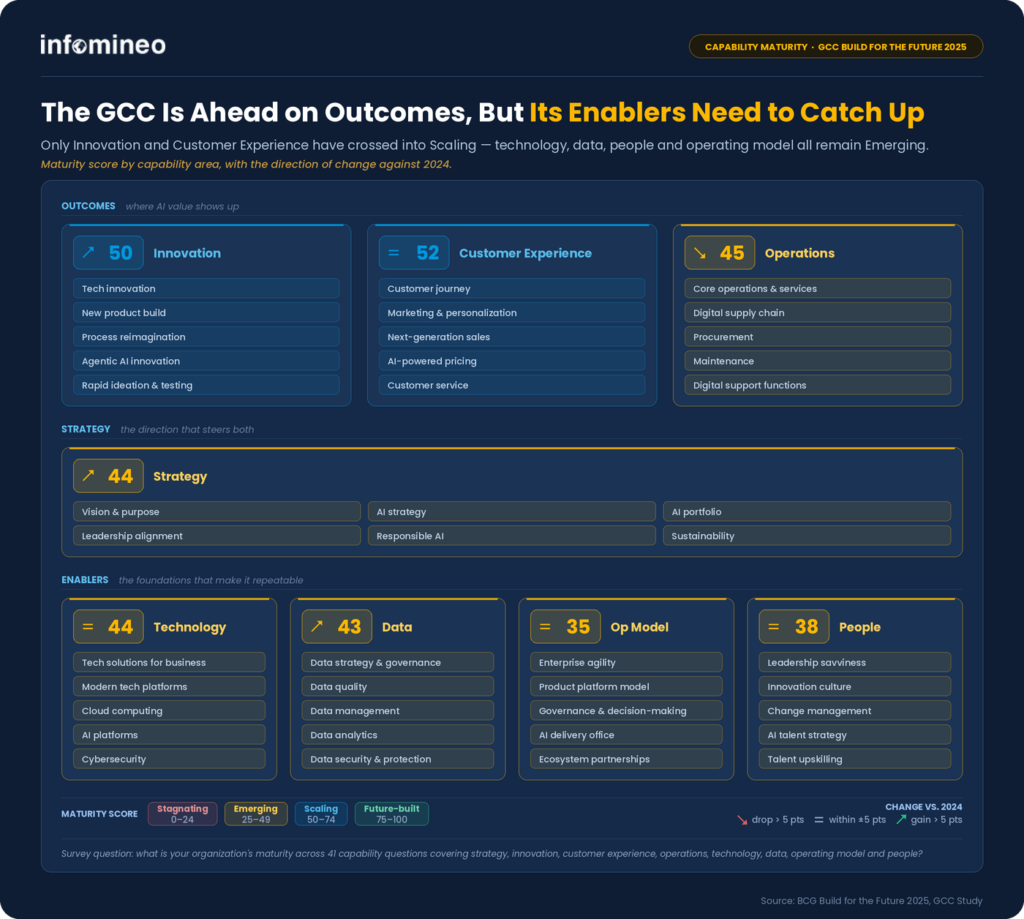
According to BCG’s 2025 Build for the Future Survey, Gulf organizations match their global counterparts on digital and AI maturity: 39% qualify as AI Leaders, against 40% globally. Maturity measures how far an organization has progressed in its AI journey rather than how much AI it uses. It scores 41 capabilities across seven industries, grouped into strategy, three outcome domains, and four enablers. The outcome domains are innovation, customer experience, and operations; the enablers are technology, data, operating model, and people.
Scaling is the point where AI leaves controlled pilots and enters wider deployment, and the share of Gulf organizations reaching it rose 14 percentage points in a year, against 8 points globally.
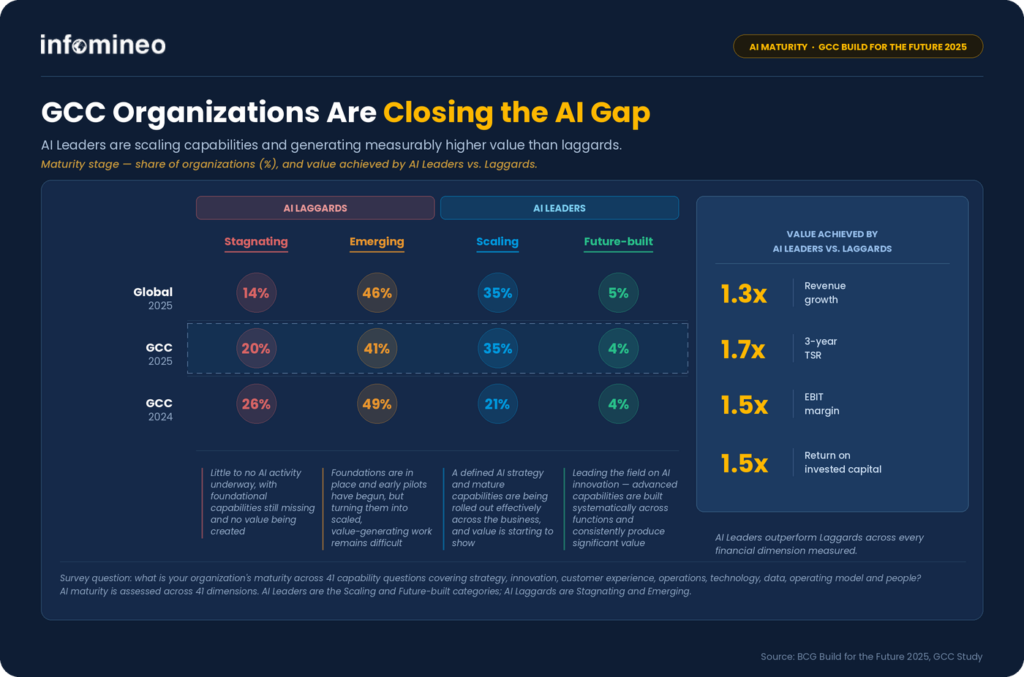
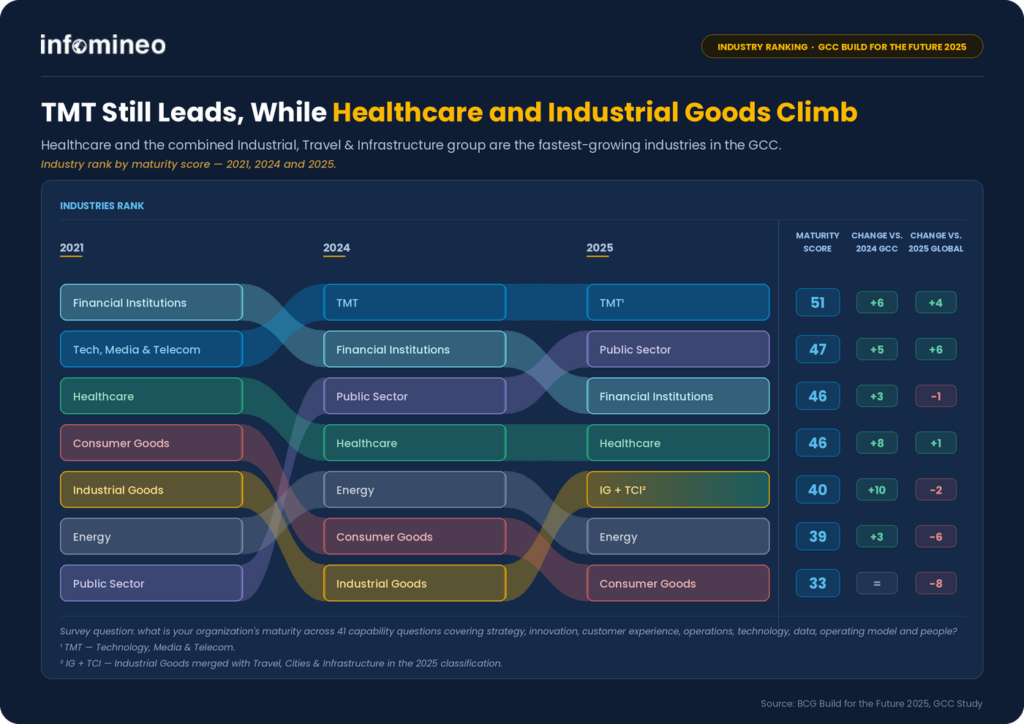
Government is typically the slowest sector to transform, but in the Gulf it has climbed five positions since 2021 to rank second, driven by cost-saving and productivity mandates alongside national data and digital strategies already reshaping public services. Industrial goods, travel and infrastructure, and healthcare also recorded significant gains.
Energy and consumer goods sit at the other end. Both are still growing, but more slowly than the rest of the market, with just 25% of organizations classified as AI Leaders.
Why AI Adoption Is Not Turning Into Value
The maturity scores show where the weakness sits. Gulf organizations are advancing rapidly on innovation, customer experience, and operations, and score above global peers on all three. The enablers underneath, technology, data, operating model, and people, continue to lag, becoming a constraint on scaling AI adoption and capturing full value. Closing that gap is what separates isolated AI wins from sustained, system-wide transformation.
Not every capability moved in the same direction. Innovation, strategy-setting, and data capabilities all matured further compared to 2024. Operations went the other way, declining despite remaining ahead of global peers, which points to a need for renewed focus on core operational processes as organizations scale.
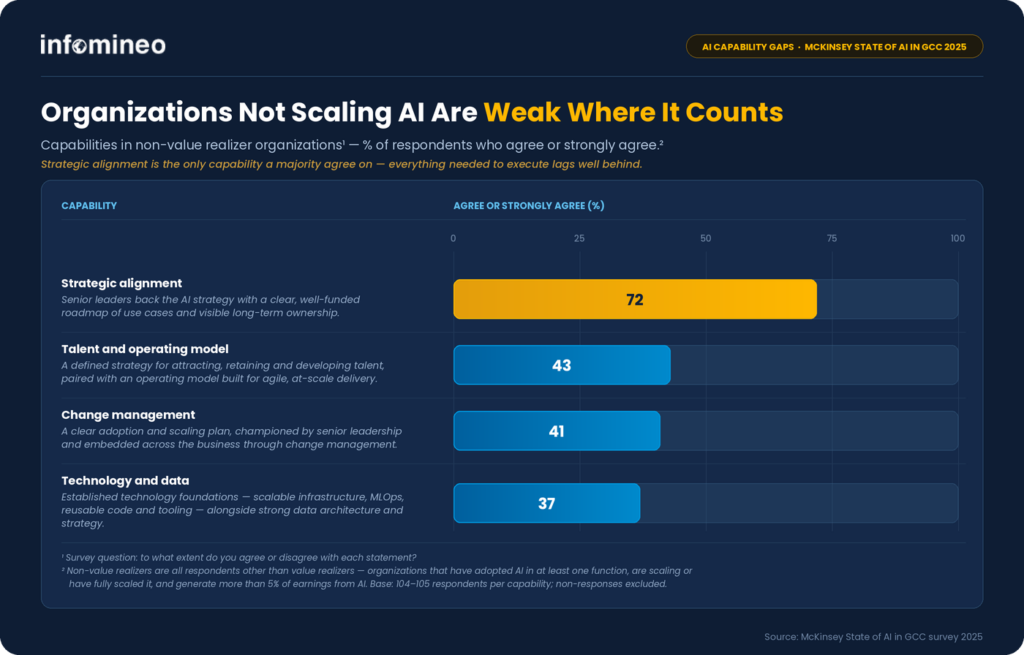
McKinsey’s survey on The State of AI in GCC Countries reaches the same conclusion by asking executives and board directors to rate their own organizations. Among organizations that are not capturing value, 72% say senior leaders back the AI strategy with a clear, well-funded roadmap.
Confidence drops sharply on the capabilities needed to deliver it: 43% have a defined talent and operating model, 41% have effective change management, and 37% have established technology foundations and data fundamentals. Leadership backing is in place. The capability to act on it is not. What these organizations lack is everything that comes after the strategy is approved.
What Do the Organizations Capturing AI Value Do Differently?
Four characteristics recur among the organizations that reached measurable outcomes. None of them are technological.
1. Business Units Own AI, Not IT
IDC’s report on The Rise of Agentic AI in the GCC finds that 66% of Gulf organizations run a devolved model, in which IT or data teams lead AI initiatives and the business sponsors them. The alternatives are a dedicated, centralized AI office holding its own budget and authority, and an embedded model where AI specialists sit inside business teams that own both the use case and the budget.
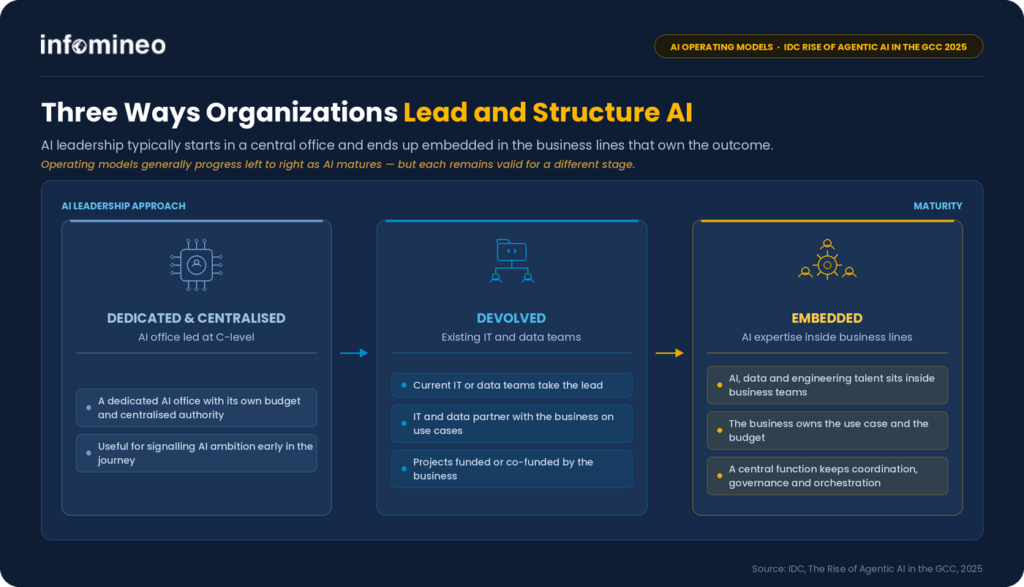
Where AI expertise sits appears to affect whether pilots reach production. McKinsey’s research in financial services found that around 70% of organizations with centralized AI operating models moved pilots into production, against about 30% of those with decentralized approaches.
The organizations capturing the most value combine centralized AI expertise with the executional know-how of the business, working in cross-functional teams. That arrangement keeps ownership with the business, lets domain priorities guide what gets built, and anchors value creation to business outcomes.
2. Data Is Addressed During the Project, Not Before It
According to IDC, the Gulf organizations that reached full-scale agentic implementation had identified specific use cases, selected the tools required, and allocated budgets to support them. Their first shared attribute was investment in streamlining the organizational data those use cases needed, with data lifecycle management identified as critical to agentic AI adoption.
Data lifecycle management covers how data is collected, stored, classified, governed, maintained, and eventually retired. The organizations that succeed scope and fund that work inside the AI programme, concentrating it on the datasets their chosen use cases require rather than remediating the entire estate first.
3. Adoption Is Planned and Resourced
In McKinsey’s survey, among value realizers, almost every respondent reported a clearly defined adoption and scaling strategy backed by change management. Among all other organizations, 41% could say the same. Resistance to change was the barrier interviewees cited most often.
Adoption is a deliverable rather than a consequence. A system that works technically will still go unused unless people are trained on it, sponsored into it, and shown that it makes their work easier. These programmes build AI literacy across the organization, secure executive sponsorship, and recognize AI achievements publicly.
4. Governance Is Proactive Rather Than Reactive
According to BCG, regional AI Leaders are 2.4 times more likely than Laggards to employ clear governance and 3.4 times more likely to establish guardrails, putting them slightly ahead of global peers. BCG attributes this partly to the region’s firmer regulatory environment.
Governance and guardrails serve different functions. Governance sets the rules, covering who is accountable for AI decisions, which use cases require approval, and how outputs are validated. Guardrails enforce those rules inside the system itself, through limits on the data a model can access, boundaries on the actions it may take without human confirmation, and audit trails recording what it did.
How Infomineo Closes the Gap Between AI Adoption and AI Value
The Gulf’s AI ambition is well established, and so is its funding. What determines whether that ambition translates into value is the capability layer beneath it. Gulf organizations already expect to build these capabilities with a partner. Data from IDC indicates that 60% of organizations in the GCC region are actively partnering or planning to partner with consultancy firms to build and deploy agentic AI strategies.
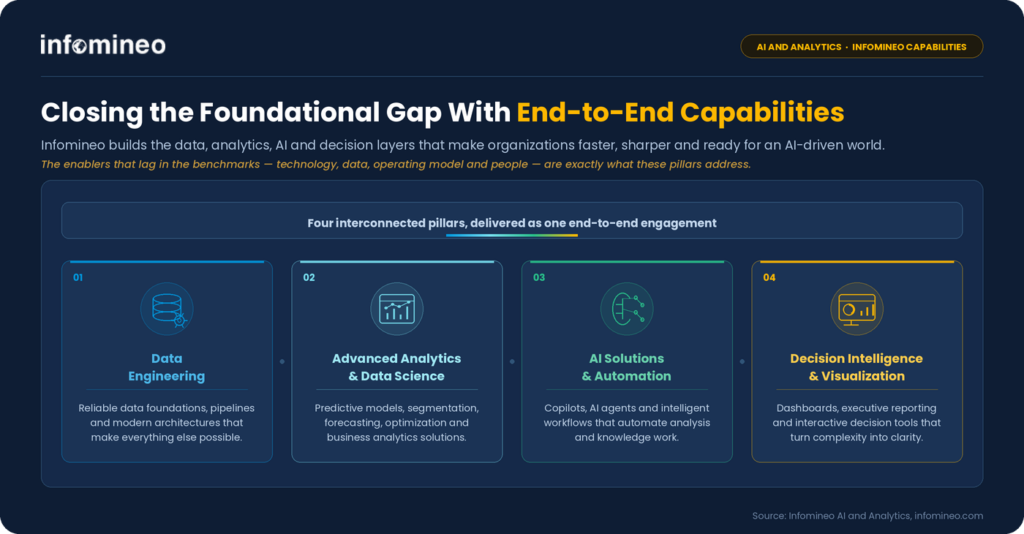
Infomineo delivers across four capability pillars: Data Engineering, Advanced Analytics and Data Science, AI Solutions and Automation, and Decision Intelligence and Visualization. Closing the four gaps takes both the right capability and the right delivery model.
Data Readiness Built Into Delivery
Infomineo’s data engineering teams treat imperfect data as scope rather than a blocker, working on three fronts: enrichment, filling gaps with additional structured and unstructured sources; restructuring, resolving fragmentation and inconsistency into a model-ready format; and supplementation, augmenting thin internal history with external benchmarks so models have enough signal to learn from. Ownership, access rules, and quality standards are established alongside, so reliability holds as usage grows.
Embedded Delivery and Phase Ownership
The ownership gap closes through the engagement model rather than the technology. Embedded team extension places data scientists, AI and machine learning engineers, data engineers, and BI developers inside client teams, working under client direction while the business retains ownership of priorities and outcomes. Where capacity rather than intent is the limiting factor, project phase ownership gives Infomineo end-to-end responsibility for a defined phase, with agreed scope and structured knowledge transfer at handover.
Decision Intelligence and Visualization supports ownership directly. Dashboards, executive reporting, and interactive decision tools give the business performance visibility without depending on IT to produce it.
Adoption Through Enablement
Enablement runs alongside implementation rather than after it, continuing across every phase from discovery through rollout rather than arriving as a final step. Role-based training gives executives, power users, and everyday users what each role actually needs, while hands-on labs are built on the organization’s own workflows and data rather than generic demonstrations.
Internal champions are identified and coached, quick wins from the pilot phase are communicated to build momentum, and playbooks, prompt libraries, and adoption KPIs sustain usage once the engagement ends.
Governance Defined in Discovery
Governance work belongs at the start. Frameworks, decision rights, KPIs, and ROI baselines are agreed during discovery, alongside the policies for responsible and compliant AI use and an assessment of risk across data privacy, security, and model reliability. That sequence matters because those decisions constrain everything designed afterward, including where data can sit and which models remain viable.
Governance then has to hold once systems are live. Human-in-the-loop validation layers audit AI outputs to keep them grounded in approved sources, while a live model health dashboard tracks accuracy, drift, and adoption. Value realization reporting compares performance against the pre-deployment baseline and attaches an explicit decision to continue, scale, re-scope, or stop.
INFOMINEO — AI & ANALYTICS
End-to-end AI implementation…from data foundations to measured value.
Infomineo supports organizations through the full AI implementation journey, from discovery and use case prioritization to data readiness, pilot validation and enterprise rollout. Built for organizations that want AI in production, not another pilot in the backlog.
Frequently Asked Questions
What is an AI maturity score, and how is it measured?
An AI maturity score assesses how far an organization has progressed in its AI journey rather than whether it uses AI at all. BCG’s Build for the Future study scores 41 capabilities spanning strategy, innovation, customer experience, operations, technology, data, operating model, and people. An organization running one successful pilot registers as an adopter while still sitting near the start of the maturity curve.
Which AI operating model works best: centralized, devolved, or embedded?
It depends on the maturity of the programme. A centralized AI office establishes standards early, a devolved model suits experimentation and is the regional default at 66%, and an embedded model aligns accountability most closely with outcomes. McKinsey’s research in financial services found around 70% of organizations with centralized models moved pilots into production, against roughly 30% with decentralized approaches.
What is data lifecycle management, and why does it matter for AI?
Data lifecycle management covers how data is collected, stored, classified, governed, maintained, and eventually retired. For AI it determines whether data is complete enough to represent the problem, consistent enough for models to learn from, and governed clearly enough that quality holds as more teams draw on it. Among Gulf organizations reaching full-scale agentic implementation in IDC’s study, investment in this area was the first shared attribute identified.
Why do AI pilots fail to scale?
AI pilots rarely fail because the technology underperforms. They run on narrow scope, with controlled data and a motivated team, none of which holds in production. The most common causes are structural: no baseline agreed beforehand, data that does not hold at volume, accountability sitting outside the function that owns the financial outcome, and workflows left unchanged.
What is the main barrier to AI value realization in the GCC?
Foundational capability rather than strategy. According to McKinsey, among organizations not capturing value, 72% report strong leadership support and a well-funded roadmap, while only 37% report established technology and data foundations.
Sources
QuantumBlack, AI by McKinsey, with the GCC Board Directors Institute. The state of AI in GCC Countries: In Pursuit of Scale and Value. November 2025. Survey of 139 senior executives and board directors across all six GCC countries, covering five sectors: industry, energy and infrastructure; financial services; consumer and professional services; social, healthcare and education; and technology, media and telecommunications. Fielded August to September 2025, supported by 14 executive interviews.
BCG. Unlocking Potential: How GCC Organizations Can Convert AI Momentum into Value at Scale. January 2026. Approximately 200 organizations benchmarked across Saudi Arabia, Qatar and the UAE, assessed on 41 digital and AI maturity capabilities across seven industries: industrial goods, travel, cities and infrastructure; energy; financial institutions; consumer goods; healthcare; public sector; and technology, media and telecommunications.
IDC, commissioned by AWS and e&. The Rise of Agentic AI in the GCC: Riding the Next Wave of AI Revolution. October 2025. Survey of 226 organizations with more than 100 employees across the UAE, Saudi Arabia, Qatar, Kuwait and Bahrain, covering five industries: energy; financial services; government; retail; and media and entertainment. Fielded August 2025, supported by 10 interviews with senior technology leaders.
